Aviation News
-
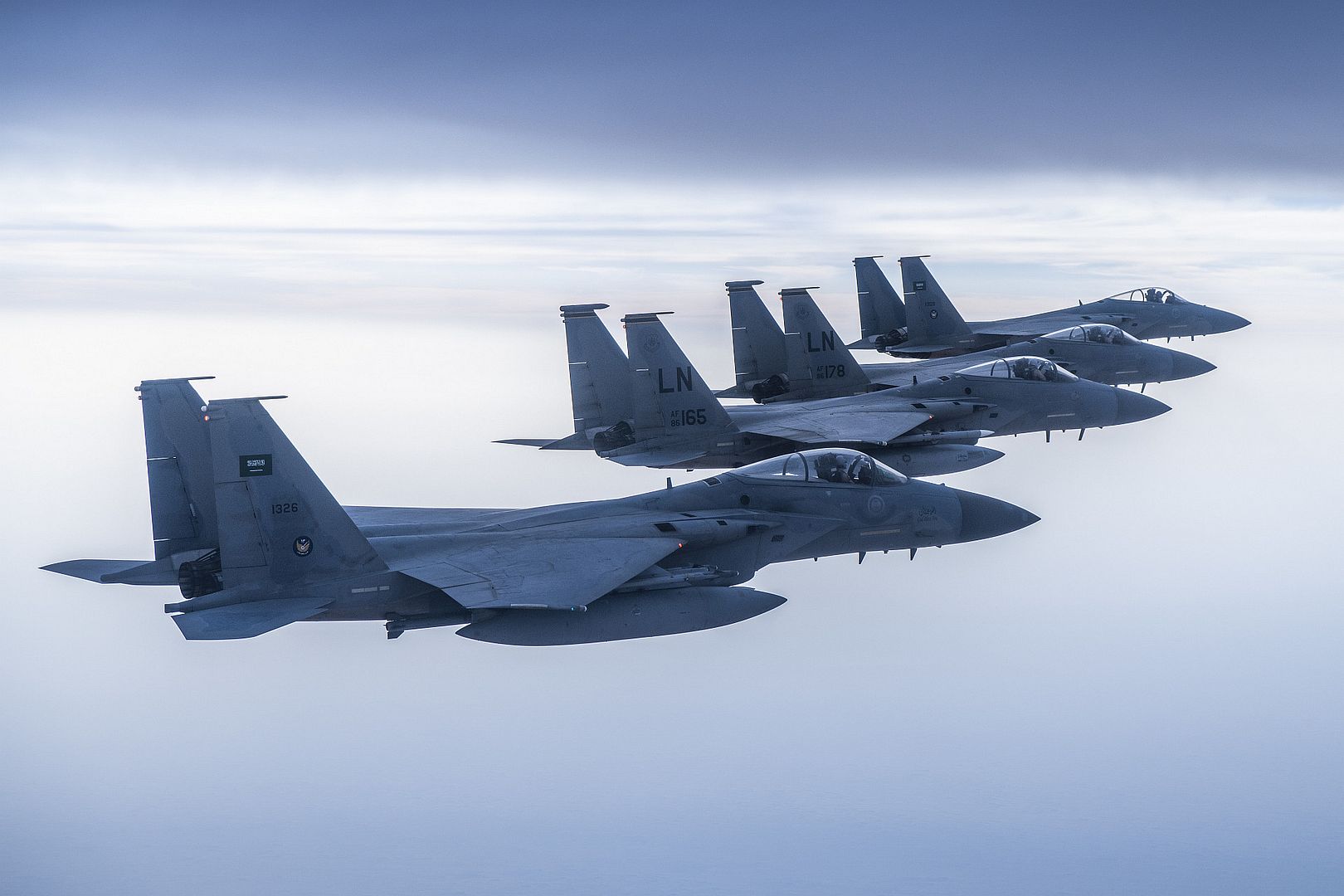
Royal Saudi Air Force F-15C Eagles fly in formation with U.S. Air Force F-15Cs in the U.S. Central Command area of responsibility, June 2, 2019. The flight was conducted as part of a larger effort to continue building military-to-military relationships and interoperability. (Courtesy photo's by Royal Saudi Air Force)
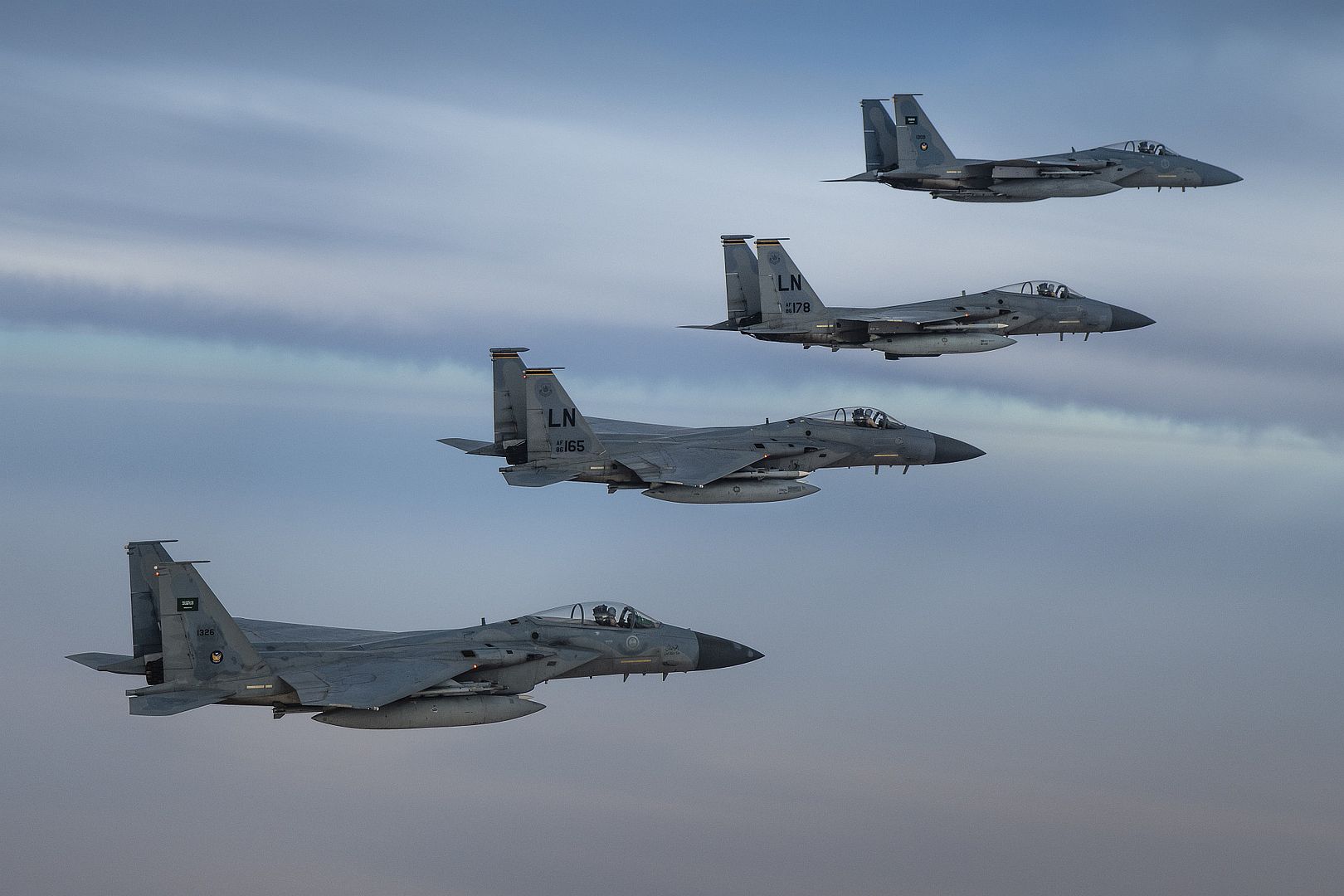
A Royal Saudi Air Force K-3 Tanker and Royal Saudi Air Force F-15C Eagles fly in formation with U.S. Air Force F-15Cs in the U.S. Central Command area of responsibility, June 2, 2019. The flight was conducted as part of a larger effort to continue building military-to-military relationships and interoperability. (Courtesy photo by Royal Saudi Air Force)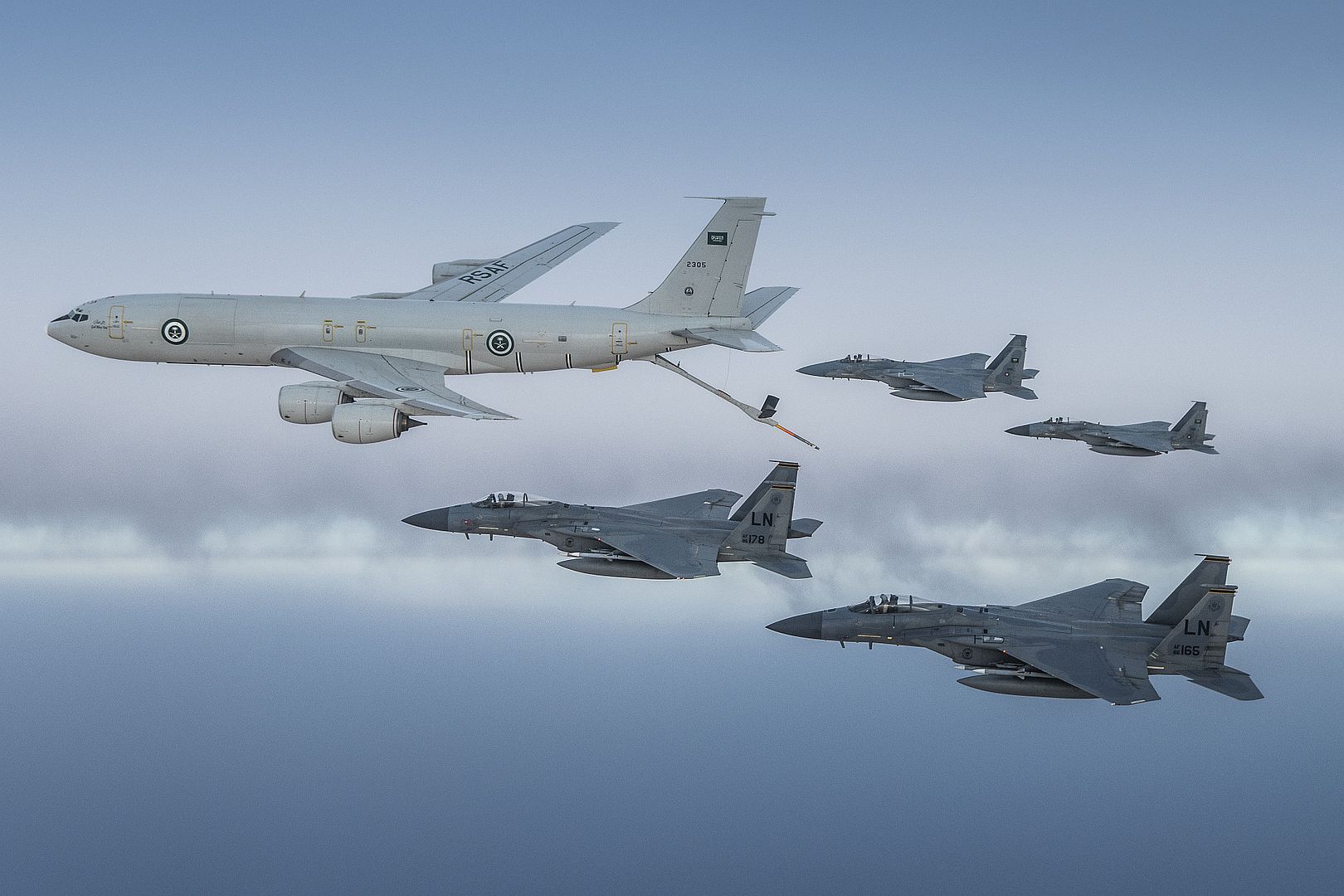
WRIGHT-PATTERSON AIR FORCE BASE, Ohio (AFNS) --
The XQ-58A Valkyrie demonstrator, a low-cost unmanned air vehicle, successfully completed all test objectives during a 71-minute flight, June 11, at Yuma Proving Grounds, Arizona.
The test marked the second successful flight for the aircraft this year. The inaugural 72-minute flight was recorded in March.
The Air Force Research Laboratory developed the low-cost unmanned air vehicle together with Kratos Defense & Security Solutions, Inc. The joint effort falls within AFRL?s Low Cost Attritable Aircraft Technology portfolio, which has the goal to break the escalating cost trajectory of tactically relevant aircraft.
?The XQ-58A is the first Low Cost Attritable Aircraft Technology flight demonstrator with (unmanned aircraft systems) technology to change the way we fly and fight, and build and buy,? said Doug Szczublewski, program manager.
There are a total of five planned test flights for the XQ-58A, with objectives that include evaluating system functionality, aerodynamic performance, and launch and recovery systems.
The Air Force Research Laboratory is the primary scientific research and development center for the Air Force. AFRL plays an integral role in leading the discovery, development and integration of affordable warfighting technologies for our air, space and cyberspace force. With a workforce of more than 11,000 across nine technology areas and 40 other operations across the globe, AFRL provides a diverse portfolio of science and technology ranging from fundamental to advanced research and technology development.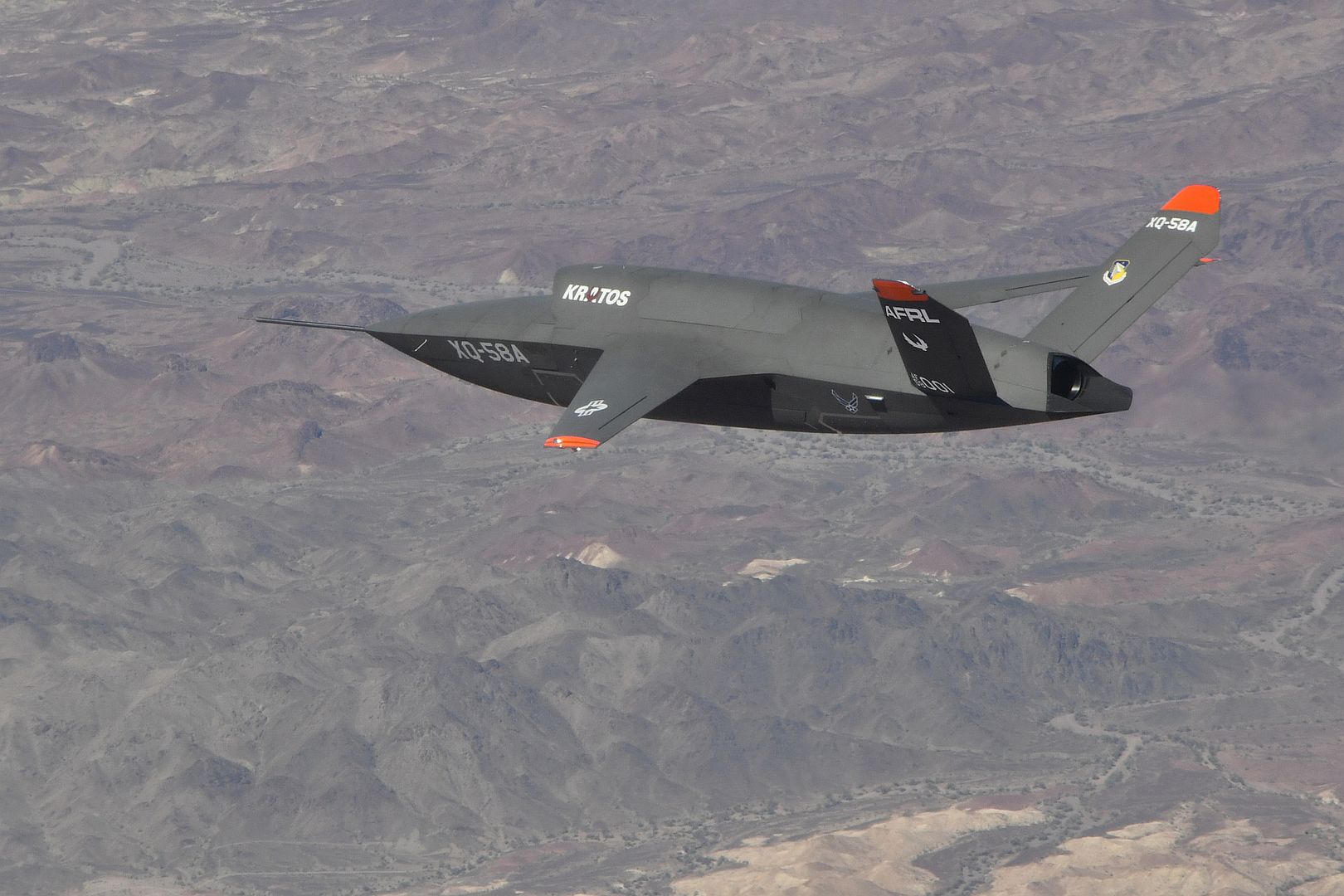
U.S. Air Force F-16 Fighting Falcons fly during RED FLAG-Alaska 19-2, June 14, 2019, at Eielson Air Force Base, Alaska. RF-A exercises provide unique opportunities to integrate various forces in a realistic threat environment and dates back to 1975, when it was held at Clark Air Force Base, Philippines and called Exercise COPE THUNDER. (U.S. Air Force photo by Senior Airman Daniel Snider)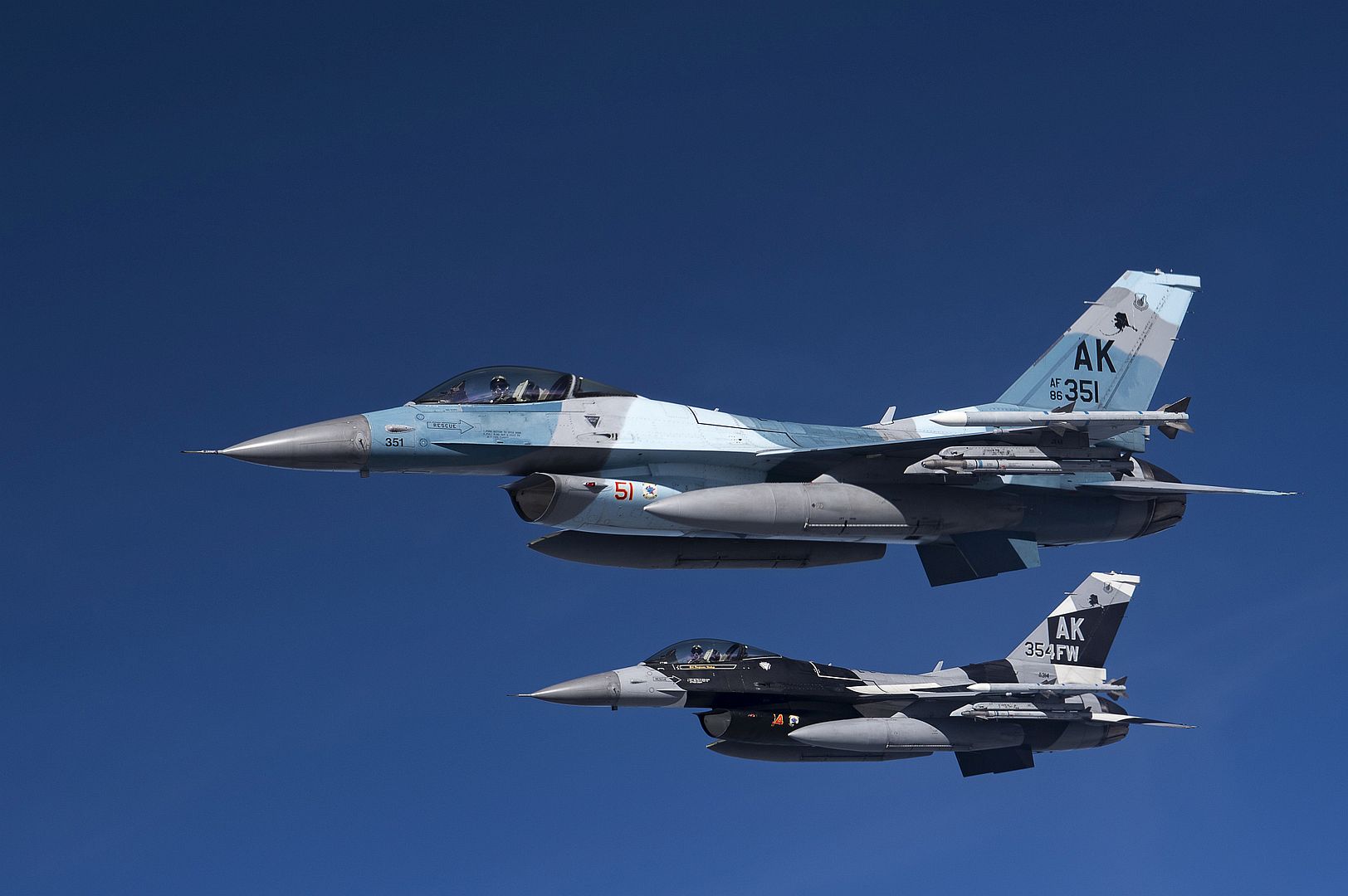
An F-15E Strike Eagle from the 336th Fighter Squadron, 4th Fighter Wing at Seymour Johnson Air Force Base, North Carolina peels away from a three-ship formation at Al Dhafra Air Base, United Arab Emirates, June 14, 2019. The F-15E?s joined ADABs inventory of other fighters to include F-15C Eagles and F-35A Lightning IIs. (U.S. Air Force photo by Staff Sgt. Chris Thornbury)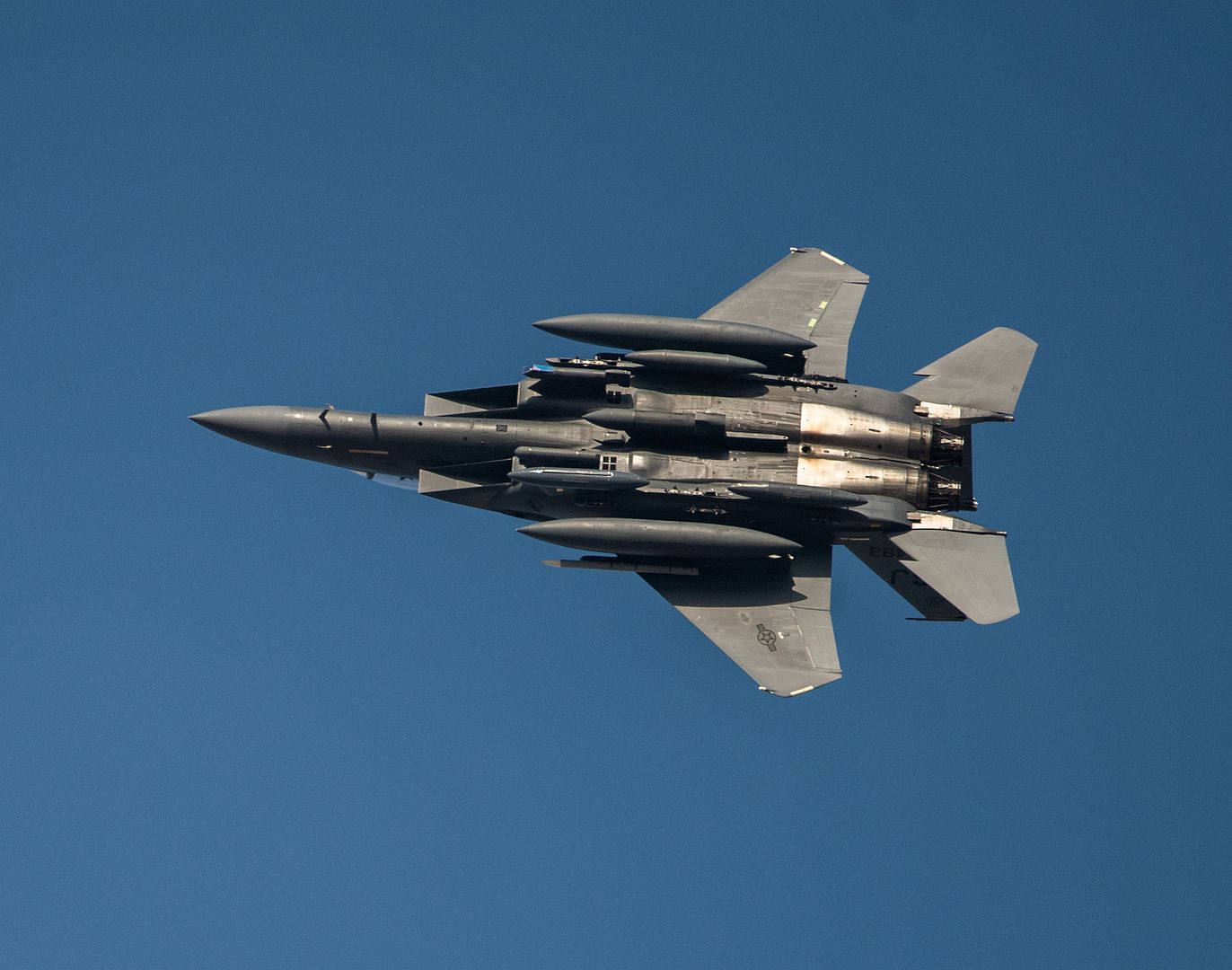
The Marine Medium Tiltrotor Squadron 764 mascot is coated on a MV-22B Osprey with VMM-764, Marine Aircraft Group 41, 4th Marine Aircraft Wing, at Canadian Forces Base Cold Lake, Canada, June 16, 2019, in support of Sentinel Edge 19. Training exercises, such as SE19, ensures Reserve Marines are proficient and capable of successful integration with active-duty Marines, making Marine Forces Reserve critical to the Marine Corps? Total Force. (U.S. Marine Corps photo by Lance Cpl. Jose Gonzalez)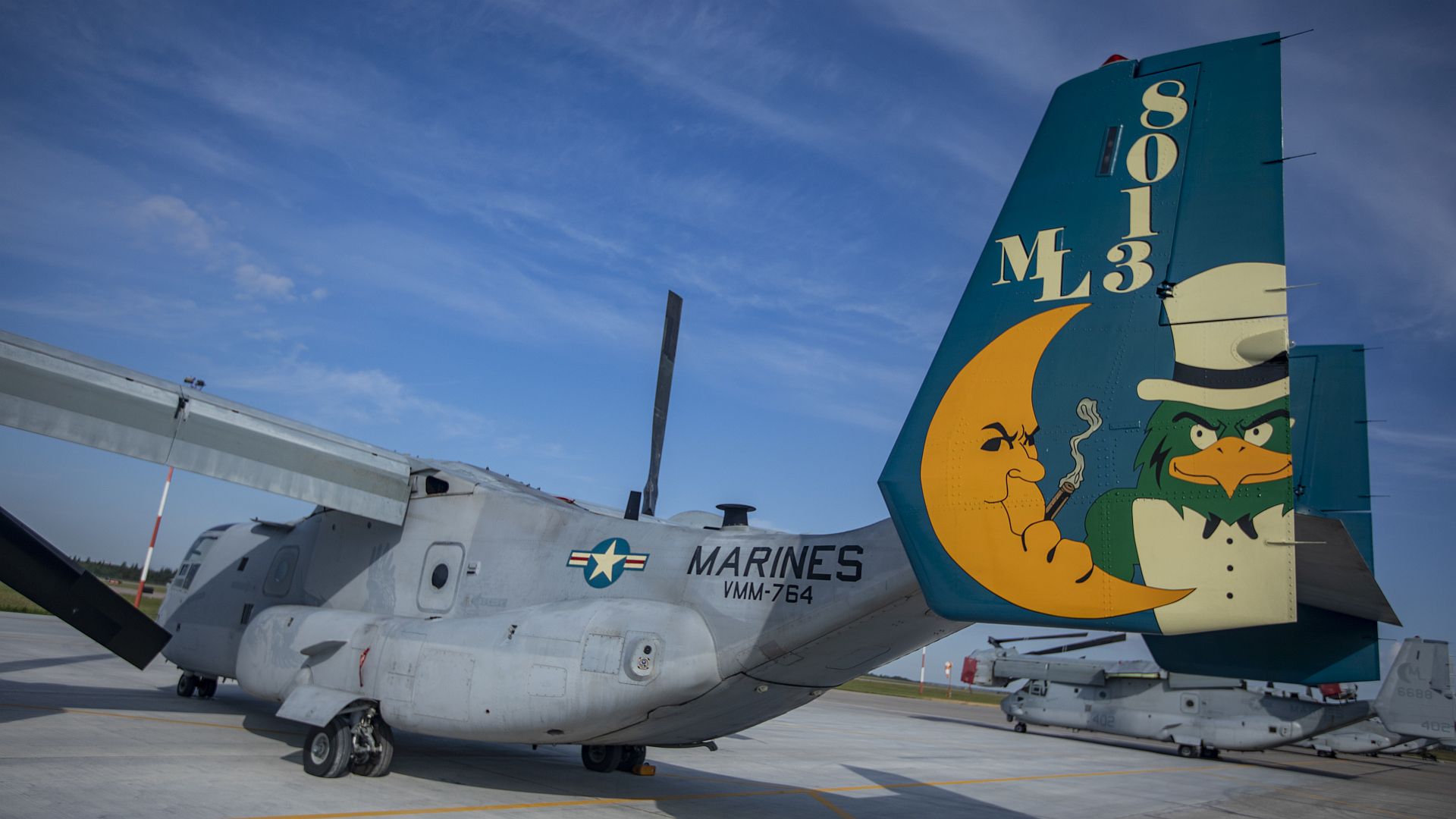
ATLANTIC OCEAN (June 14, 2019) Rear Adm. John Meier, Commander, Carrier Strike Group 10, prepares for flight in a T-45C Goshawk training aircraft, assigned to Training Air Wing 2 (TW 2), with Capt. Richard Rivera on the flight deck aboard the aircraft carrier USS Dwight D. Eisenhower (CVN 69). Ike is underway in the Atlantic Ocean conducting carrier qualifications while in the basic phase of the Optimized Fleet Response Plan. (U.S. Navy photo by Mass Communication Specialist 3rd Class James Norket)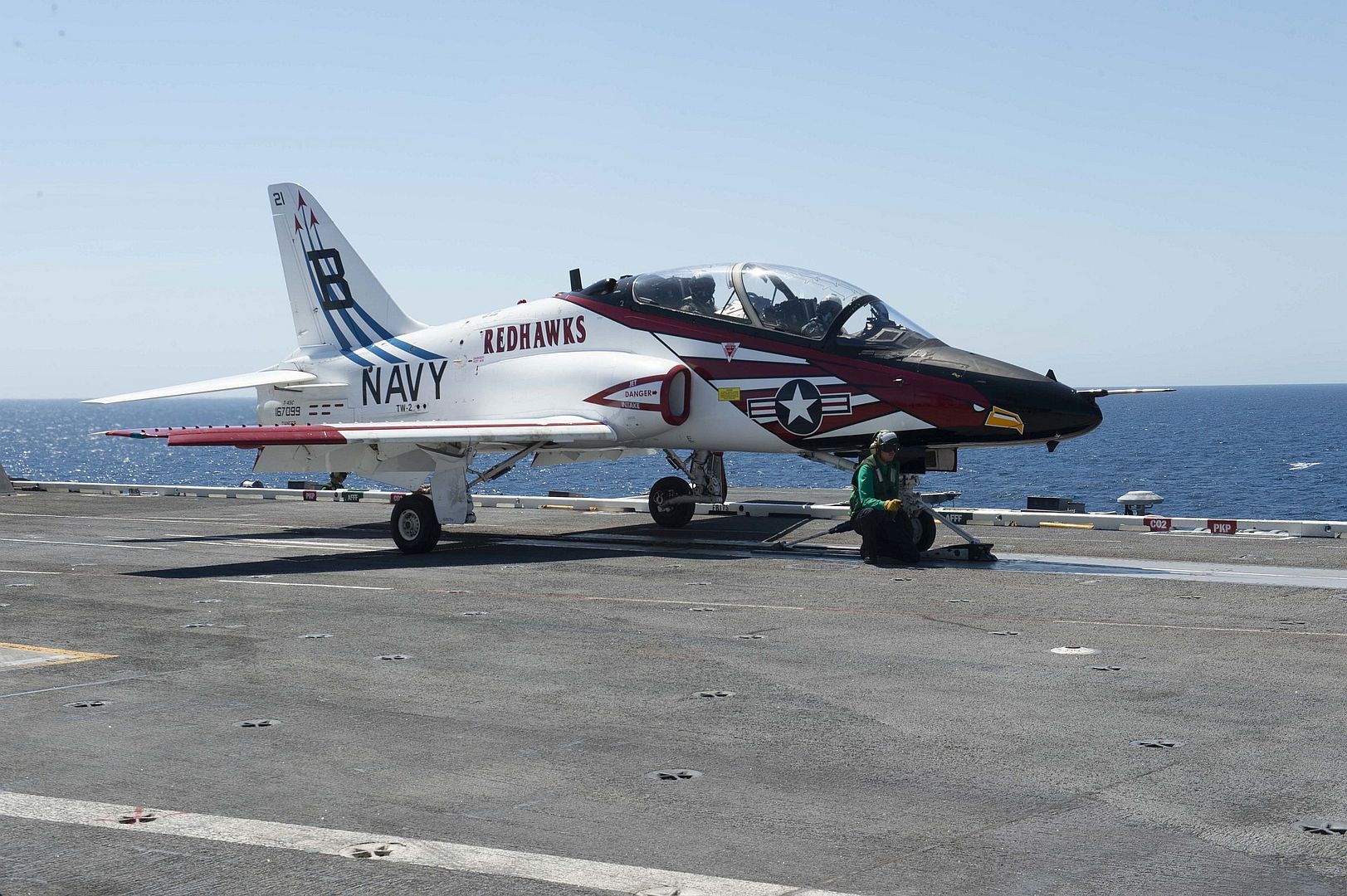
BALTIC SEA (June 15, 2019) A German Westland Sikorsy WS-61 Sea King search and rescue helicopter departs the Blue Ridge class command and control ship USS Mount Whitney (LCC 20) during exercise Baltic Operations (BALTOPS) 2019. BALTOPS is the premier annual maritime-focused exercise in the Baltic Region, marking the 47th year of one of the largest exercises in Northern Europe enhancing flexibility and interoperability among allied and partnered nations. (U.S. Navy Photo by Mass Communication Specialist 2nd Class Scott Barnes)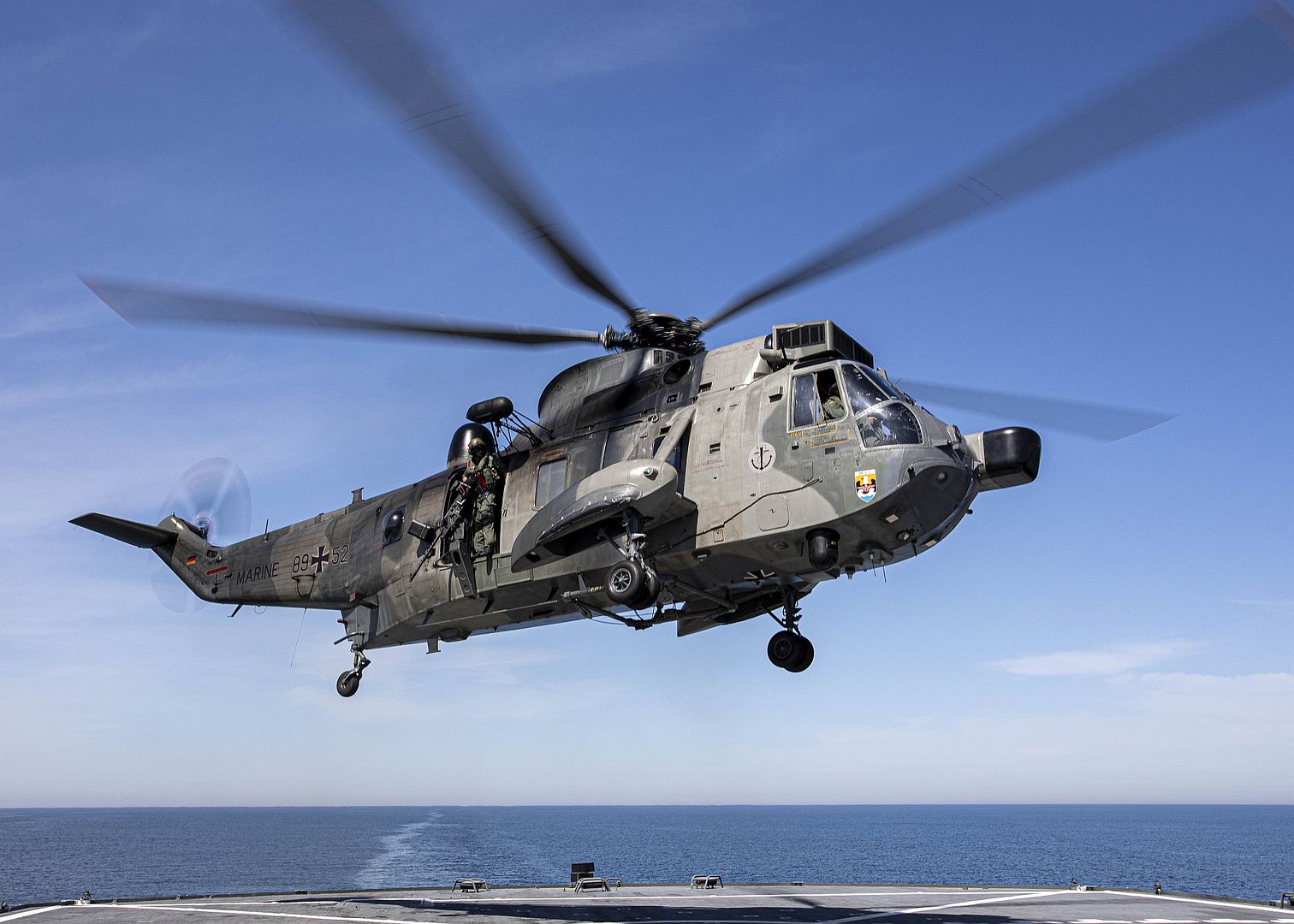
Le Bourget ? Virgin Atlantic has selected 14 A330-900s to replace its A330ceos from 2021, with options to further expand its fleet of highly efficient wide-body aircraft. The firm order for eight aircraft and six additional on lease from Air Lease Corporation (ALC) (NYSE: AL), was signed at the Paris Air Show by Shai Weiss, Virgin Atlantic CEO and Guillaume Faury, Airbus CEO.
Virgin Atlantic currently operates a fleet of 40 wide-body aircraft and will soon take delivery of its first of 12 A350-1000s. This latest order for A330neos is a further commitment by Virgin Atlantic to continue modernising its fleet with aircraft offering the highest standards of fuel efficiency and noise reduction alongside the best in class cabin comfort.
The A330neo Family is the new generation A330, comprising two versions: the A330-800 and A330-900 sharing 99 percent commonality. It builds on the proven economics, versatility and reliability of the A330 Family, while reducing fuel consumption by about 25 percent per seat versus previous generation competitors and increasing range by up to 1,500 nm compared to the majority of A330s in operation.
The A330neo is powered by Rolls-Royce?s latest-generation Trent 7000 engines and features a new wing with increased span and new A350 XWB-inspired Sharklets. The cabin provides the comfort of the new Airspace amenities including state-of-the-art passenger inflight entertainment and Wifi connectivity systems.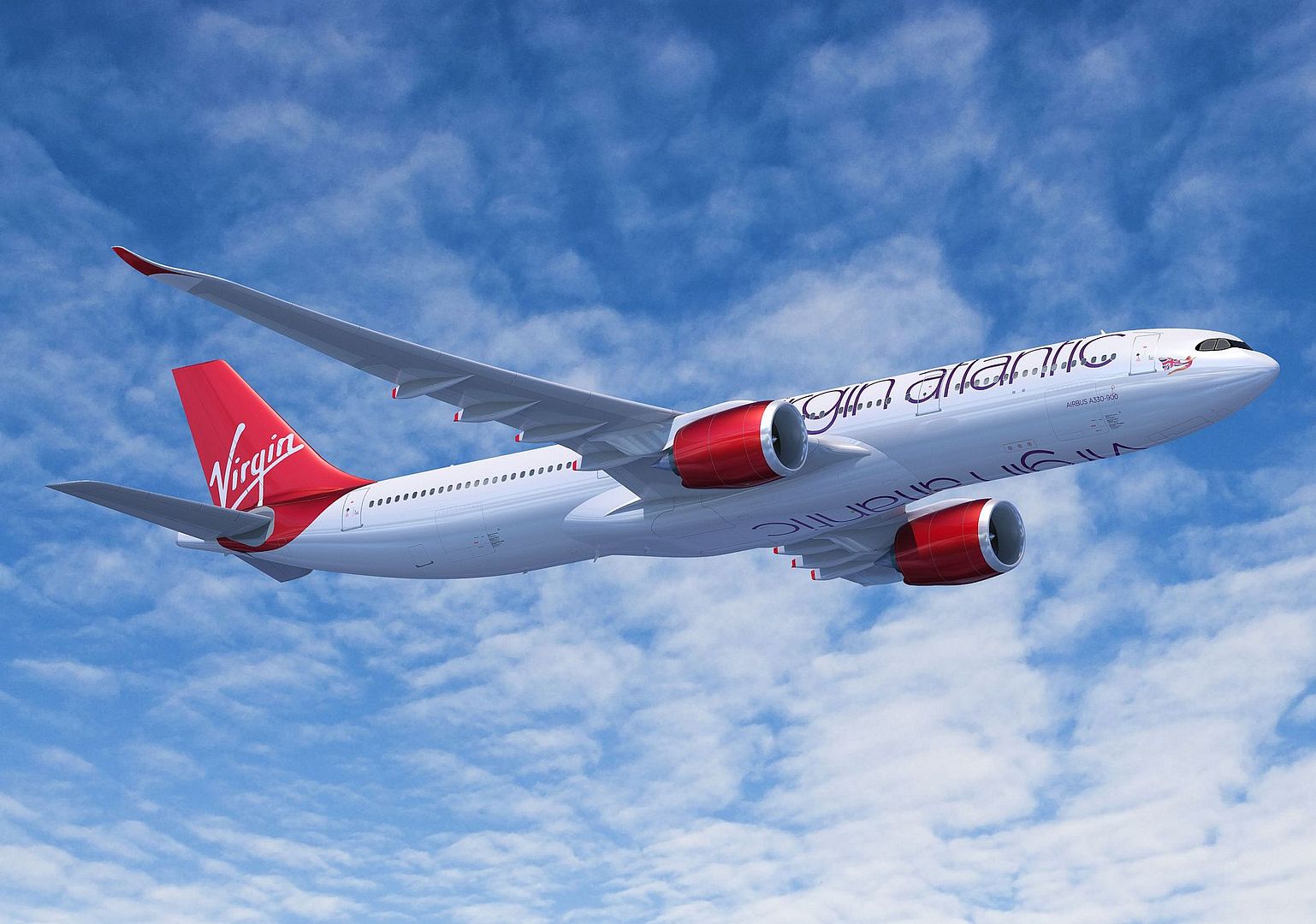
Le Bourget - Middle East Airlines (MEA), the flag carrier of Lebanon, has signed a firm order for four A321XLRs, making it the launch airline customer of Airbus latest evolution of the winning A321neo family.
The agreement takes Middle East Airlines? cumulative single aisle orders with Airbus to 15 A321neo family aircraft, including 11 A321neos and 4 A321XLRs with deliveries starting in 2020. MEA will use the A321XLR to strengthen its network in Africa and Asia.
The A321XLR is the next evolutionary step from the A321LR which responds to market needs for even more range and payload, creating more value for the airlines. From 2023, it will deliver an unprecedented Xtra Long Range of up to 4,700nm ? 15% more than the A321LR and with 30% lower fuel burn per seat compared with previous generation competitor aircraft. This will enable operators to open new world-wide routes such as India to Europe or China to Australia, as well as further extending the Family?s non-stop reach on direct transatlantic flights between continental Europe and the Americas. For passengers, the A321XLR?s new Airspace cabin will provide the best travel experience, while offering seats in all classes with the same high-comfort as on a long-haul wide-body, with the low costs of a single-aisle aircraft.
The A320neo and its derivatives are the world?s best-selling single-aisle aircraft family with over 6,500 orders from some 100 customers since its launch in 2010. It has pioneered and incorporated the latest technologies, including new generation engines and the industry's reference cabin design, delivering 20% fuel cost per seat savings alone. The A320neo also offers significant environmental benefits with nearly a 50% reduction in noise footprint compared to previous generation aircraft.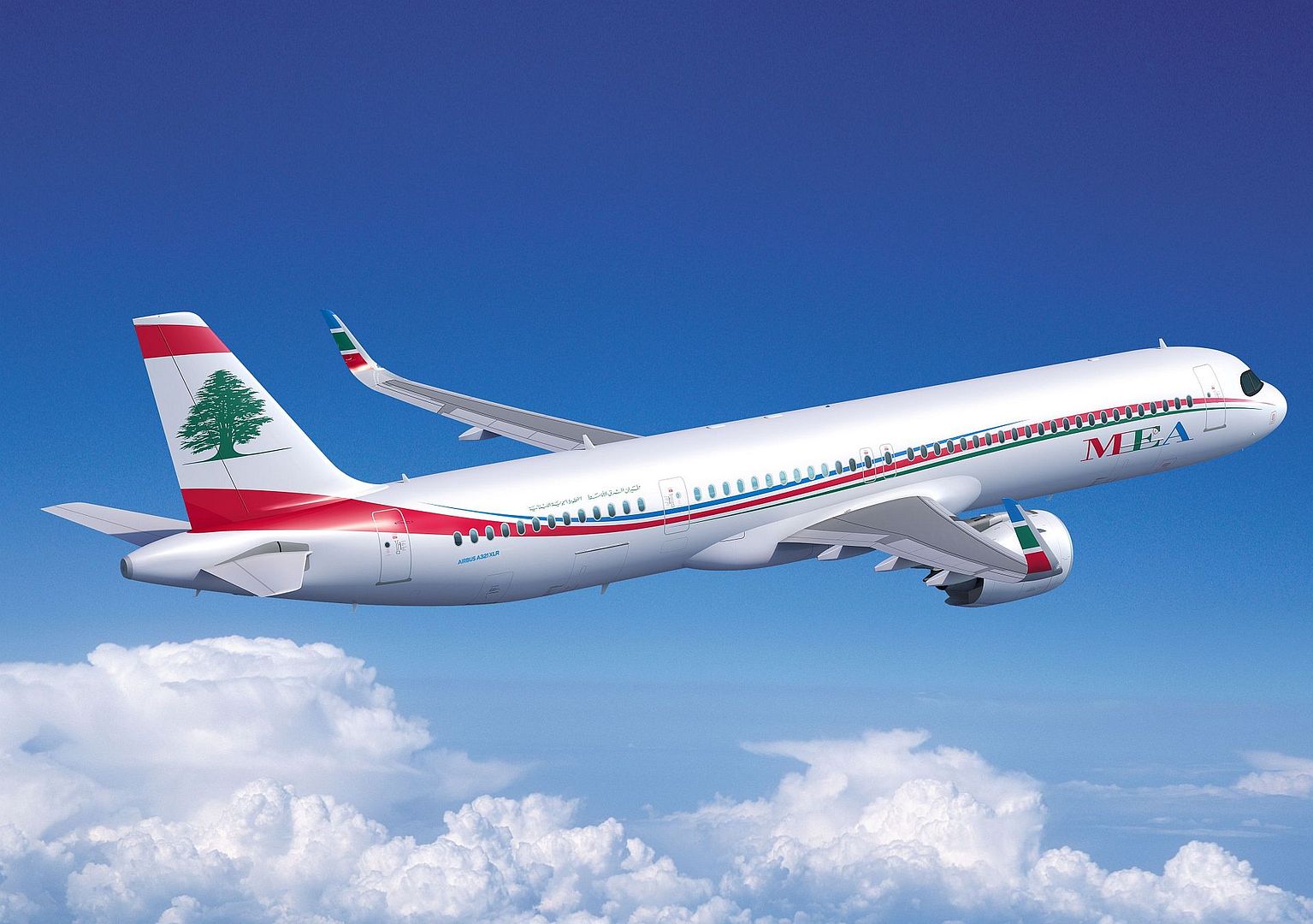
Paris, France, June 17, 2019 ? Embraer announced today, at the 53rd International Paris Air Show, that it has signed a contract with United Airlines for up to 39 E175s. The order comprises 20 firm aircraft and 19 options in a 70-seat configuration. The order has a value of USD 1.9 billion, based on Embraer?s current list prices, with all options being exercised. The firm order will be included on Embraer?s 2019 second-quarter backlog. Deliveries are expected to begin in the second quarter of 2020. These aircraft will replace older 70-seat aircraft currently operated by United?s regional partners.
?With this contract, we have the opportunity to continue serving United?s fleet with our class-leading E175 platform,? said Charlie Hillis, Vice President, Sales & Marketing, North America, Embraer Commercial Aviation. ?Embraer's dedication to finding solutions that meet our customer's needs is the primary reason we continue to outperform in this market segment.?
?The E175, operated by our regional partners, has proven to be an important part of our fleet as we continue to grow our mainline airline and provide an enhanced customer experience,? said Gerry Laderman, Chief Financial Officer of United Airlines. ?As we focus on providing our customers the utmost comfort and convenience, we will rely on aircraft like the E175 to help us achieve our goal of delivering the best experience in the sky.?
Including this new contract, Embraer has sold more than 585 E175s to airlines in North America since January 2013, earning more than 80% of all orders in this 70-76-seat jet segment.
Embraer is the world?s leading manufacturer of commercial aircraft up to 150 seats with more than 100 customers from all over the world. For the E-Jets program alone, Embraer has logged more than 1,800 orders and 1,500 aircraft have been delivered. Today, E-Jets are flying in the fleet of 75 customers in 50 countries. The versatile 70 to 150-seat family is flying with low-cost airlines as well as with regional and mainline carriers.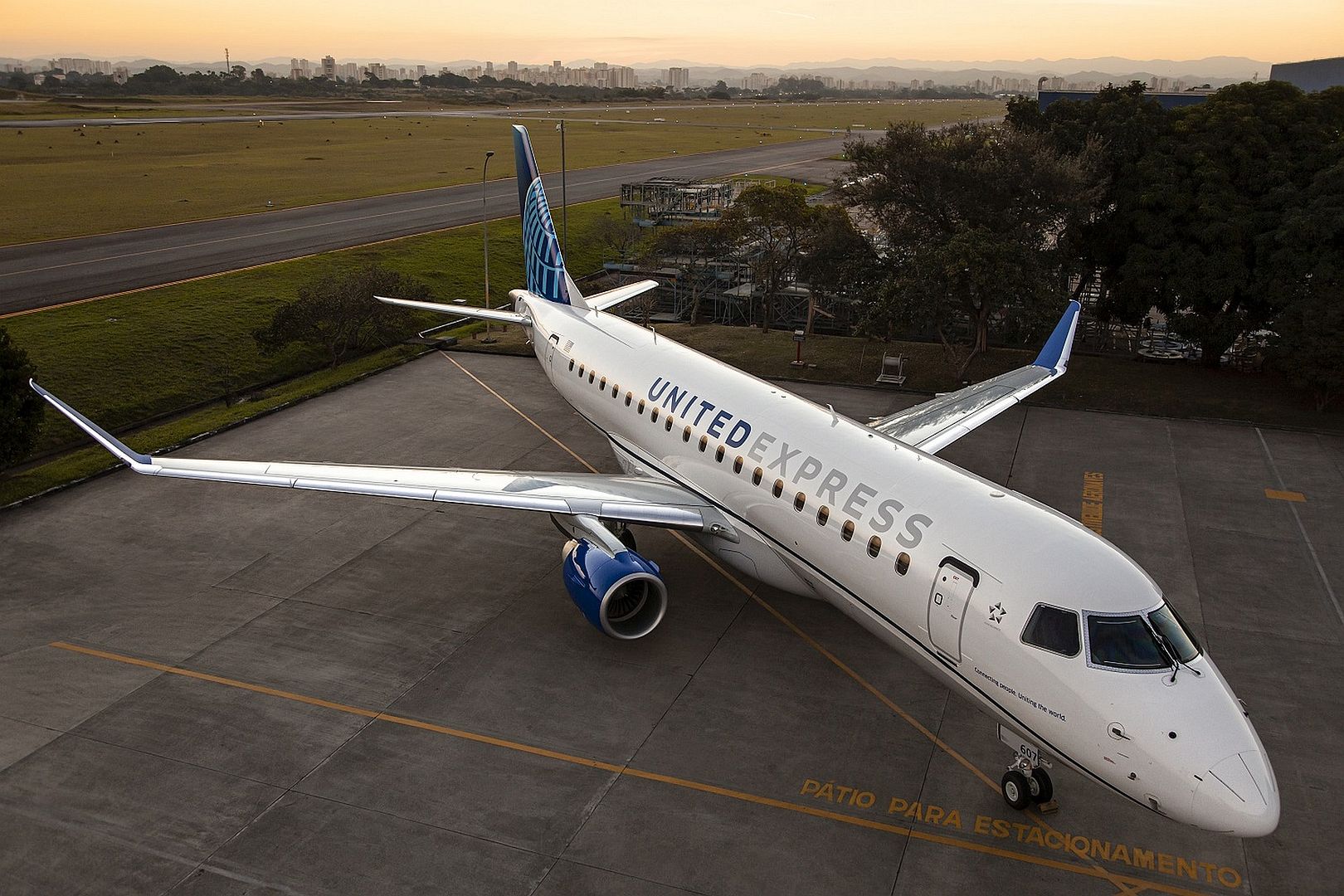
RAF Typhoon fighter jets based at Amari Air Base in Estonia were scrambled twice, from Friday 14th June to Saturday 15th June to intercept Russian fighter aircraft.
Working in partnership with the Estonian authorities, this was a routine NATO airspace policing mission for the Typhoon detachment providing continued reassurance in the region.
This weekend?s activity means that the RAF have made eight intercepts of Russian aircraft since taking over the Baltic Air Policing mission on 3 May 2019.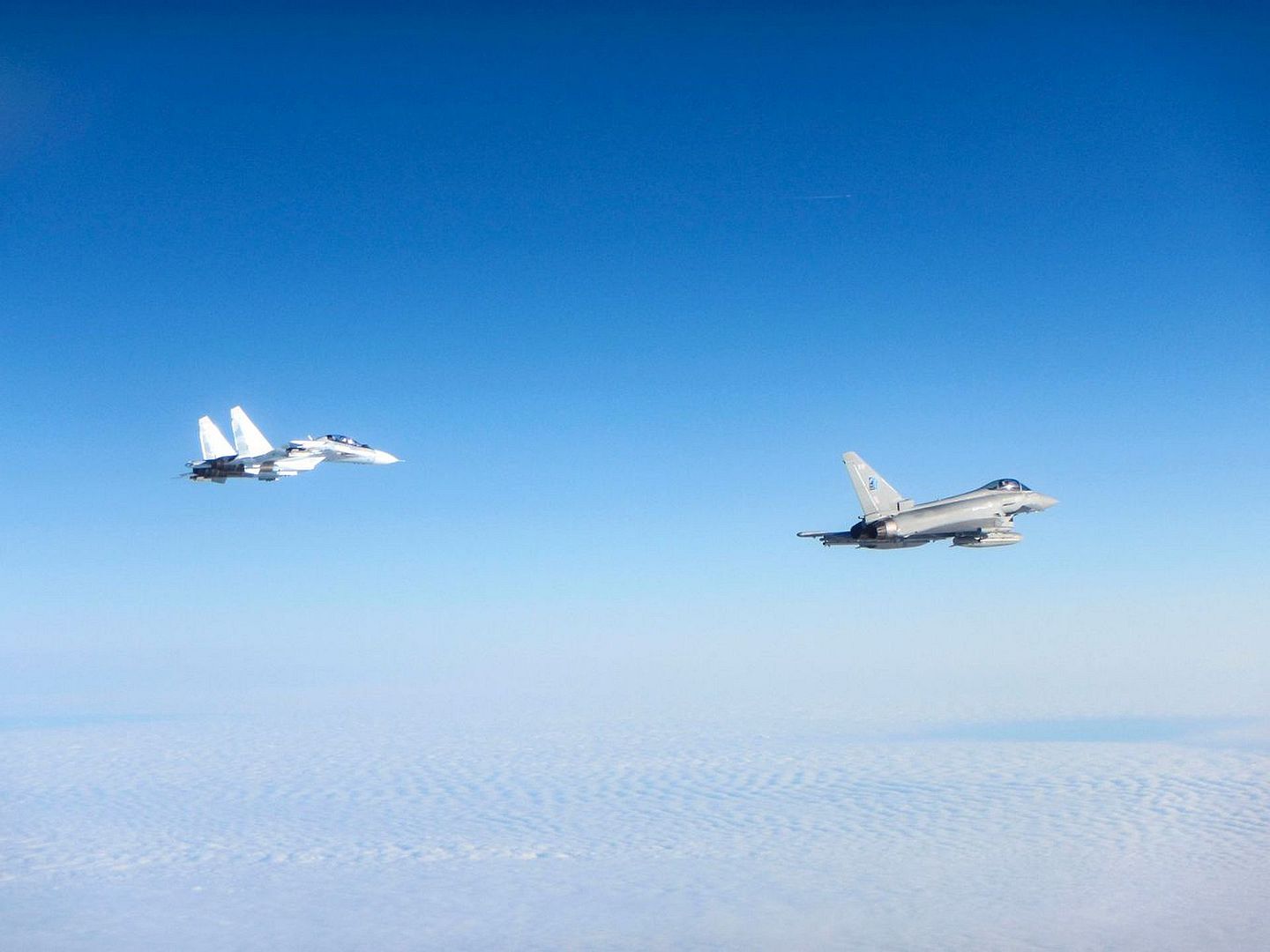
Typhoons on QRA alert launched during the evening of Friday 14 June to intercept a Russian SU-30 fighter aircraft that was flying to the north of Estonia.
A Typhoon pilot from XI(Fighter) Squadron on duty when the scramble was called, he said:
?We were scrambled to intercept a contact close to Estonian airspace in the early evening, between two periods of poor weather. Shortly after getting airborne we came alongside a SU-30 Flanker fighter aircraft. We escorted the fighter over the Baltic sea, around Estonia and passing over another Russian military transport aircraft in the process.?
RAF crews made a second scramble on Saturday 15 June to intercept a Russian SU-30 Flanker fighter and an Ilyushin IL-76 Candid transport aircraft transiting north from Kaliningrad towards Estonian and Finnish airspace.
A Typhoon pilot from XI(Fighter) Squadron on completion of the intercept, said:
?We scrambled to intercept two contacts that were approaching Estonian airspace from the south. We escorted the two aircraft for 15 minutes as they transited back towards mainland Russia. We then handed over responsibility to two Finnish QRA aircraft, which had also been scrambled as the Russian aircraft operated on the airspace boundary between Estonia and Finland.?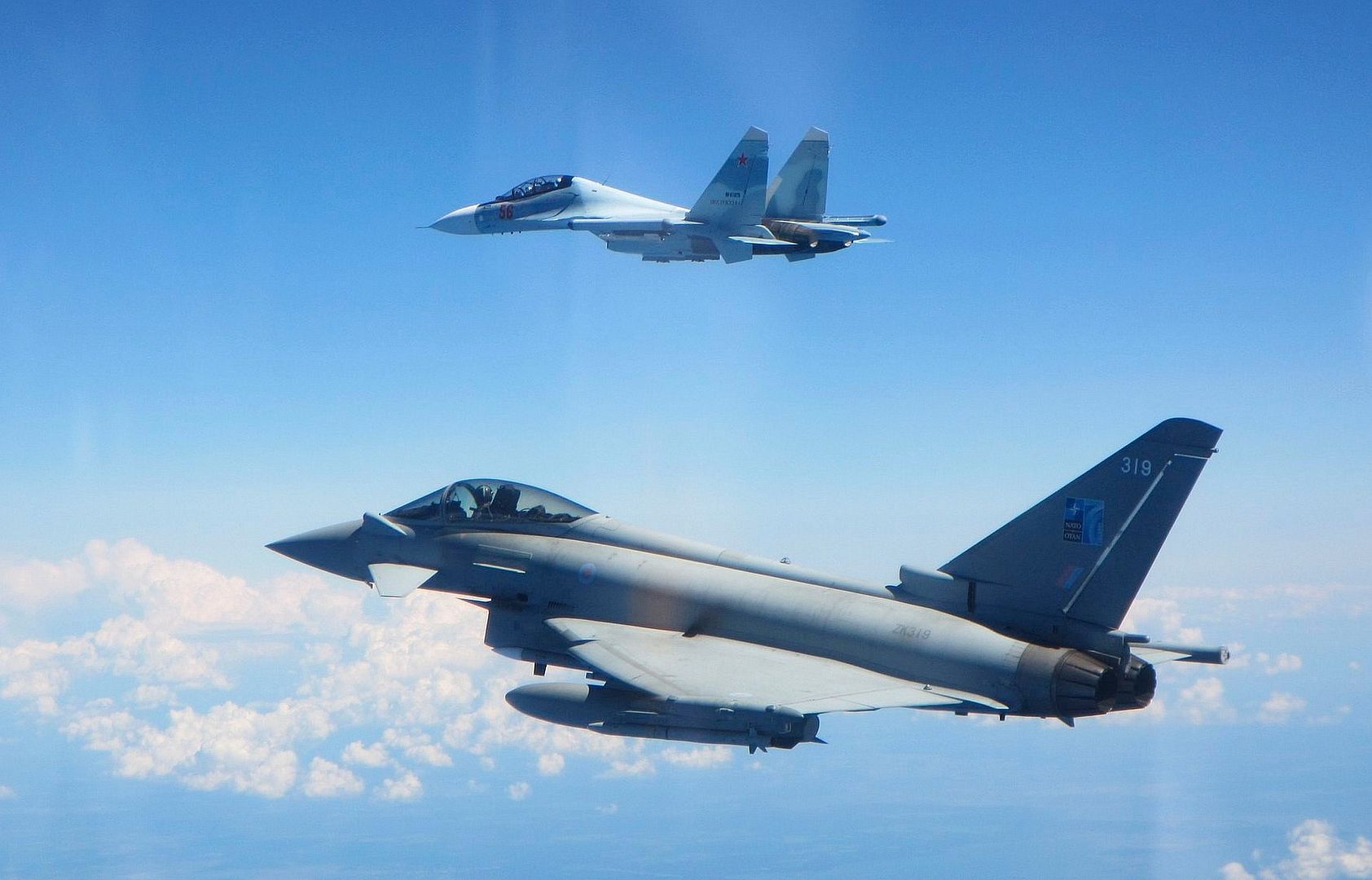
During both intercepts, the aircraft were flown at a safe distance and operated in a professional manner throughout.
The Royal Air Force is deployed on Operation AZOTIZE in Estonia in support of NATO Baltic Air Policing.
The UK operates in support of NATO to reassure our allies and is a further demonstration of the UK?s commitment to the security of the region.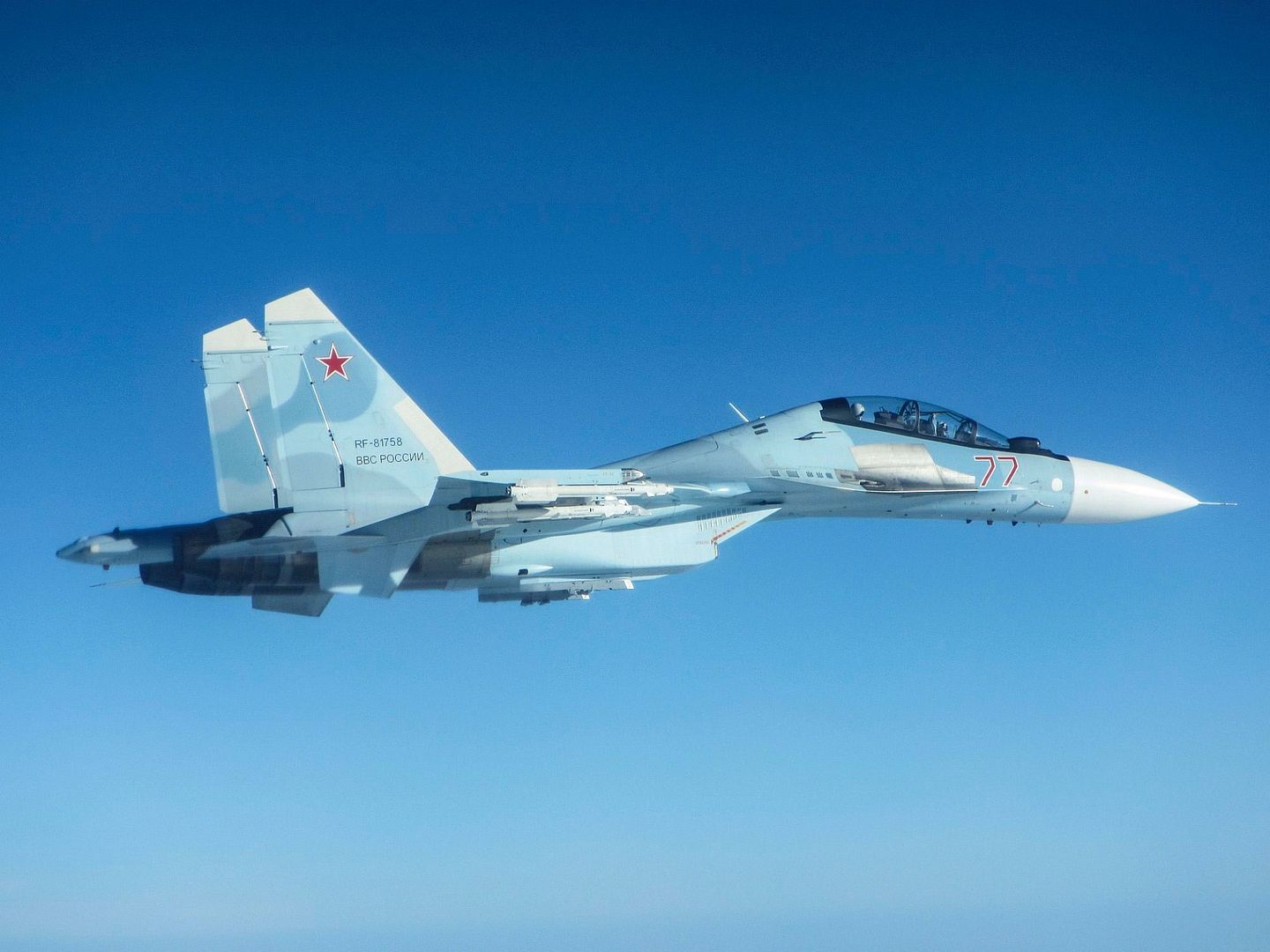
-
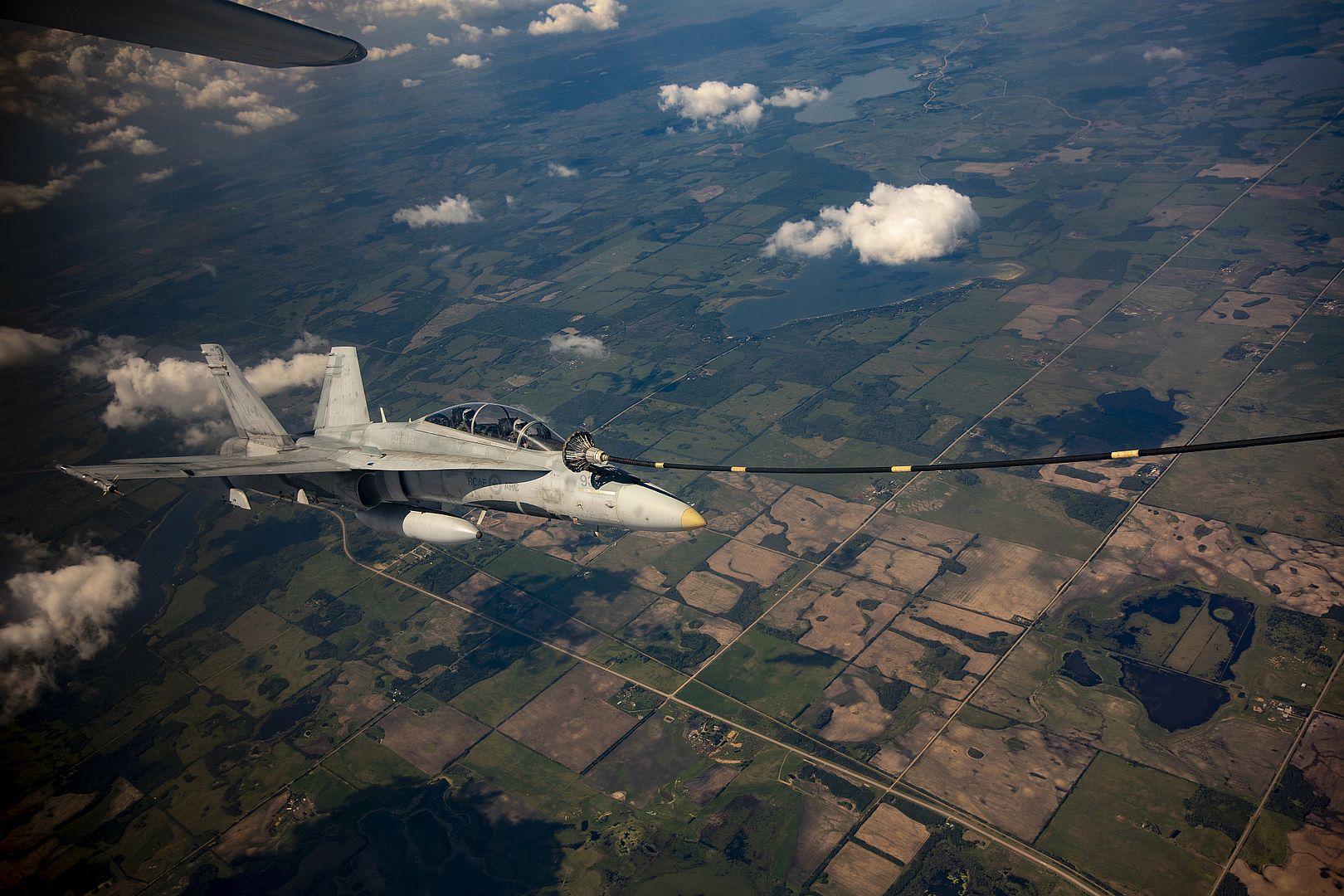
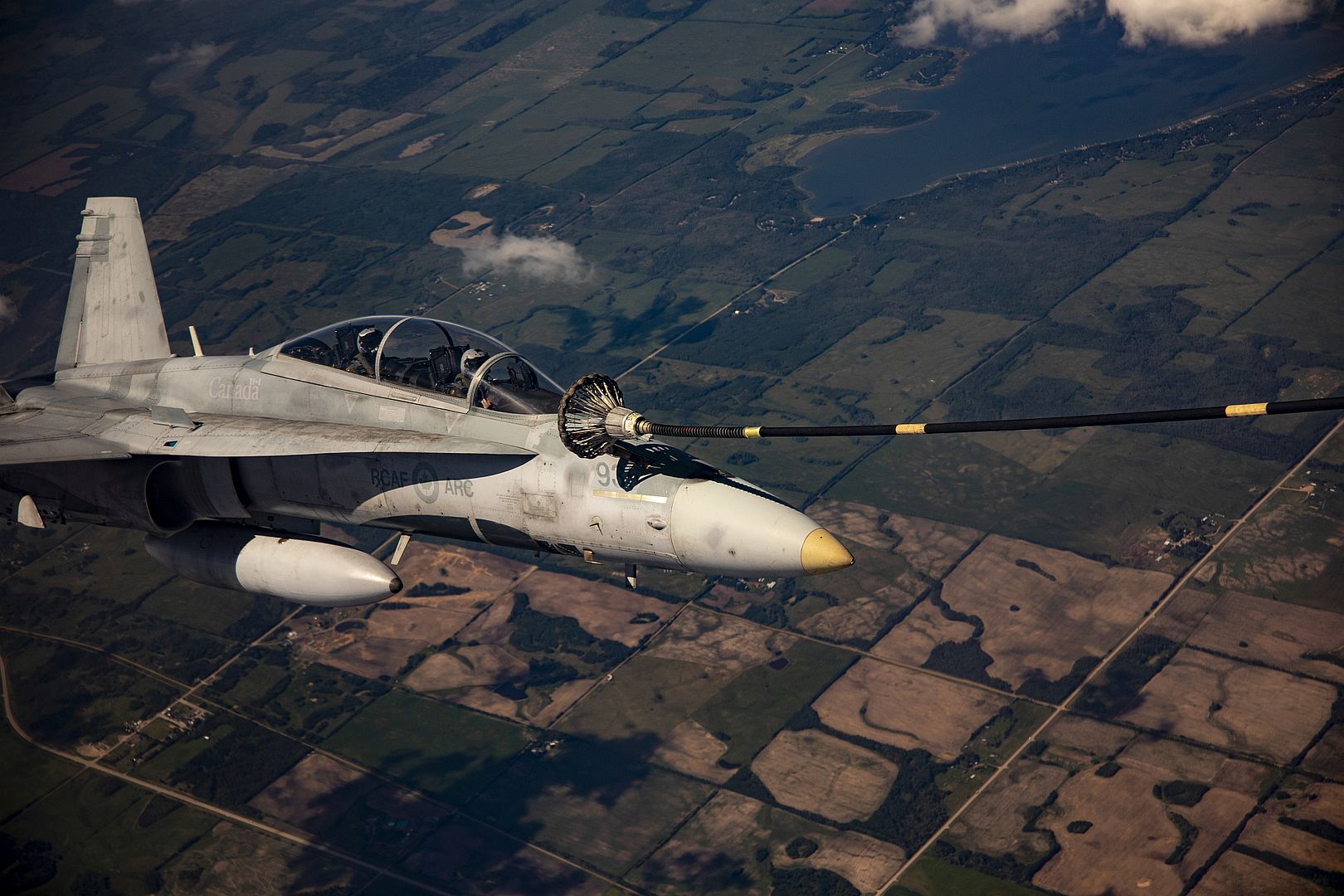
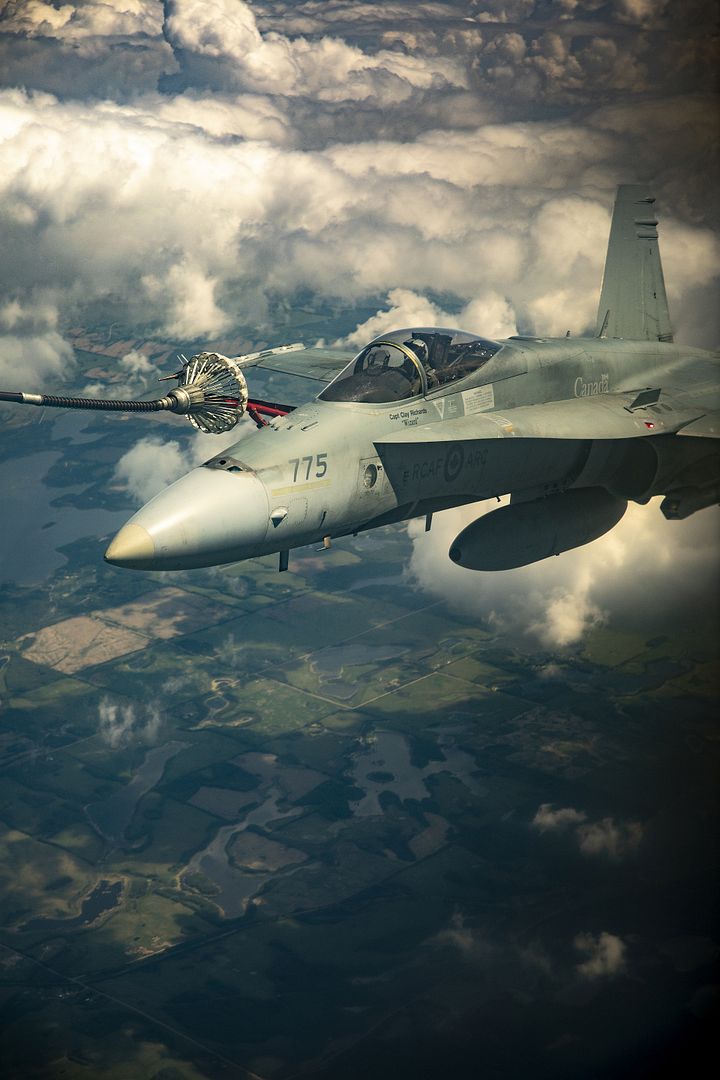
Royal Canadian Air Force CF-188 Hornet's from 409 Tactical Fighter Squadron, Canadian Forces Base Cold Lake are refueled by a KC-130 Hercules from Marine Aerial Refueler Transport Squadron 234, Marine Aircraft Group 41, 4th Marine Aircraft Wing, during an aerial refueling training mission in the air over Cold Lake, Canada, June 17, 2019, in support of Sentinel Edge 19. MARFORRES squadrons participate in SE19 to both complete annual training requirements and to increase unit readiness and proficiency. (U.S. Marine Corps photo's by Sgt. Andy O. Martinez)
One of the two B-29("Doc") Superfortresses that still actively fly today soars over Whiteman Air Force Base, Missouri, on June 16, 2019. The B-29 is a four-engine propeller-driven heavy bomber designed by Boeing and flown primarily by the United States during World War II and the Korean War.(U.S. Air Force photo by Staff Sgt. Kayla White)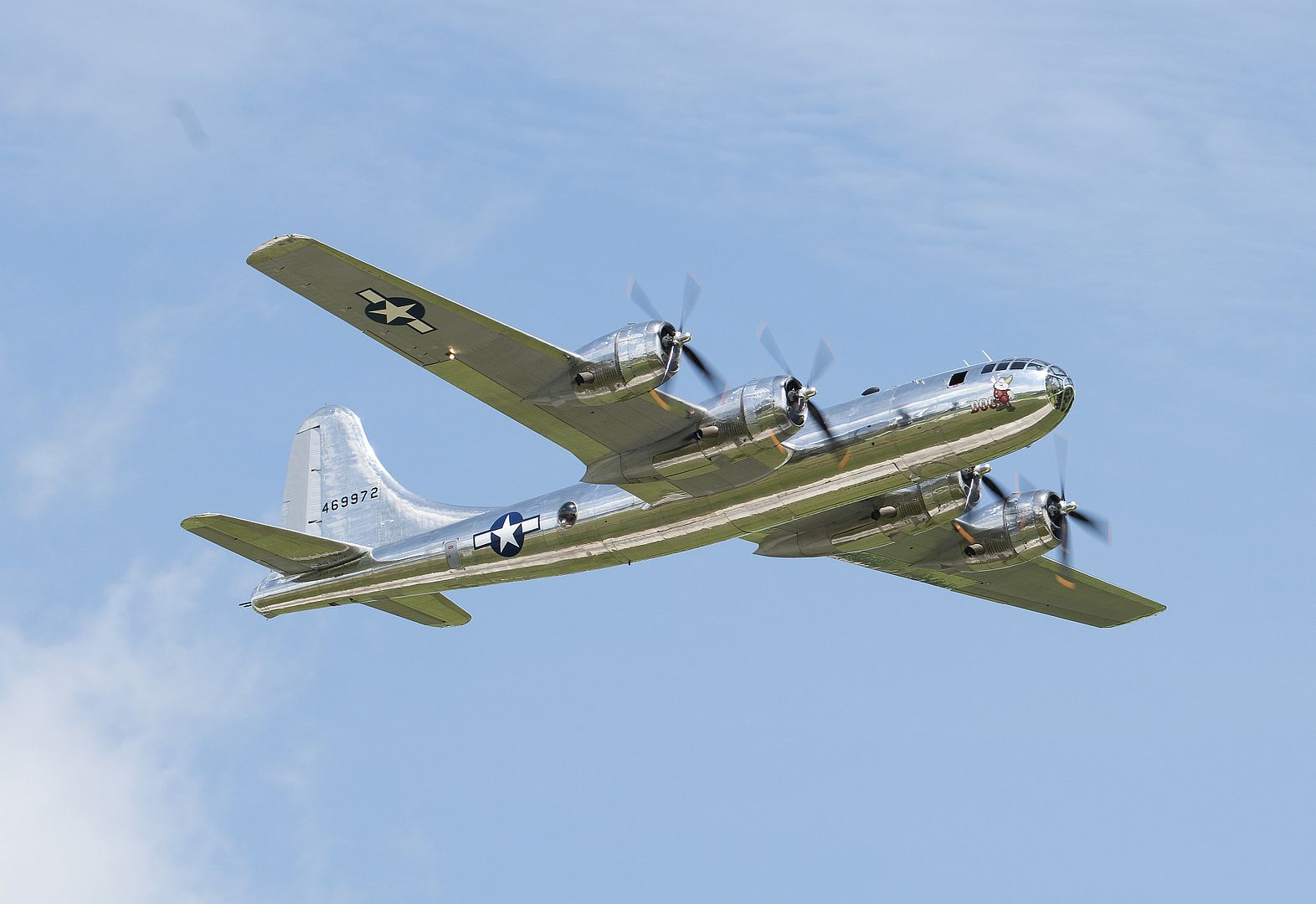
A U.S. F-16 Fighting Falcon aircraft from the Air Force's 18th Aggressor Squadron soars through the air during RED FLAG-Alaska 19-2, at Eielson Air Force Base, Alaska, June 17, 2019. Aerial training took place in the Joint Pacific Alaska Range Complex, which is comprised of approximately 67,000 square miles of airspace. (U.S. Air Force photo's by Senior Airman Daniel Snider)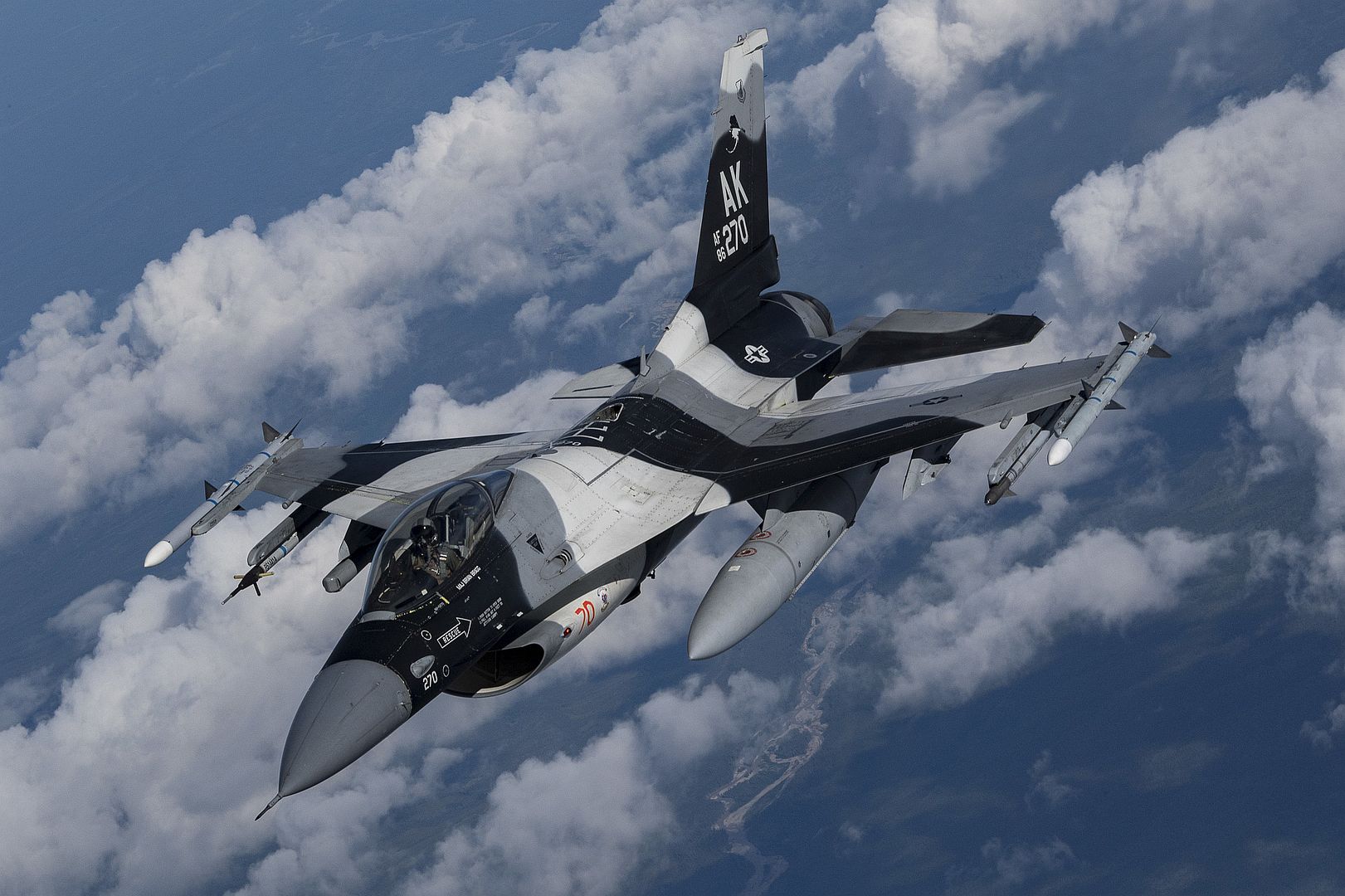
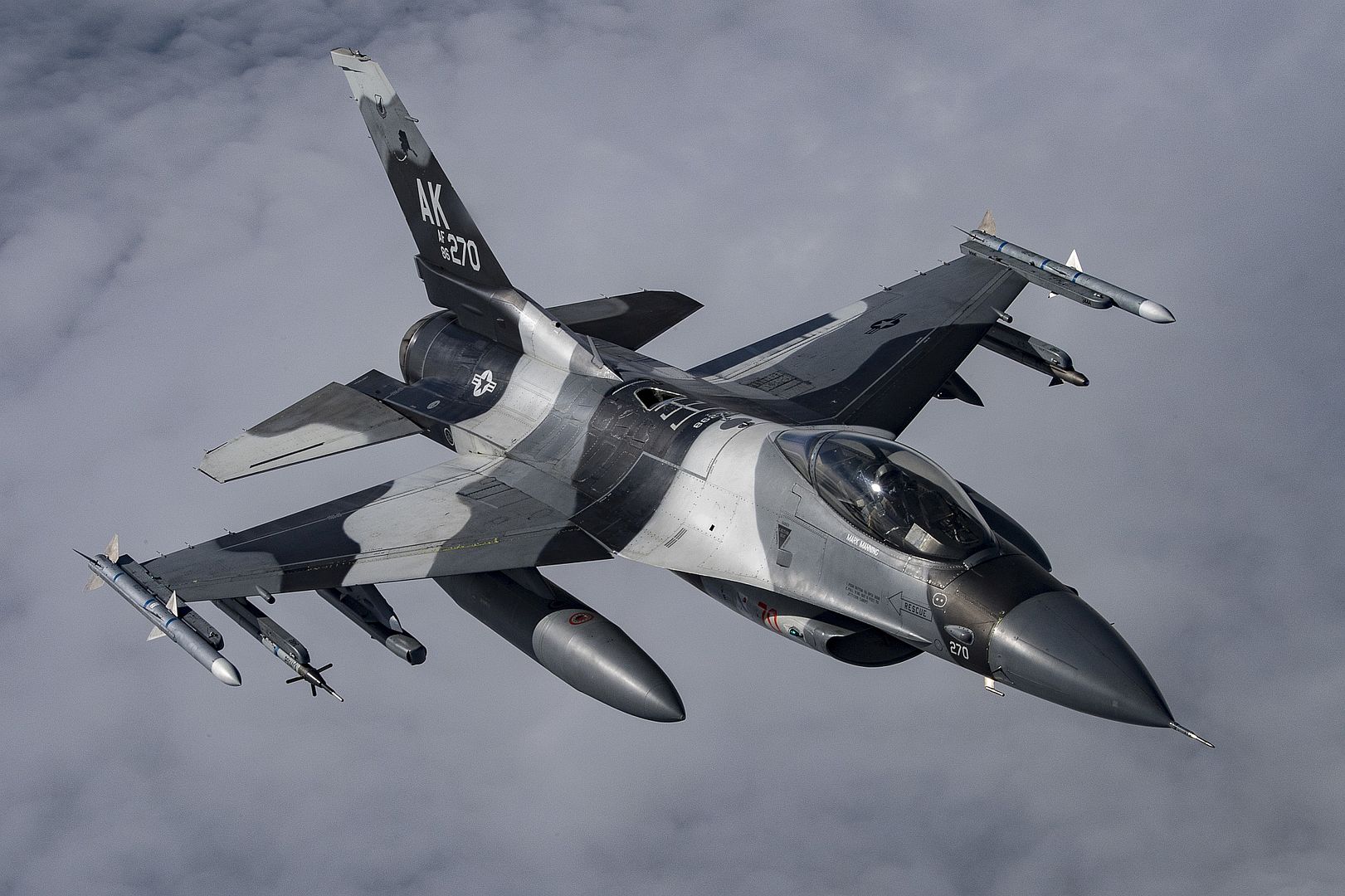
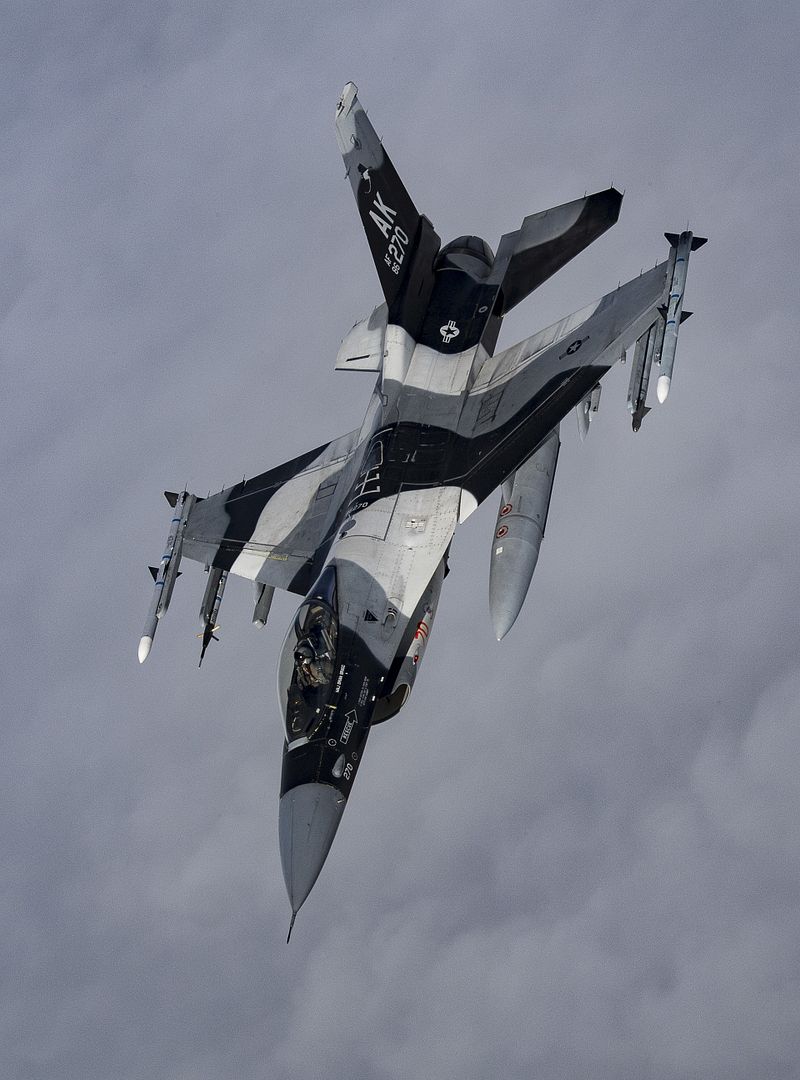
A B-52 Stratofortress assigned to the 5th Bomb Wing, Minot Air Force Base, North Dakota, completes refueling behind a KC-135 Stratotanker assigned to the 134th Air Refueling Wing, Tennessee Air National Guard, during exercise Saber Guardian 19, June 17, 2019. The bombers participated in three exercises in the Baltic and Black Sea regions, providing opportunities for training with our allies and partners. Strategic bomber missions enhance the readiness and training necessary to respond to any potential crisis or challenge across the globe. The USECOM, NATO exercise promotes regional stability and security while increasing readiness, strengthening partner capabilities and fostering trust. (U.S. Air National Guard photo by Tech. Sgt. Daniel Gagnon)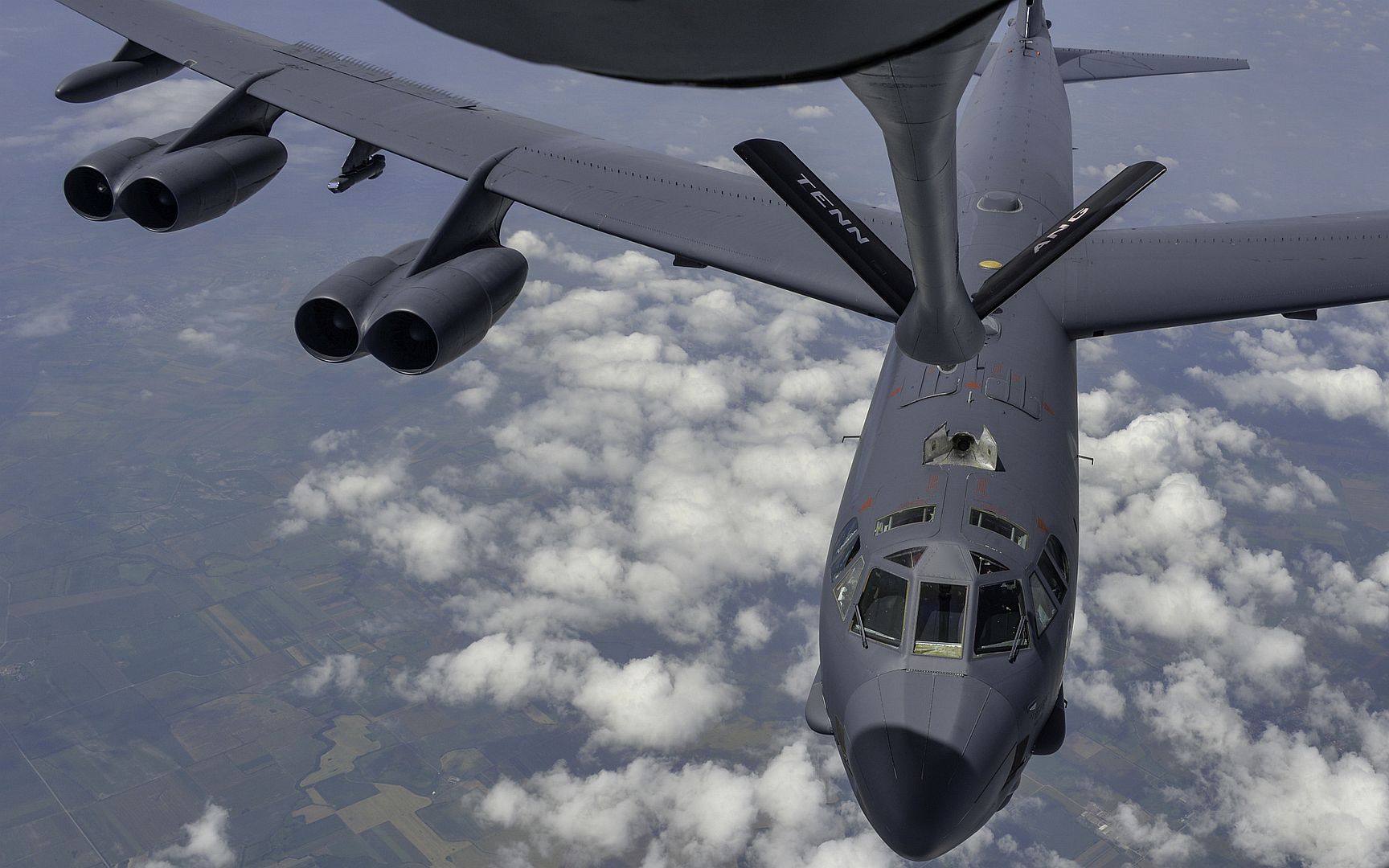
British Royal Marines fast rope from a British Merlin helicopter during a distinguished visitor (DV) day amphibious landing exhibition held as part of Exercise Baltic Operations (BALTOPS) 2019 at Palanga, Lithuania, June 16, 2019 . BALTOPS is the premier annual maritime-focused exercise in the Baltic Region, marking the 47th year of one of the largest exercises in Northern Europe enhancing flexibility and interoperability among allied and partner nations. (U.S. Navy photo by Mass Communication Specialist 2nd Class Joshua M. Tolbert)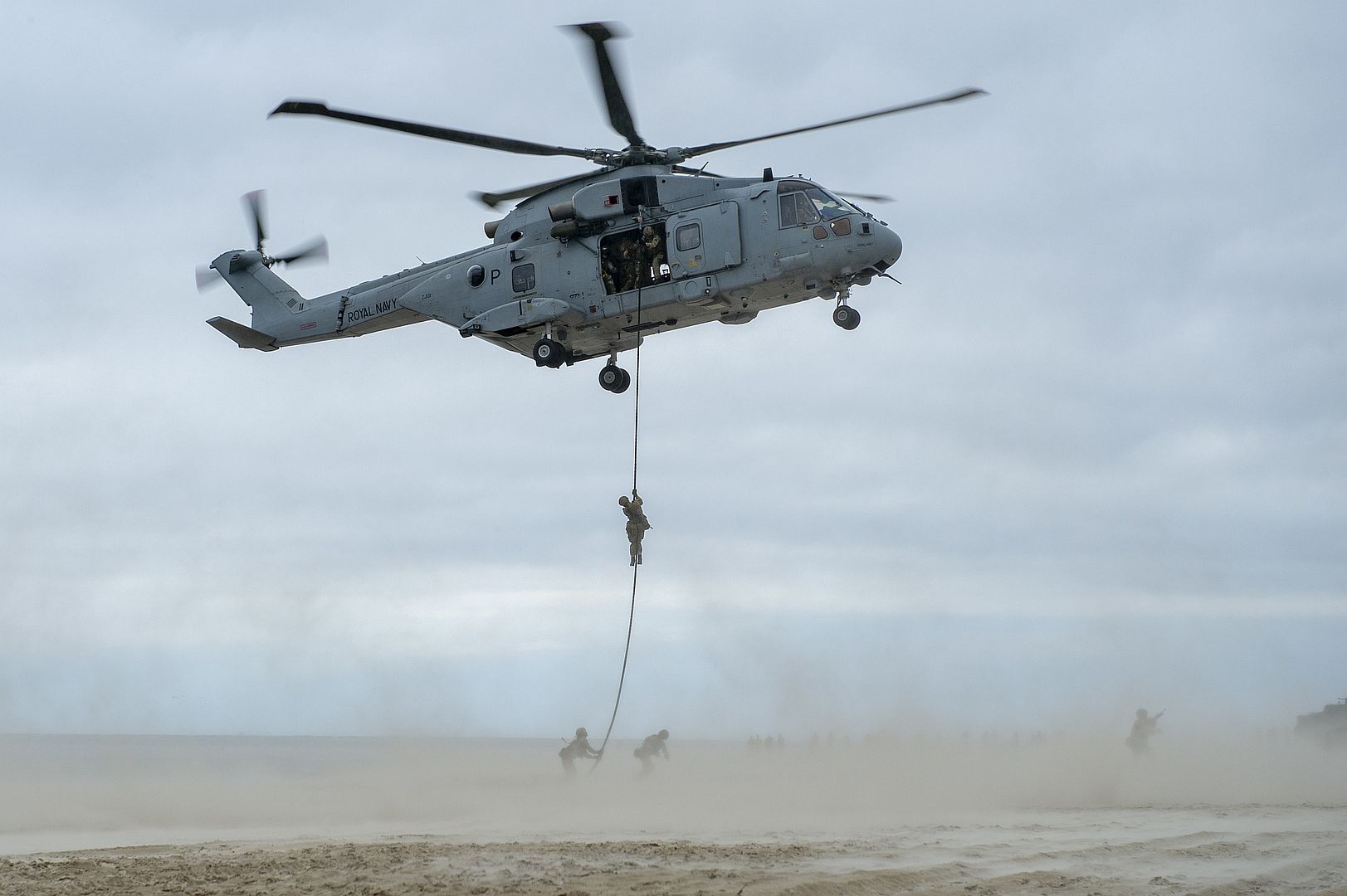
A Bulgarian Air Force H215M ?Cougar? helicopter transports leaders from the Bulgarian Land Forces and the Helenic Army at the Novo Selo Training Area, Bulgaria June 17, 2019 as part of Strike Back 19. Strike Back 19 is a multinational exercise hosted by the Bulgarian Armed Forces. Strike Back 19 is designed to increase capabilities and interoperability with Bulgarian, Albanian, Greek, North Macedonian, and U.S. troops. (US Army photo by Spc. Alan Prince)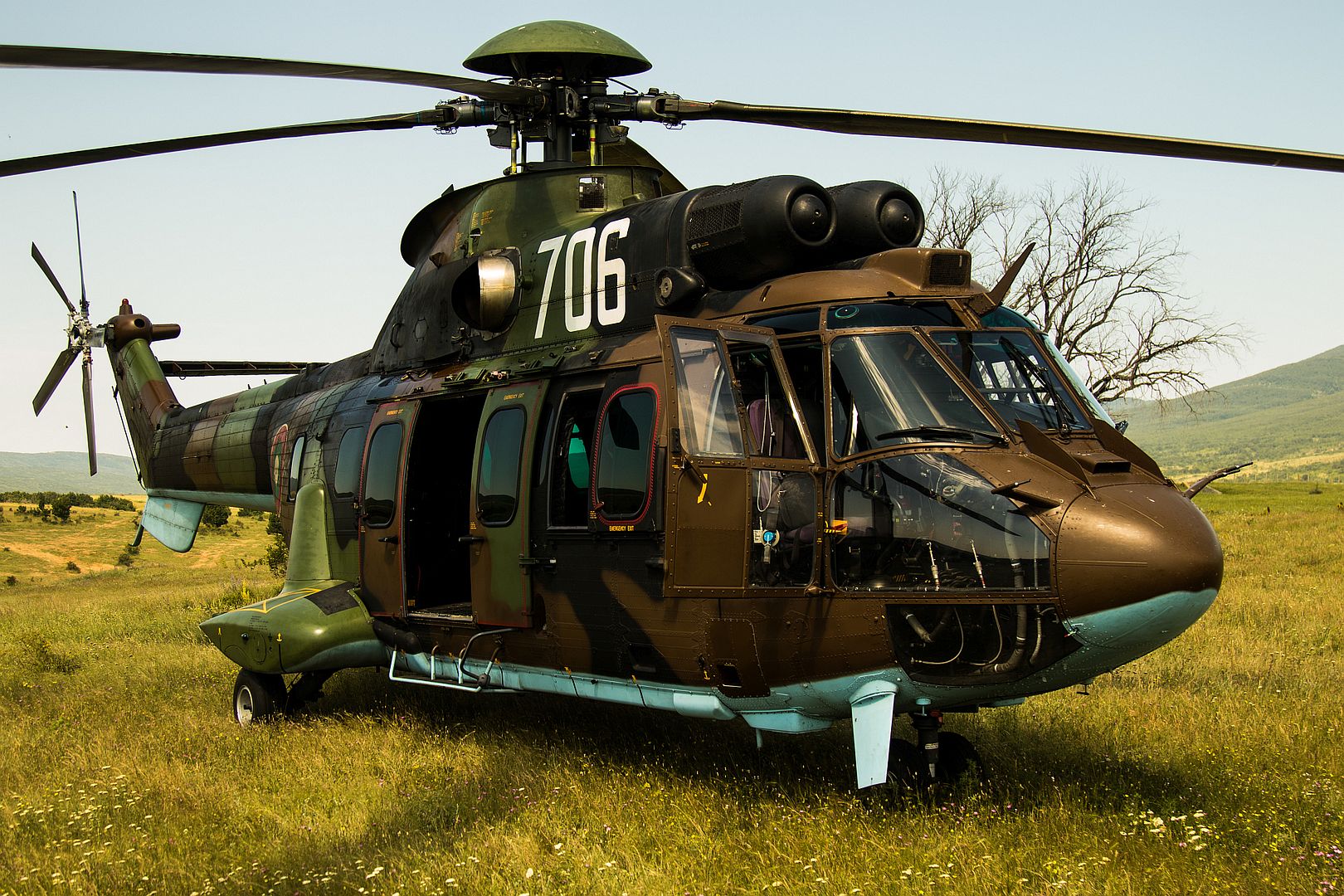
EDWARDS AIR FORCE BASE, Calif. --
The U.S. Air Force?s newest air refueling aircraft, the KC-46A Pegasus, is undergoing a variety of tests out of Edwards Air Force Base, California.
Starting on April 29th, the KC-46 conducted the first refueling test with a Travis AFB C-5M Super Galaxy. The testing is a part of a larger test program to certify aerial refueling operations between the KC-46 and 22 different receiver aircraft.
Maj. Drew Bateman, 22nd Airlift Squadron chief of standardization and evaluation and a C-5M pilot, flew the Air Force?s largest aircraft for testing on April 29. He flew it again May 15.
?The April 29 sortie was the first where the KC-46 and the C-5M made contact,? Bateman said. ?That was awesome to be a part of. You have a few pinch me moments in life and this was one of them for me. Not everyone gets to be a part of something like this. We were able to get two aircraft together for the first time.?
?Every test flight begins with a continuity check so the KC-46 crew ensures they can connect and disconnect safely with our aircraft,? Bateman added. ?From there, we continue testing a variety of items at multiple speeds and altitudes throughout the sortie.?
One capability Bateman and his C-5M crew mates tested with the KC-46 was the ability to connect with both aircraft near max gross weight.
?For these tests, we were required to be over 800,000 pounds with cargo and fuel,? Bateman said. ?Our 60th Aerial Port Squadron Airmen developed a load plan, the expediters loaded the cargo onto the airplane and our maintainers ensured the C-5M was flyable. It?s a huge team effort to ensure we are mission ready. I feel like I have the smallest part of it. I just fly the airplane.?
On April 29, Master Sgt. Willie Morton, 418th Flight Test Squadron flight test boom operator, oversaw operations in the back of the KC-46 during the testing process.
?This was a once-in-a-lifetime opportunity,? Morton said. ?I was a KC-10 Extender boom operator at Travis for about 13 years so going to the KC-46 and being a part of the next step in aerial refueling is pretty awesome. I have the chance to provide input on an aircraft that will be flying missions for many years.?
To complete refueling with the KC-46, boom operators must use a series of cameras that project a 3D image on a screen. These refueling experts then use that image to carefully guide aircraft into position, Morton said.
?We are testing capabilities at low altitudes, high speeds, high altitudes and high speeds, as well as heavy and light gross weights so we know how the aircraft will respond,? he said. ?We have to find the optimal speed the C-5M can fly at to support refueling. We are also doing our best to ensure the mechanical compatibility of the KC-46 and C-5M.?
According to Lt. Col. Zack Schaffer, 418th FLTS KC-46 Integrated Test Force director, the testing is a joint effort between the USAF and Boeing.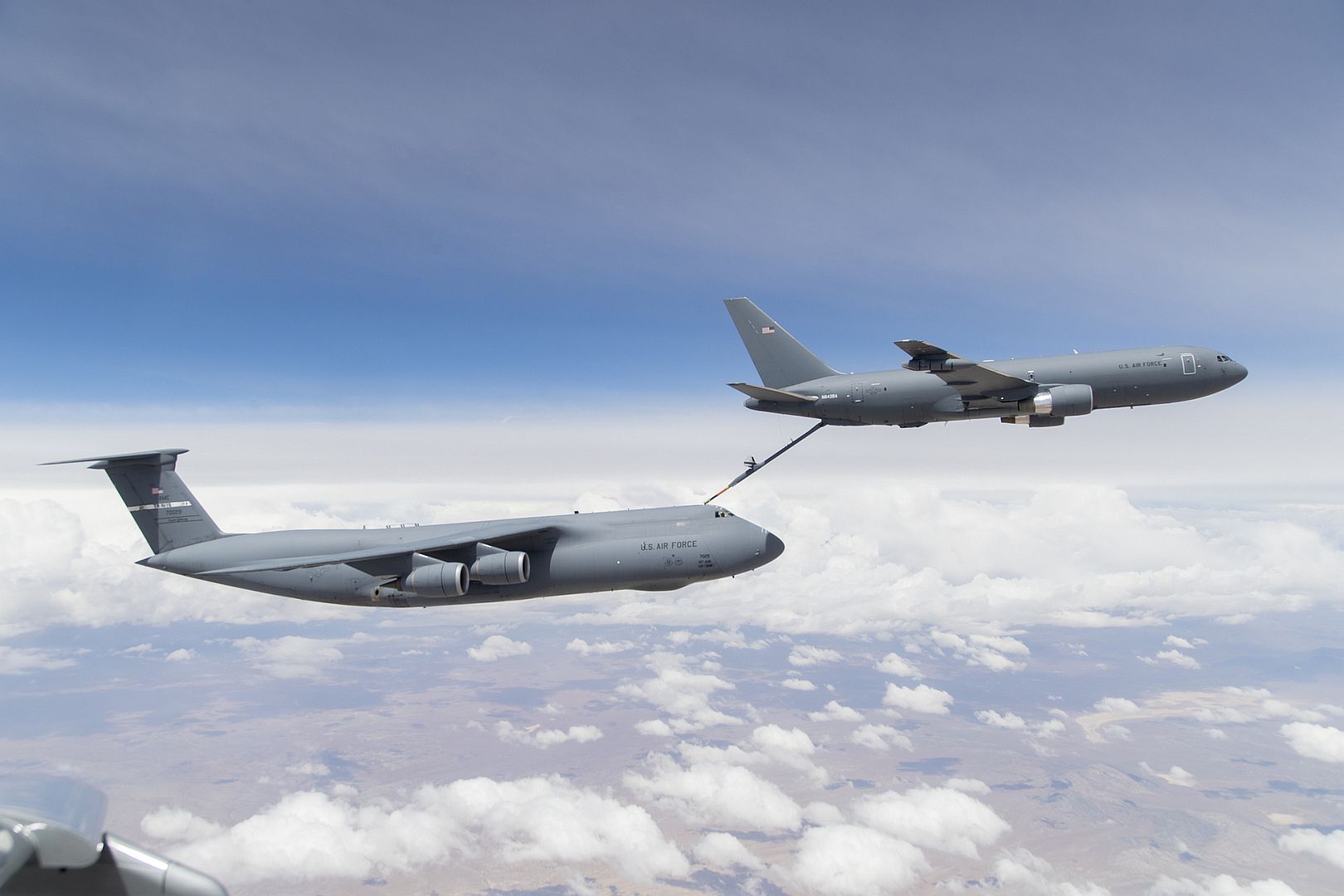
?The KC-46s being used for this test effort are owned by Boeing and operated by a combined Air Force and contractor crew,? Schaffer said. ?All the test planning and execution is being led by the 418th FLTS, part of the 412th Test Wing at Edwards. The flight test program evaluates the mechanical compatibility of the two aircraft at all corners of the boom flight envelope, as well as handling qualities of both the tanker, boom and receiver throughout the required airspeed and altitude envelope at different gross weights and center of gravity combinations.?
The 418th FLTS is also responsible for developmental testing of the C-5M, and is providing a test pilot to support the C-5M side of the certification testing, Schaffer added. The C-5M was crewed primarily by the 22nd AS with augmentation from the 418th.
?Additionally, the military utility, lighting compatibility and fuel transfer functionality is also being evaluated,? Schaffer said. ?The testing is expected to take approximately 12 sorties to complete.?
Once the testing is complete, the results will be used to develop the operational clearance necessary to allow KC-46s to refuel the C-5M for missions.
?The C-5M is also one of the receivers required to complete the KC-46 Initial Operational Test and Evaluation program, which is a prerequisite to the KC-46 being declared operationally capable,? Schaffer said. ?Completing the testing necessary to expand the operational capabilities of the KC-46 is a critical step in modernizing the Air Force?s aging tanker fleet. The 60th Air Mobility Wing at Travis has provided outstanding support to ensure this testing can get the warfighter expanded capabilities as soon as possible.?
Identifying potential problems is also a focus of the testing, Moore added.
?It?s important, if any issues are identified during the testing, to ensure counter measures are created to overcome those issues,? Moore said. ?We want to get the best product to the warfighter to extend global reach and mobility.?
Travis is scheduled to receive its first KC-46 in 2023.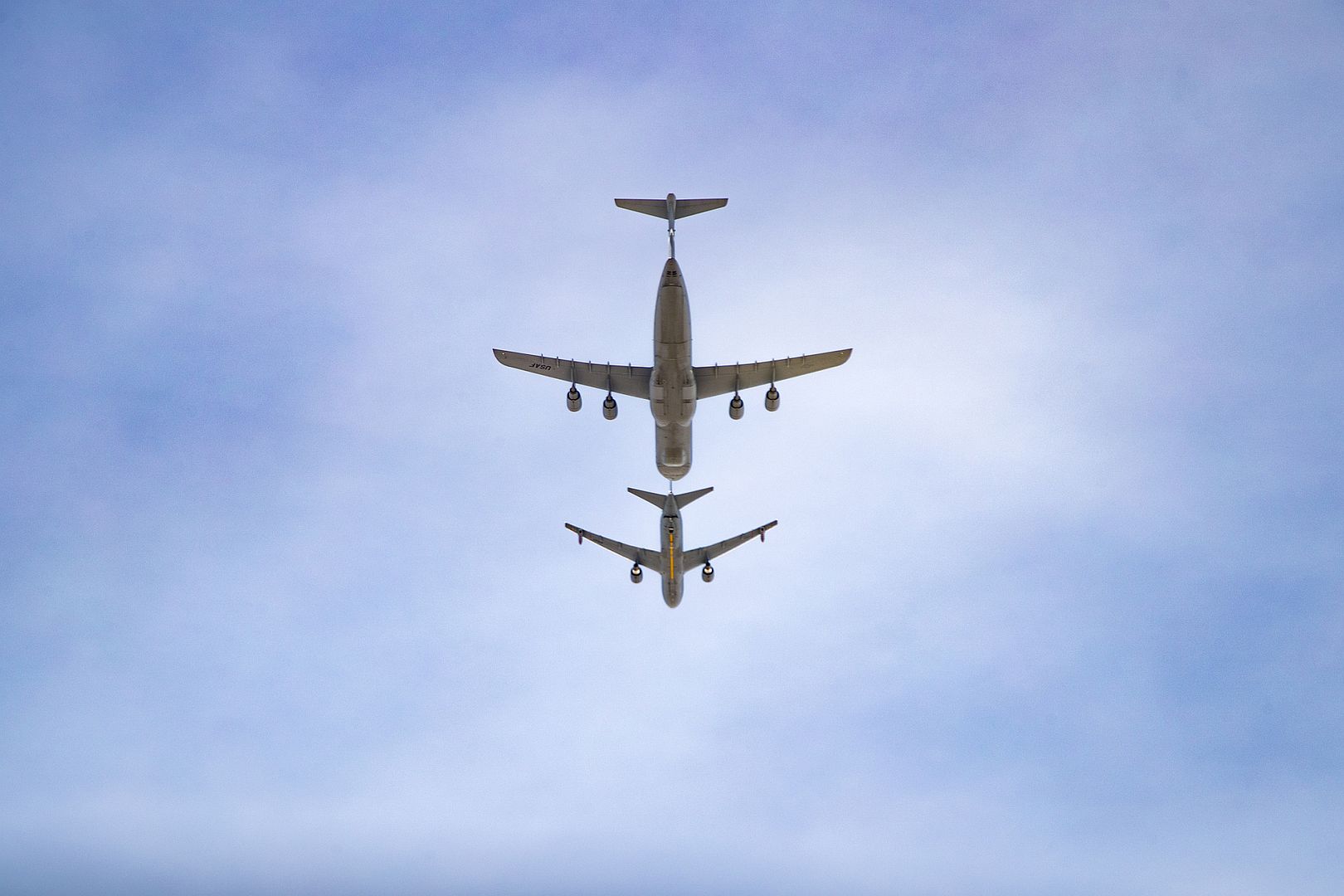
LE BOURGET, France, June 17, 2019 /PRNewswire/ -- Boeing [NYSE: BA] and International Airlines Group (IAG), one of the world's largest airline groups, signed two agreements at the Paris Air Show today that will provide key services for IAG's British Airways, including parts for the airline's Airbus A320 family and its Boeing 777 fleet.
With the first agreement, Boeing will furnish British Airways with its Component Services Program where Boeing and its partners will own, manage, and maintain a global exchange inventory of parts for the airline's A320 and A320neo aircraft. This agreement - the first of its kind for Boeing ? will open convenient access to parts for British Airways, which operates an extensive route network.
British Airways has also signed an agreement for three Landing Gear Exchanges for its 777 fleet. Through the program, operators receive an overhauled and certified landing gear from an exchange pool maintained by Boeing, with stocked components and supporting parts shipping within 24 hours.
"We are proud to have the opportunity to serve British Airways' needs regardless of platform," said Ihssane Mounir, senior vice president of Commercial Sales & Marketing for The Boeing Company. "In partnership with our partners and repair providers, we look forward to leveraging the strength of our global supply chain's aftermarket resources to support British Airways and help them operate even more efficiently."
Following the signing of these new services agreements, Boeing and IAG held a deferred ceremonial signing to celebrate its order for 18 777X airplanes. Earlier this year, IAG placed firm orders for 18 777-9 aircraft and 24 options for British Airways. The airline selected the 777X, the world's largest, most efficient twin aisle jet, as part of its long-haul fleet modernization program, joining a group of leading global carriers that have selected the new 777X.
The firm order by IAG puts the 777X at 364 orders and commitments from more than eight customers. Production of the 777X began in 2017, with first flight expected later this year and first delivery expected in 2020.
International Airlines Group (IAG) operates 582 aircraft and serves 268 destinations, carrying 113 million passengers in 2018. It is the parent company of Aer Lingus, British Airways, Iberia, LEVEL and Vueling.
Boeing is the world's largest aerospace company and leading provider of commercial airplanes, defense, space and security systems, and global services. The company supports commercial and government customers in more than 150 countries. Boeing employs more than 150,000 people worldwide and leverages the talents of a global supplier base. Building on a legacy of aerospace leadership, Boeing continues to lead in technology and innovation, deliver for its customers and invest in its people and future growth.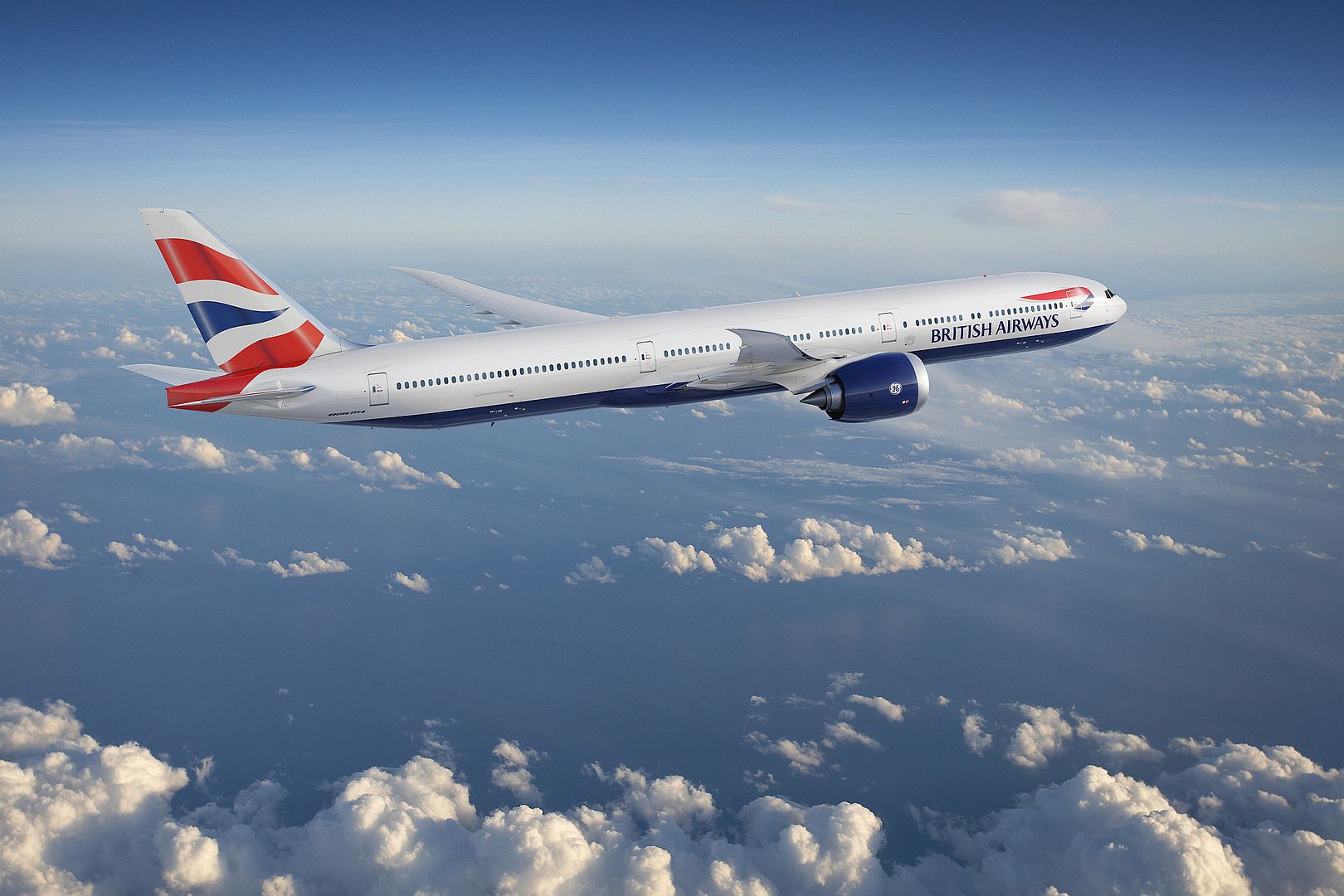
LE BOURGET, France, June 18, 2019 /PRNewswire/ -- Boeing [NYSE: BA], Korean Air and Air Lease Corporation [NYSE: AL; "ALC"] today announced at the Paris Air Show the airline plans to add 30 new 787 Dreamliner airplanes to its fleet, with a commitment to purchase 10 new 787-10s and 10 additional 787-9 airplanes valued at $6.3 billion at current list prices. As part of this agreement, Korean Air will also lease 10 787-10s from ALC.
The airline, one of the largest transpacific carriers in Asia with 16 non-stop routes to North America, will introduce the larger 787-10 to complement its long-haul fleet of 787-9 and 777 airplanes. This order will be reflected on Boeing's Orders and Deliveries website once it is finalized.
"As we continue to innovate our product offering, the 787 Dreamliner family will become the backbone of our long-haul fleet for many years to come," said Walter Cho, Chairman of Korean Air. "In addition to 25 percent improved fuel efficiency, the stretched 787-10 offers around 15 percent more space for passengers and cargo than our 787-9s, which will be critical to our long-term business goals."
With this order, Korea's flag carrier will quadruple its 787 fleet to 40 airplanes as it looks to strengthen its long-haul fleet.
"ALC is delighted and honored to bring the 787-10 to Korean Air's fleet in a joint effort with Boeing. The 787-10 provides significant revenue enhancement to complement Korean's 787-9 fleet, and the long-term lease of ten 787-10s from ALC will greatly expand the scope and reach of the 787-10 in Korean Air's global network," said John L. Plueger, CEO and President of Air Lease Corporation.
The 787-10 is the largest member of the super-efficient and passenger-pleasing Dreamliner family. At 224 feet long (68 meters), the 787-10 can serve up to 330 passengers in a standard two-class configuration, about 40 more than Korean Air's existing fleet of 787-9 airplanes. Powered by a suite of new technologies and a revolutionary design, the 787-10 sets a new benchmark for fuel efficiency and operating economics when it entered commercial service last year. The airplane allows operators to achieve 25 percent better fuel efficiency per seat compared to the previous airplanes.
"Today's announcement demonstrates the strength of our enduring partnership with Korean Air. The airline has been a pioneer in Asia's commercial aviation industry over the past five decades and Boeing is honored to play an important role in their continued success," said Kevin McAllister, president and chief executive officer, Boeing Commercial Airplanes.
Korean Air operates a fleet of 96 Boeing passenger airplanes, including the Next-Generation 737, 747, 777 and 787 airplanes. The airline also operates an all-Boeing cargo fleet with the 747-400, 747-8 and 777 Freighters.
"Korean Air is a leading global airline and has become one of Asia's largest transpacific carriers. We are honored that Korean Air has decided to quadruple its 787 Dreamliner fleet and we will work closely with them to finalize this landmark deal," said Ihssane Mounir, senior vice president of Commercial Sales and Marketing of The Boeing Company. "Korean Air continues to build its incredible widebody airplane fleet to enable its philosophy of providing 'Excellence in Flight' for its passengers."
Korean Air employs a variety of Boeing Global Services to support its fleet, including Airplane Health Management services, which optimizes aircraft scheduling using predictive analytics with real-time flight data to reduce delays for its 787 aircraft. The airline also employs Jeppesen FliteDeck Pro electronic flight bag services that streamline access to digital navigational data, charts, manuals, and weather information for pilots. In addition, Korean Air also uses digital flight planning and runway performance analysis solutions, to further enhance operational efficiency and reduce costs across all phases of flight.
Korean Air also selected the GEnx engine to power its 30 additional Boeing 787 Dreamliners. This selection will increase Korean Air's GEnx-powered Dreamliner fleet to 40 aircraft.
Korean Air's Aerospace Division is a key Boeing partner on the 747-8 and 787 programs, supplying the distinctive raked wing-tips for each model. The division is also a supplier of the new 737 MAX Advanced Technology (AT) Winglet.
With a fleet of 168 aircraft, Korean Air is one of the world's top 20 airlines and serves 126 destinations in 44 countries worldwide. It is a founding member of the SkyTeam alliance and recently formed a Joint Venture partnership with Delta Air Lines.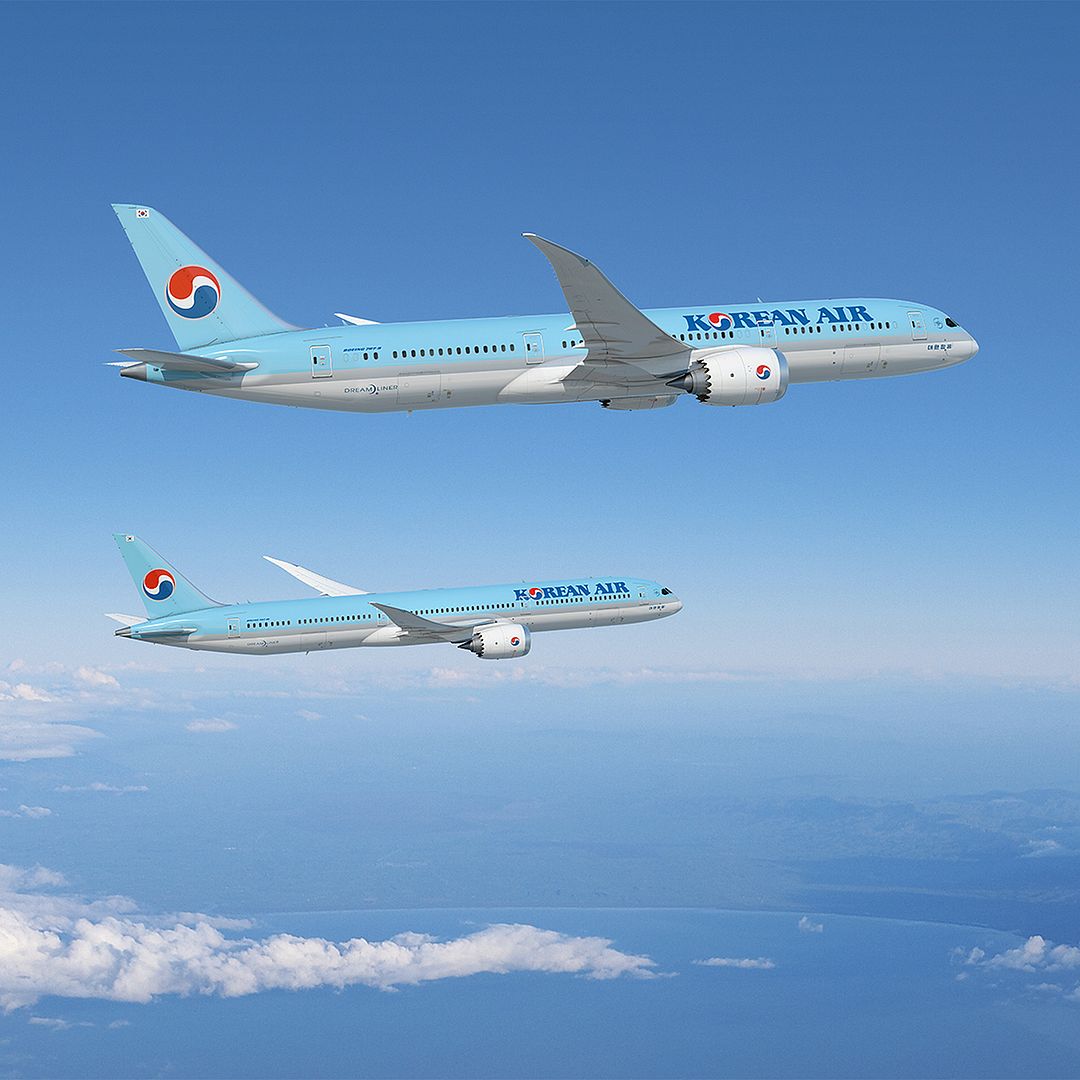
LE BOURGET, Paris, June 18, 2019 /PRNewswire/ -- Boeing [NYSE: BA] and Air Lease Corporation [NYSE: AL; "ALC"], a leading aircraft leasing company, announced a commitment during the Paris Air Show to purchase five 787-9 Dreamliners, valued at $1.5 billion at list prices.
"Demand for reliable, versatile, and fuel-efficient airplanes is at an all-time high," said Steven Udvar-H?zy, Executive Chairman of Air Lease Corporation. "These five Boeing 787-9 aircraft are required by our airline customers to satisfy strong ALC lease placements of the 787."
Boeing has sold more than 1,400 Dreamliners since the program's introduction, making it the fastest-selling widebody jet in history. The 787 Dreamliner allows airlines to reduce fuel use and emissions by 20 to 25 percent and serve far-away destinations.
The 787-9, a stretch of the 787-8, can fly 296 passengers 7,635 nautical miles (14,140 km) in addition to carrying more cargo and allowing airlines to profitably grow routes first opened by the 787-8. The combination of unrivaled fuel efficiency and long range has helped airlines flying the 787 family of airplanes save more than 36 billion pounds (16 billion kilograms) of fuel and open more than 235 non-stop routes.
"We are thrilled that ALC has decided to add more 787 Dreamliners to its elite portfolio of airplanes that they place with customers across the globe," said Ihssane Mounir, senior vice president of Commercial Sales and Marketing of The Boeing Company. "I'm confident that the market-leading capabilities of the 787-9 will continue contributing to ALC's long-term success."
About Boeing:
Boeing is the world's largest aerospace company and leading provider of commercial airplanes, defense, space and security systems, and global services. The company supports commercial and government customers in more than 150 countries. Boeing employs more than 150,000 people worldwide and leverages the talents of a global supplier base. Building on a legacy of aerospace leadership, Boeing continues to lead in technology and innovation, deliver for its customers and invest in its people and future growth. www.boeing.com
About Air Lease Corporation:
ALC is a leading aircraft leasing company based in Los Angeles, California that has airline customers throughout the world. ALC and its team of dedicated and experienced professionals are principally engaged in purchasing commercial aircraft and leasing them to its airline customers worldwide through customized aircraft leasing and financing solutions. For more information, visit ALC's website at www.airleasecorp.com.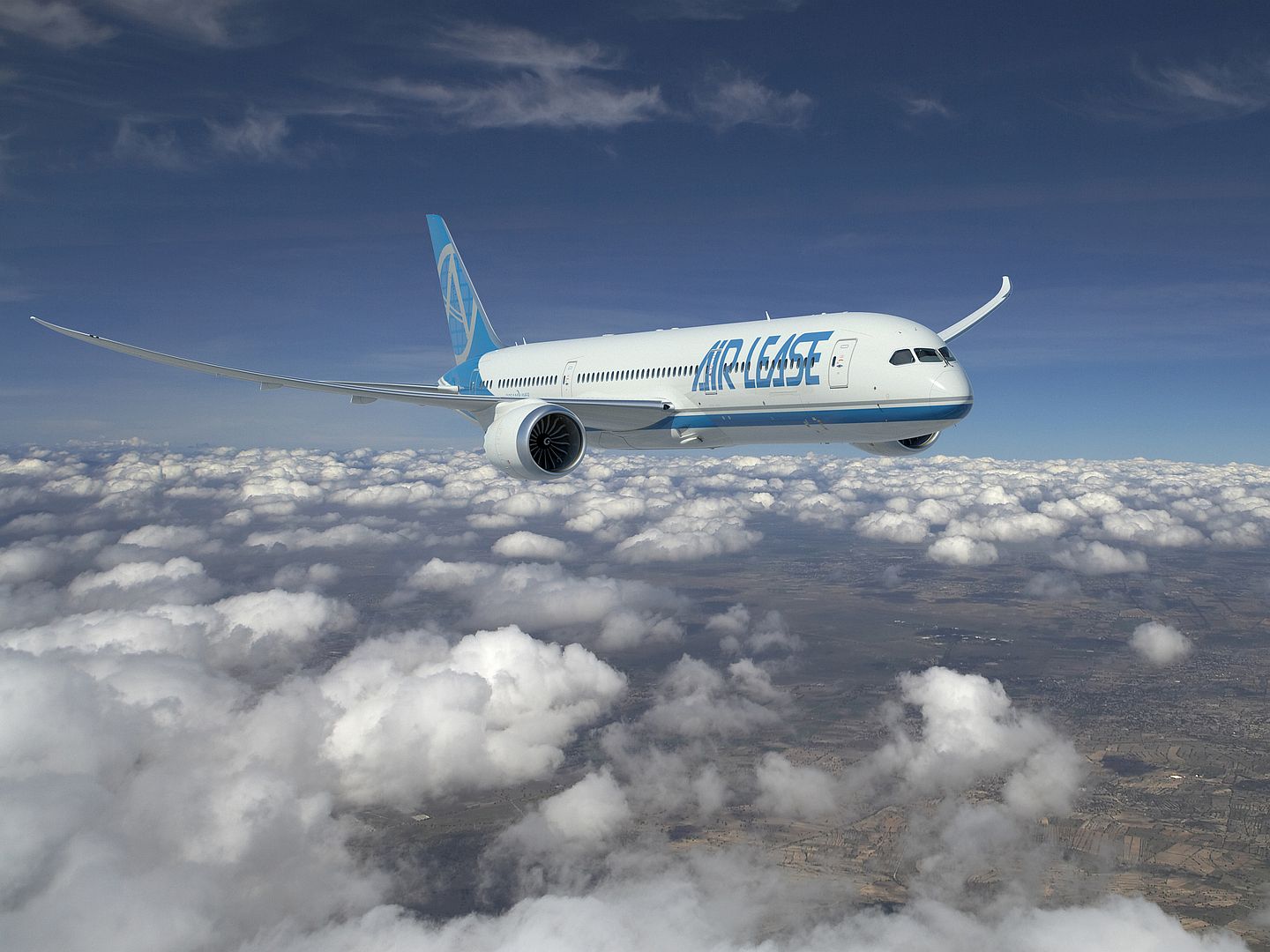
International Airlines Group (IAG) has selected the A321XLR to expand its fleet of highly efficient single aisles with a firm order for 14 aircraft. Of these, eight are destined for Iberia and six for Aer Lingus.
IAG, the parent company of leading airlines also including British Airways, Level and Vueling, is one of Airbus?s largest customers and this agreement will take the overall order from the group to 530 aircraft. IAG airlines combined operate one of the world?s largest Airbus fleets with over 400 aircraft.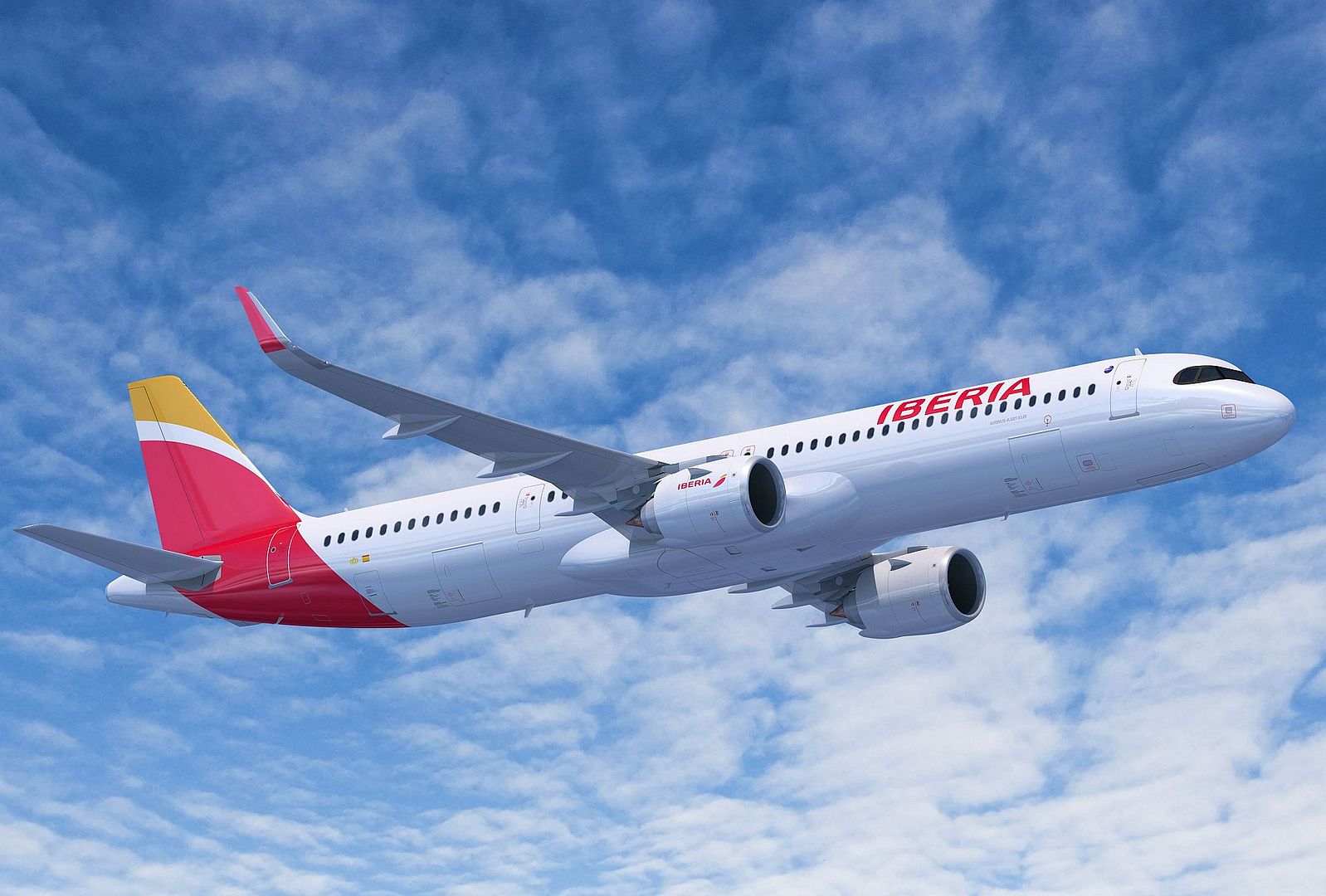
The aircraft will enable Aer Lingus to launch new routes beyond the US East Coast and Canada. For Iberia, this is a new aircraft type that will enable it to operate new transatlantic destinations and increase frequencies in key markets.
The A321XLR is the next evolutionary step from the A321LR which responds to market needs for even more range and payload, creating more value for the airlines. From 2023, it will deliver an unprecedented Xtra Long Range of up to 4,700nm ? 15% more than the A321LR and with 30% lower fuel burn per seat compared with previous generation competitor aircraft. This will enable operators to open new world-wide routes such as India to Europe or China to Australia, as well as further extending the Family?s non-stop reach on direct transatlantic flights between continental Europe and the Americas. For passengers, the A321XLR?s new Airspace cabin will provide the best travel experience, while offering seats in all classes with the same high-comfort as on a long-haul wide-body, with the low costs of a single-aisle aircraft.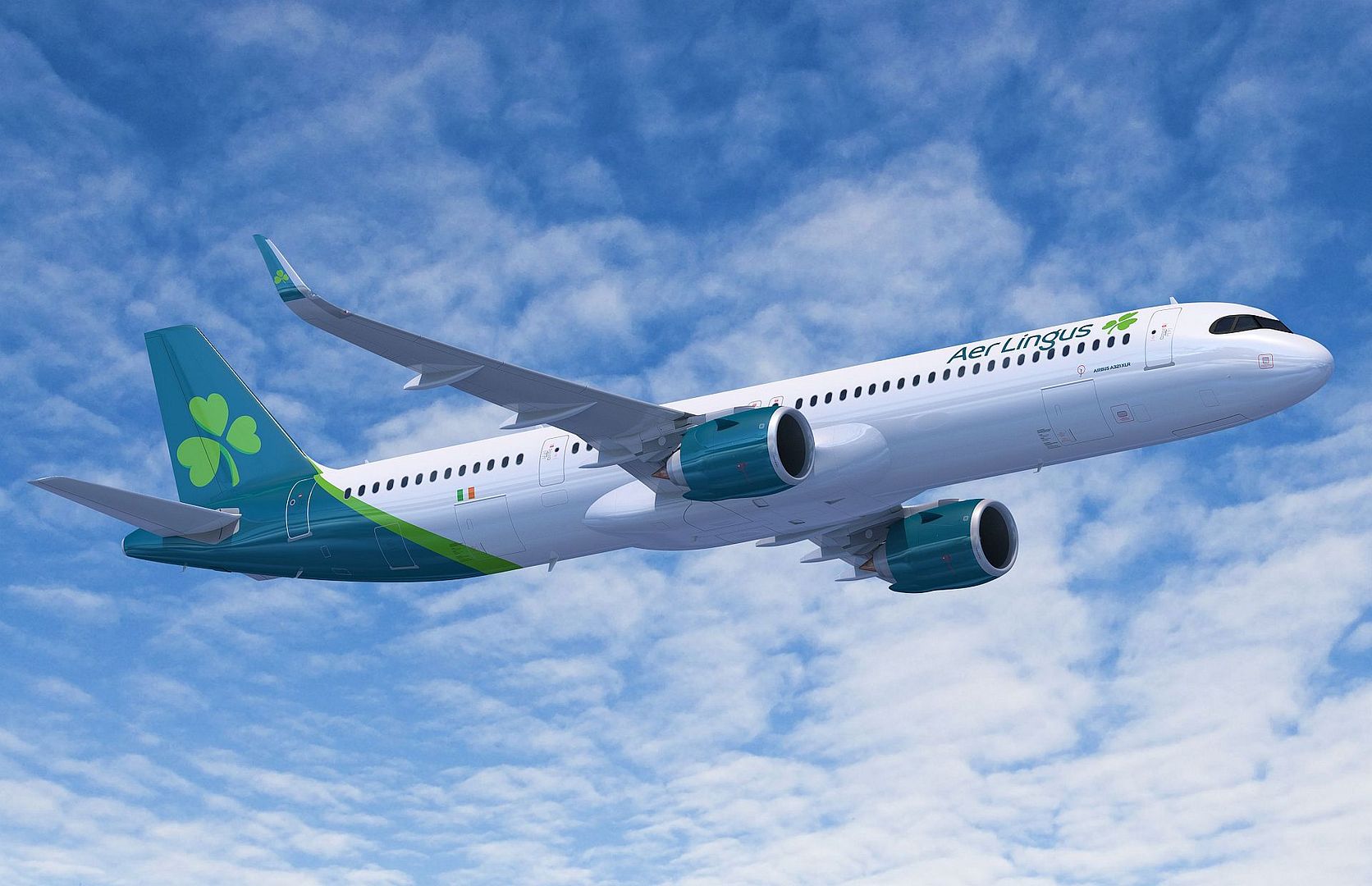
Paris, France, June 18, 2019 ? Embraer announced today, at the 53rd International Paris Air Show, that it has signed a contract with Binter, of Spain, for two additional E195-E2s, confirming purchase rights from the original contract, signed in 2018. The two new E195-E2s will be included in Embraer?s 2019 second-quarter backlog and have a value of USD 141.8 million, based on Embraer?s current list prices. The airline is celebrating 30 years of operations in 2019.
?We are extremely proud that Binter is reinforcing its commitment to the E2 program and has confirmed these new acquisitions even before the first E195-E2 delivery to the airline. We wish continued success to Binter as it modernizes its fleet and continues to expand into new international markets in Europe and Africa?, said Martyn Holmes, Vice President, Europe, Russia & Central Asia, Embraer Commercial Aviation.
Binter will receive its first E195-E2 jet in the second half of 2019, becoming the first European customer of the E-Jets E2?s largest model. The airline is configuring the aircraft with 132 seats in a very comfortable single-class layout.
?We are pleased to confirm the firm order for these two additional Embraer E195-E2s,? said Binter?s Vice President, Rodolfo N??ez ?We know that the E195-E2 is the ideal aircraft model for our operations, and, with typical Embraer efficiency, Type Certification was exactly on schedule. This along with fuel burn and other performance indicators being even better than originally expected, we have total confidence in placing this new firm order.?
Embraer is the world?s leading manufacturer of commercial aircraft up to 150 seats with more than 100 customers from all over the world. For the E-Jets program alone, Embraer has logged more than 1,800 orders and 1,500 aircraft have been delivered. Today, E-Jets are flying in the fleet of 75 customers in 50 countries. The versatile 70 to 150-seat family is flying with low-cost airlines as well as with regional and mainline carriers.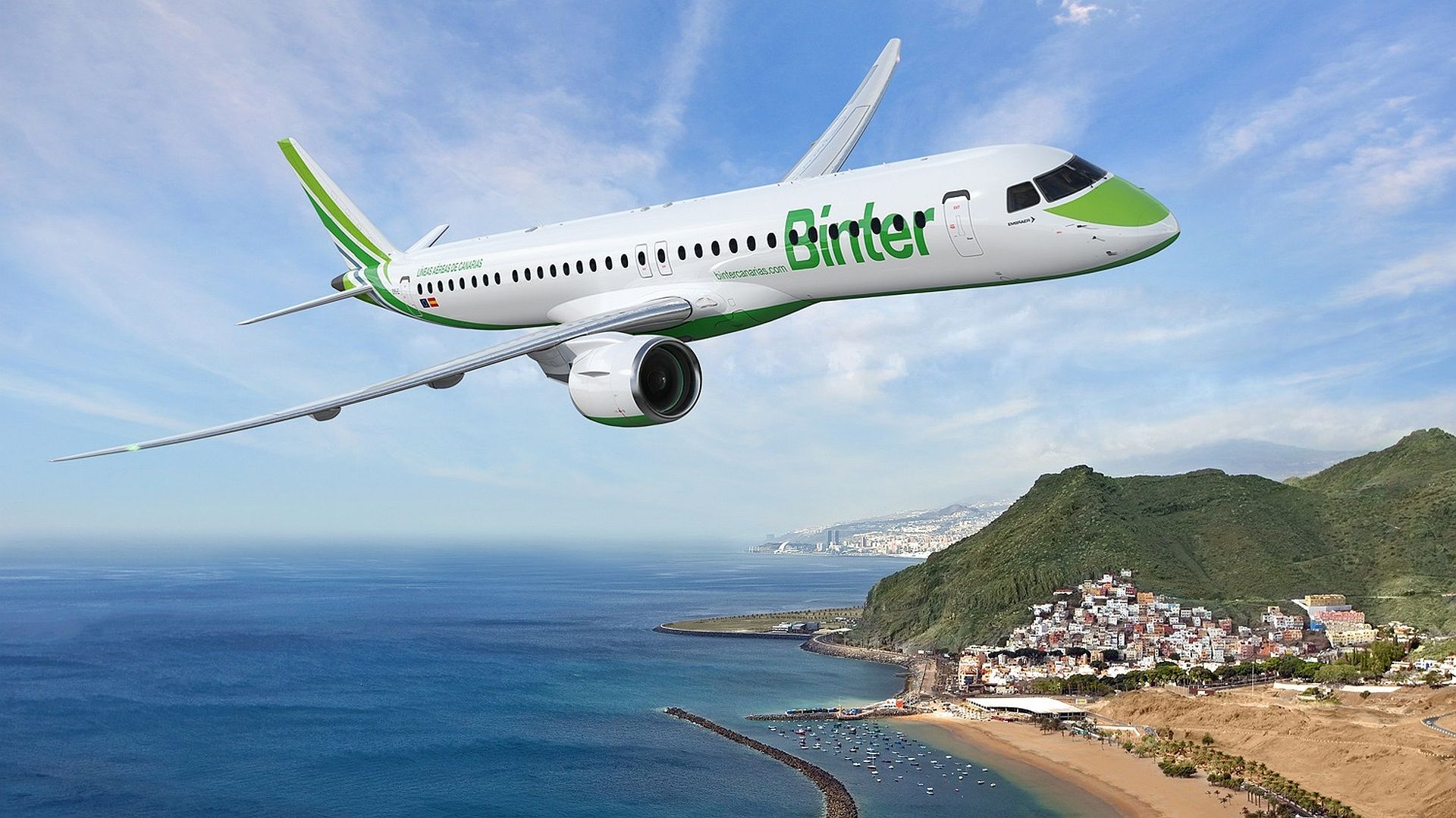
Paris, France, June 18, 2019 ? Embraer announced today, at the 53rd International Paris Air Show, that it has signed a contract with Japan?s Fuji Dream Airlines (FDA) for a firm order of two E175 jets. The order has a value of USD 97.2 million, based on 2019 list prices, and was already included in Embraer?s 2019 first-quarter backlog as ?undisclosed.?
?We are extremely pleased to continuously grow our fleet and our relationship with Embraer,? said Yohei Suzuki, Chairman and CEO of Fuji Dream Airlines. ?FDA currently operates 14 aircraft - three E170s and eleven E175s. These new aircraft will give us the ability to grow our capacity, allowing us to add more routes and frequencies, while also offering our passengers the best cabin in its category.?
FDA?s new E175s will be configured in a single-class layout with 84 seats, with deliveries starting in 2019. Embraer delivered the first E-Jet, an E170, to Fuji Dream Airlines in 2009.
?After nearly 10 years of operations, Fuji Dream Airlines has established itself as an exemplary model for sustainable growth with the support of the E175?s unrivaled attributes underpinning the success of their continued network expansion with new point-to-point services,? said Cesar Pereira, Asia Pacific Vice President, Embraer Commercial Aviation. ?As a testament to Embraer?s merits, there will be a total of 48 E-Jets flying in Japan by the end of 2019. Of which, FDA's all-Embraer fleet of 14 aircraft represents the largest of its kind in Asia and has a world leading 99.83% dispatch reliability - yet another example of how Embraer's products and customer support have been setting new standards in the industry.?
The E175 is the best seller of the E-Jets family with more than 770 orders from airlines and lessors around the world. Since January 2013, Embraer has sold more than 565 E175s to airlines in North America alone, earning more than 80% of all orders in the 70-76-seat jet segment.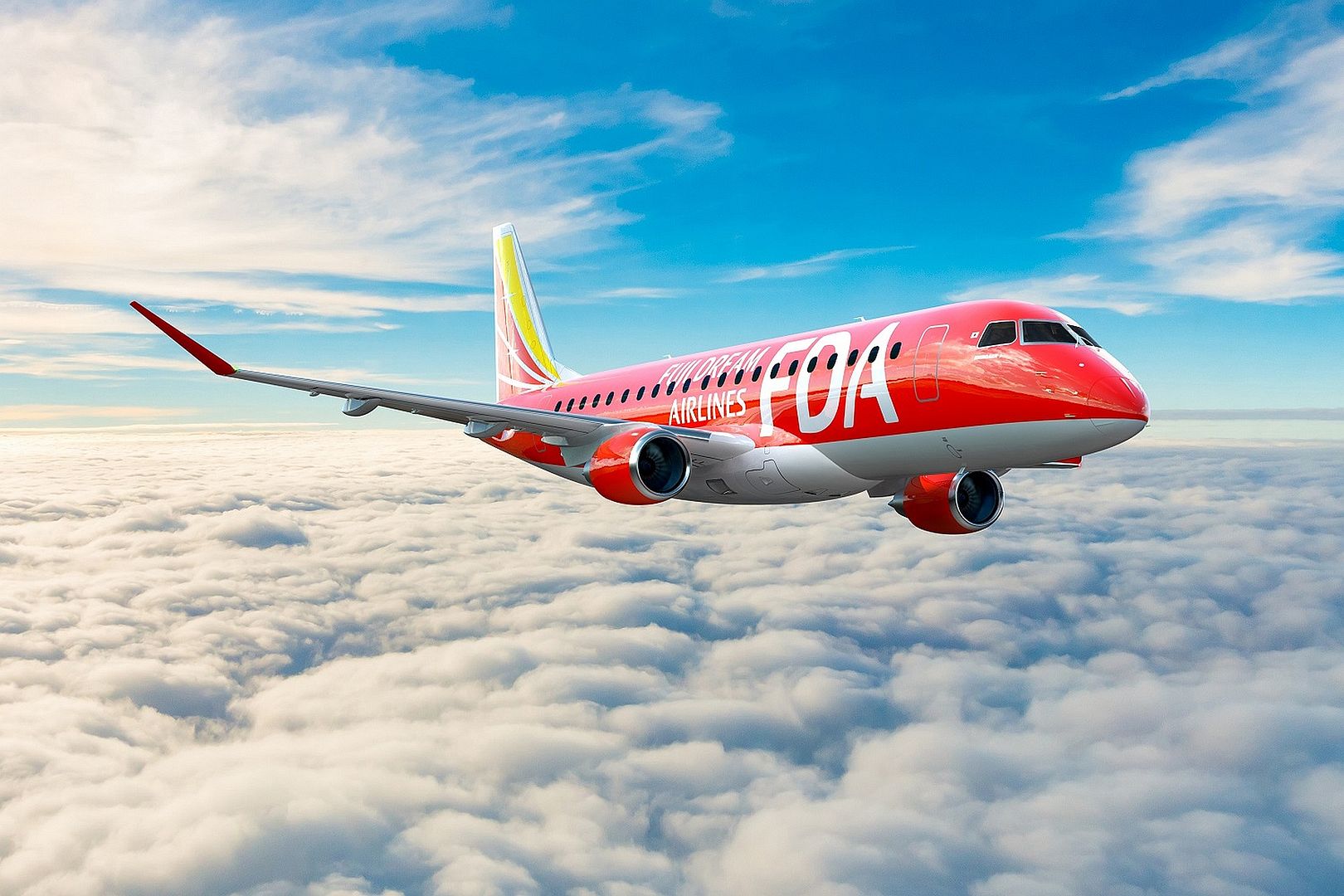
-
MISAWA AIR BASE, Japan (AFNS) --
One of Misawa Air Base?s most famous flightline assets hit a historic milestone June 10. A 29-year-old Block-50 F-16 Fighting Falcon, tail number 808 and affectionately known as ?BOB,? reached 10,000 flight hours during a sortie flown across Japan.
BOB is the first Block-50 F-16 in the entire Air Force inventory to hit 10,000 hours after Col. Kristopher W. Struve, the 35th Fighter Wing commander, piloted the aircraft through the history-making flight.
?10,000 flight hours is a testament to American engineering, but more importantly, the blood, sweat and tears of the thousands of maintainers who have turned a wrench on this aircraft since 1990,? Struve said following the flight. ?This jet has been in service for 29 years and an 18-year-old maintainer launched me today. I am proud of our maintenance team and how they continue to make the mission happen. They work around the clock to ensure our base is ready and able to ensure a free and open Indo-Pacific at any time, whenever called upon.?
Senior Airman Gage Putman, a 14th Aircraft Maintenance Unit dedicated crew chief, may have taken over primary maintenance of the jet on May 4, 2018, but gives credit to the whole AMU and countless others throughout its lifetime for the aircraft's longevity.
?Everybody has pitched in with their effort to get BOB to where it?s at now,? Putman said. ?BOB having so many flight hours is just a reflection of everybody?s work ethic here.?
Aircraft 808 etched its name in history flying in support of Operation Southern Watch in 1999 and during exercises like Pitch Black, Vigilant Ace, Red Flag and, most recently, in support of exercise Cope Tiger. The longevity of this aircraft is thanks to its maintenance team, consisting of one crew chief and several other maintenance professionals, rotating in and out to provide service to the F-16s 24 hours a day, seven days a week.
In order to maintain this high-level operations tempo, every 400 flight hours the jets are put into what?s known as ?phase maintenance.? This is no quick process; it takes more than 800 maintenance actions, consuming upwards of 1,500 man-hours to complete. Maintenance crews disassemble the jet, thoroughly inspect all of the systems and components and then rebuild it. Throughout the entire process, some maintainers feel the jets take on their own temperaments, said Capt. Kayla Pipe, the 14th AMU officer in charge.
?I would say BOB has the most personality on the flightline,? Pipe explained. ?BOB will throw a fit every TDY. He doesn?t like going, but when he?s in the air, he is the show horse and a real champ.?
It is for this reason she believes the aircraft engineers have extended the life of the aircraft, allowing an F-16, like BOB, to surpass milestone after milestone. And every time this aircraft flew past yet another engineering landmark, there, side-by-side, stood a dedicated crew chief.
Like so many before him, Senior Master Sgt. Daniel Grochowski, the 14th AMU superintendent, said every Airman who touched this aircraft played a huge part in ensuring the maximum safety and longevity of BOB and other F-16s like ?him.?
?I?m real proud of all of the maintainers,? Grochowski said. ?It?s not just Samurais and Panthers I?m proud of; I?m proud of the back shop, the people no longer stationed here and even the retirees who used to crew BOB.?
Grochowski said the number of people aside from the pilot and dedicated crew chief who don't receive recognition or high fives grows as every year passes. They may not have their names on the side of the jet, but that does not take away from the fact those individuals keep the jets going for thousands of hours beyond their original engineering.
Similarly, Putman added that taking on this job as a senior airman can get overwhelming, but most of the time it gives him a good feeling.
?Life out here can get pretty rough,? Putman said. ?But seeing a pilot go knock out a mission while the jet is doing crazy stuff in the air, hitting milestones like this and all with your name on it is pretty satisfying.?
Of all the crew chiefs who?ve worked on BOB and those who could?ve been selected as the aircraft?s dedicated crew chief, Putman added that it is a privilege because it is one of Misawa AB?s best F-16s and it?s his F-16.
?Hitting 10,000 hours honestly doesn?t surprise me as much as it probably should because it?s an awesome jet and it?s mine,? Putman expressed.
Given that the Air Force extended the F-16's service life to 12,000 hours in 2017, maintainers like Putman will continue to pour their blood, sweat and tears into BOB and every other aircraft on Misawa AB's flightline for many years to come and continue to accomplish the 35th Fighter Wing mission every day.
Col. Kristopher Struve, the 35th Fighter Wing commander, holds up the 14th Fighter Squadron call sign, ?wood,? before a takeoff at Misawa Air Base, Japan, June 10, 2019. This aircraft is the first Block-50 F-16 Fighting Falcon in the entire Air Force inventory to hit the 10,000-flight hour milestone. (U.S. Air Force photo by Airman 1st Class China Shock)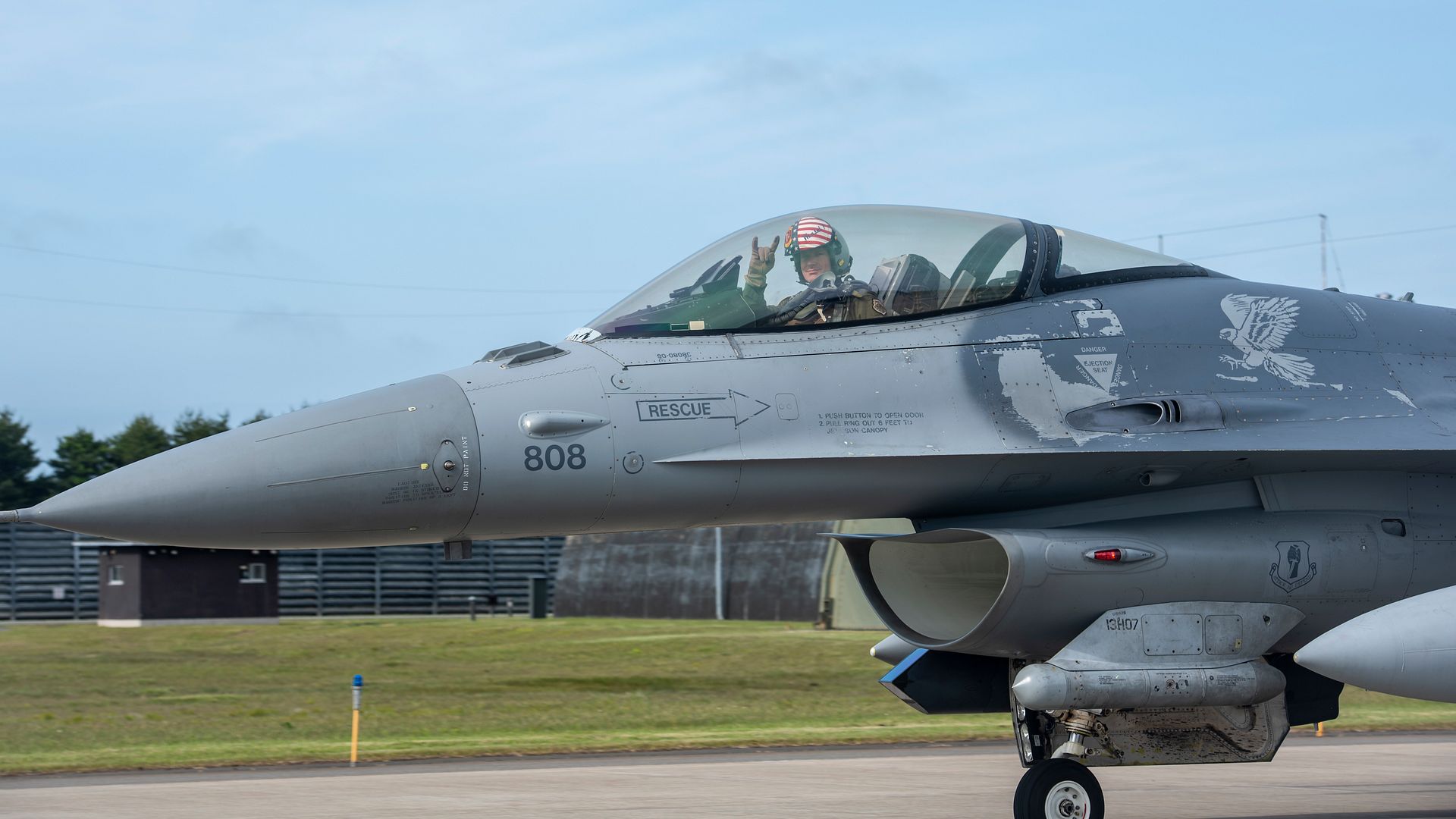
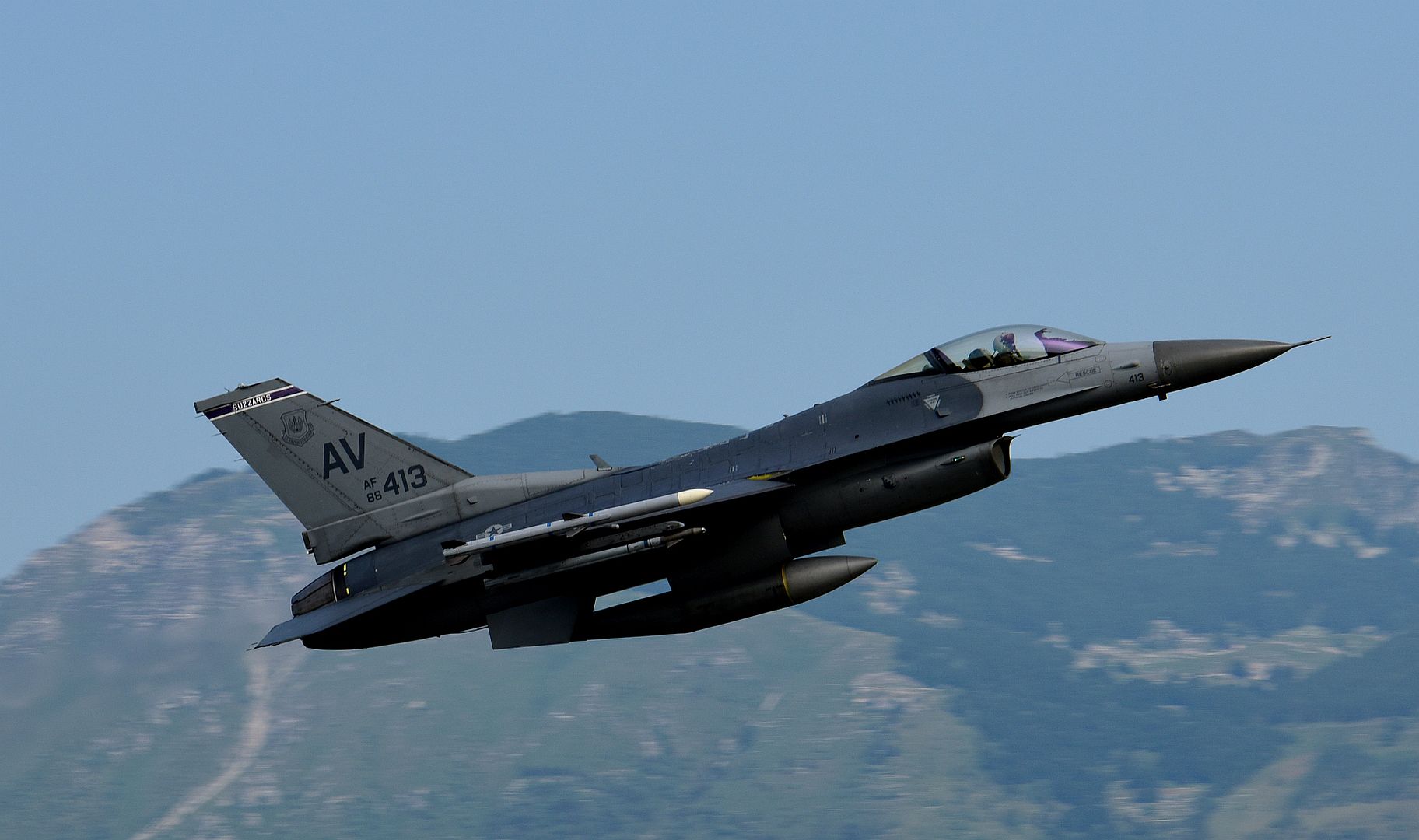
F-16 Fighting Falcons from the 31st Fighter Wing take off from Aviano Air Base, Italy, June 19, 2019. The 31st Fighter Wing boasts a diverse combat mission set including the 555th and 510th Fighter Squadrons, 56th and 57th Rescue Squadrons and the 606th Air Control Squadron. (U.S. Air Force photo's by Airman 1st Class Caleb House)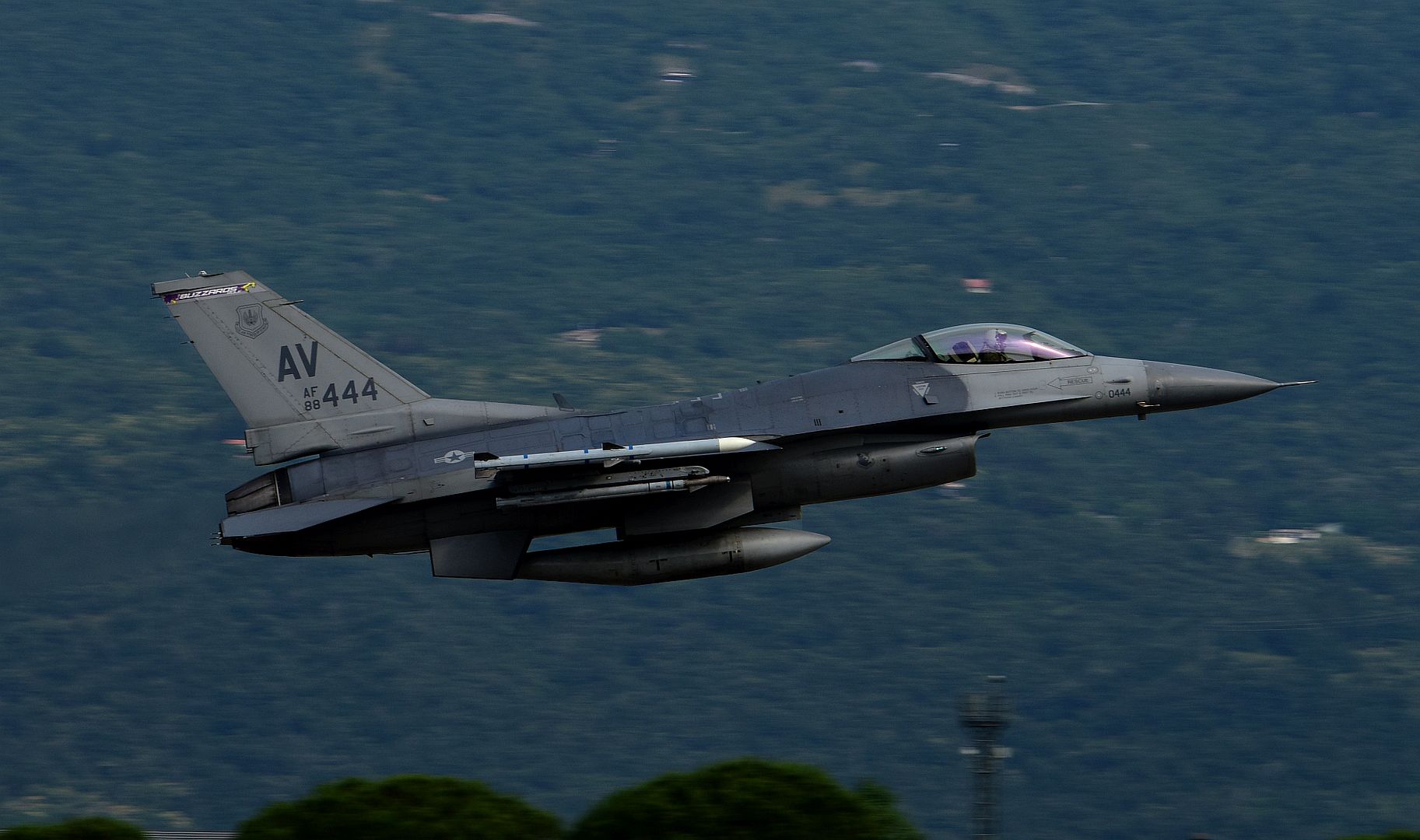
Two AH-64 Apache Helicopters, part of the Greek Army?s participation in Operation Strike Back 19, take part in the final live fire exercise of the operation at the Bulgarian Army?s Novo Selo Training Area June 19, 2019. STRIKE BACK 19 is a multinational exercise hosted by the Bulgarian Armed Forces at Novo Selo Training Area, Bulgaria, from June 6-20, 2019. STRIKE BACK 19 is designed to increase capabilities and interoperabilities with Bulgarian, Albanian, Greek, North Macedonian and U.S. Troops. (U.S. Army photo by Sgt. Robert Douglas)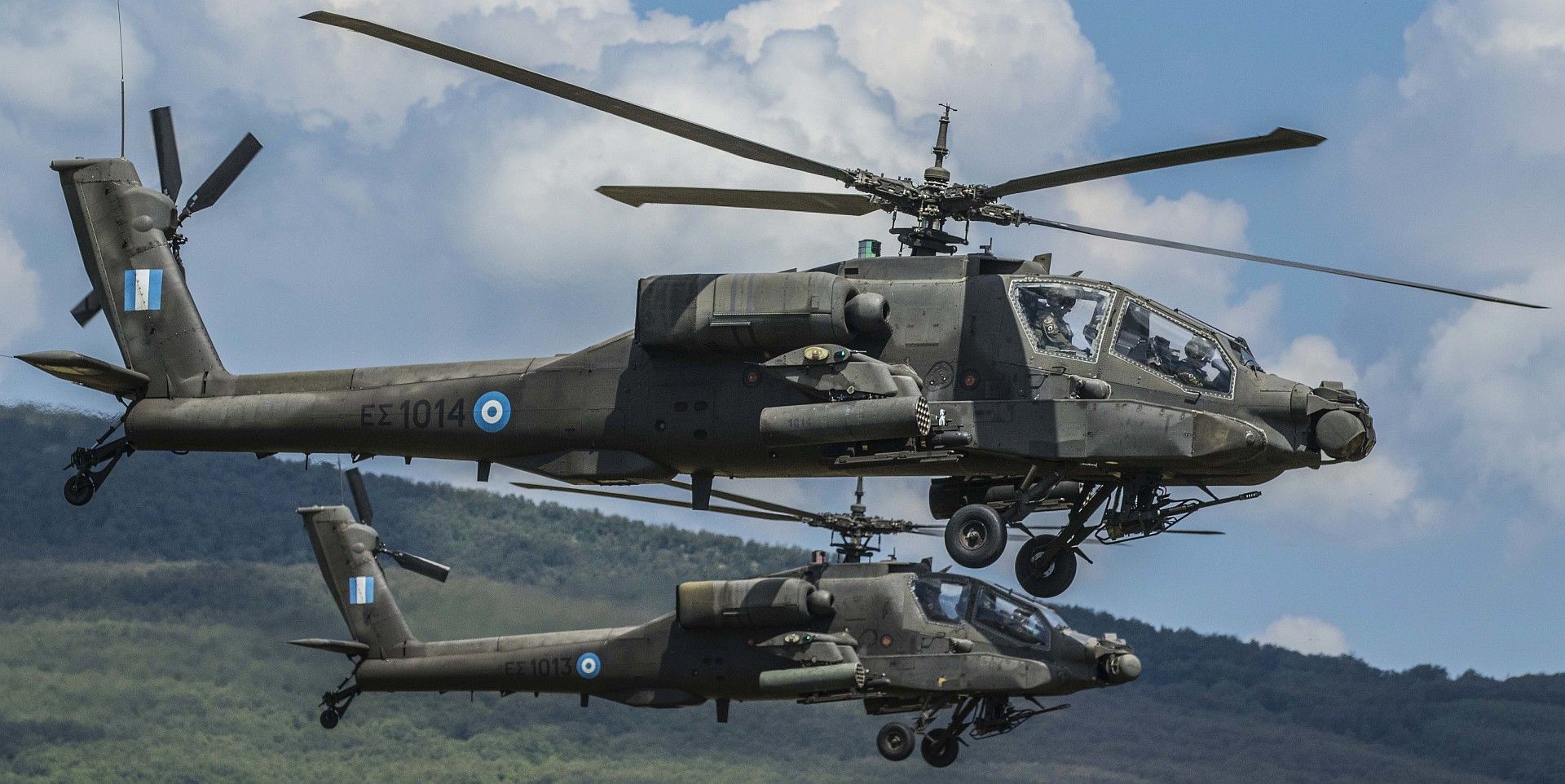
ARABIAN SEA (June 16, 2019) An F/A-18F Super Hornet from the Jolly Rogers of Strike Fighter Squadron (VFA) 103 makes an arrested landing on the flight deck of the Nimitz-class aircraft carrier USS Abraham Lincoln (CVN 72). The Abraham Lincoln Carrier Strike Group is deployed to the U.S. 5th Fleet area of operations in support of naval operations to ensure maritime stability and security in the Central Region, connecting the Mediterranean and the Pacific through the western Indian Ocean and three strategic choke points. With Abraham Lincoln as the flagship, deployed strike group assets include staffs, ships and aircraft of Carrier Strike Group (CSG) 12, Destroyer Squadron (DESRON) 2, the guided-missile cruiser USS Leyte Gulf (CG 55) and Carrier Air Wing (CVW) 7. (U.S. Navy photo by Mass Communication Specialist Seaman Apprentice Stephanie Contreras/Released)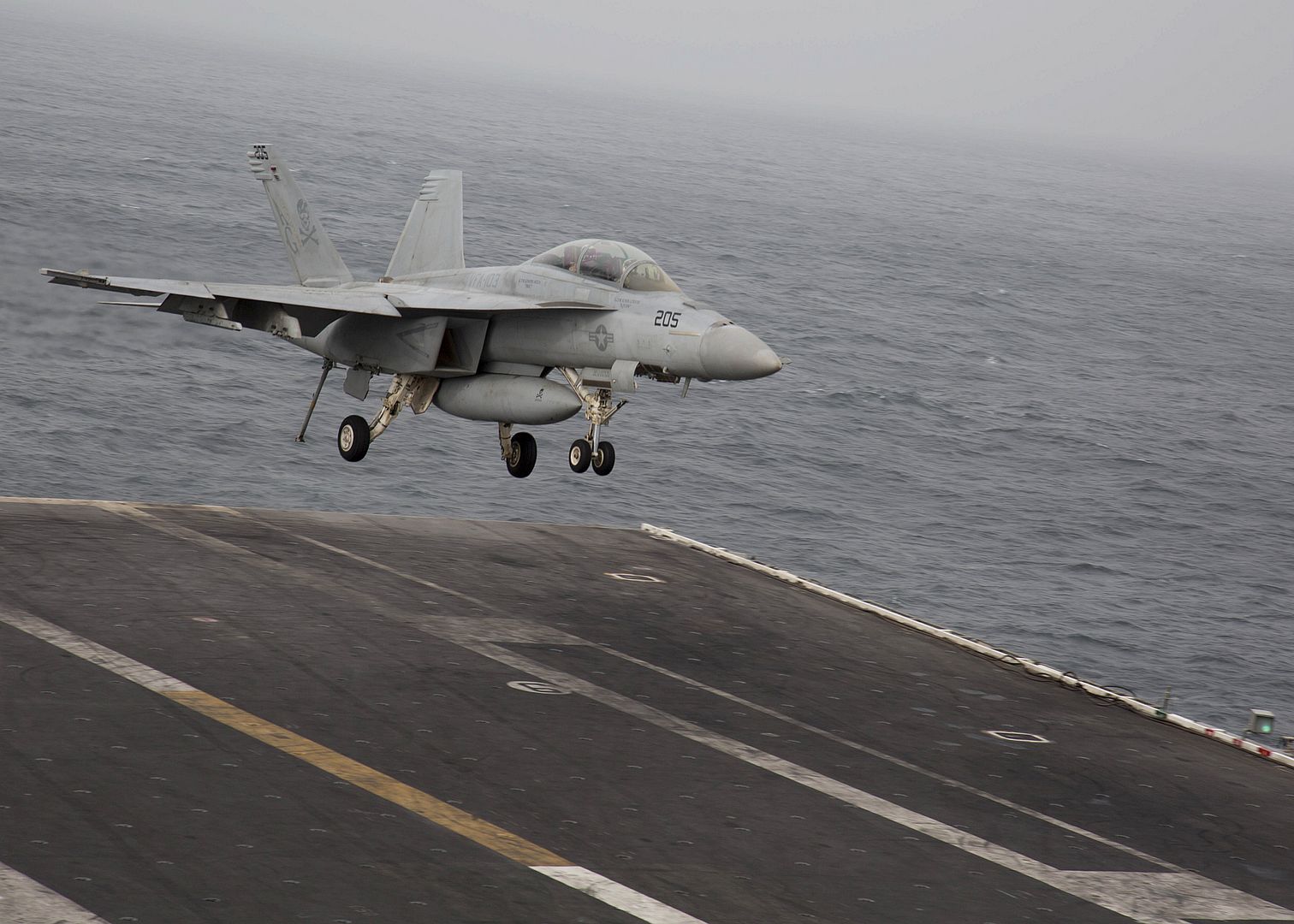
LE BOURGET, France, June 19, 2019 /PRNewswire/ -- Qatar Airways, one of the world's leading air cargo carriers, announced a commitment today to purchase five additional 777 Freighters from Boeing [NYSE: BA]. The deal, valued at $1.8 billion at list prices, was unveiled at the Paris Air Show and signed in the presence of His Excellency Jassim Saif Ahmed Al-Sulaiti, Qatari Minister of Transport and Communications.
When the purchase is finalized, it will be posted to Boeing's Orders and Deliveries website.
"I am very pleased that Qatar Airways has today signed this landmark order for five new Boeing 777 Freighters to add to our cargo fleet," said His Excellency, Mr. Akbar Al Baker, CEO, Qatar Airways Group. "It will increase our 777 freighter fleet by a full 20 percent, enabling us to further develop our business and offer new customers the chance to experience a truly first-class logistics service. This is an order that will propel our growth and, I firmly believe, confirm us as the leading cargo operator in the world."
Qatar Airways has rapidly grown its air cargo operations to serve more than 60 global destinations, becoming one of the top international air freight operators in the world. The latest freighter deal builds on the airline's 777 Freighter order book as the airplane has become the backbone of Qatar Airways freighter fleet. It currently operates 23 freighters, including 16 Boeing 777 Freighters.
"Qatar Airways continues to implement a bold vision to be the world's leading air cargo carrier and we are thrilled that they have again chosen to build that future with the Boeing 777 Freighter. It is a great testament to the airplane's unmatched capabilities," said Kevin McAllister, president and CEO of Boeing Commercial Airplanes. "We are proud of our long-standing partnership with Qatar Airways. We deeply appreciate their business and positive impact on Boeing, our employees, suppliers and communities."
The 777 Freighter is the world's largest and most capable twin-engine freighter. It can fly 4,970 nautical miles (9,200 kilometers) with a payload of 224,900 lbs (102,010 kg). The airplane's long range translates into significant savings as fewer stops mean lower landing fees, less congestion, lower cargo handling costs and shorter delivery times.
Customers from around the world have ordered 217 777 Freighters since the program began in 2005, including a record 45 units in 2018. Boeing is the air cargo market leader, providing over 90 percent of the dedicated freighter capacity around the world.
Qatar Airways also uses Boeing Global Services digital solutions, including Maintenance Performance Toolbox, and Airplane Health Management and flight deck solutions powered by Boeing AnalytX. These solutions provide Qatar Airways personnel with real-time access to maintenance, flight and aircraft performance information to optimize efficiency and lower fleet operating costs.
About Boeing:
Boeing is the world's largest aerospace company and leading provider of commercial airplanes, defense, space and security systems, and global services. The company supports commercial and government customers in more than 150 countries. Boeing employs more than 150,000 people worldwide and leverages the talents of a global supplier base. Building on a legacy of aerospace leadership, Boeing continues to lead in technology and innovation, deliver for its customers and invest in its people and future growth.
About Qatar Airways:
Qatar Airways, the national carrier of the State of Qatar, is celebrating more than 20 years of Going Places Together with travellers across its more than 160 business and leisure destinations on board a modern fleet of more than 250 aircraft. The world's fastest-growing airline will add a number of exciting new destinations to its growing network this year, including Lisbon, Portugal; Langkawi, Malaysia; Davao, Philippines; and Mogadishu, Somalia.
A multiple award-winning airline, Qatar Airways was named 'World's Best Business Class' by the 2018 World Airline Awards, managed by international air transport rating organisation Skytrax. It was also named 'Best Airline in the Middle East', 'World's Best First Class Airline Lounge' and 'Best Business Class Seat', in recognition of its ground-breaking Business Class experience, Qsuite. Qatar Airways has been awarded the coveted "Skytrax Airline of the Year" title, which is recognized as the pinnacle of excellence in the airline industry, four times.
Qatar Airways Cargo, one of the world's leading international air cargo carriers, serves more than 60 freighter destinations worldwide via its world-class Doha hub and also delivers freight to more than 160 key business and leisure destinations globally on more than 250 aircraft. The Qatar Airways Cargo fleet includes two Boeing 747-8 freighters, 16 Boeing 777 freighters and five Airbus A330 freighters.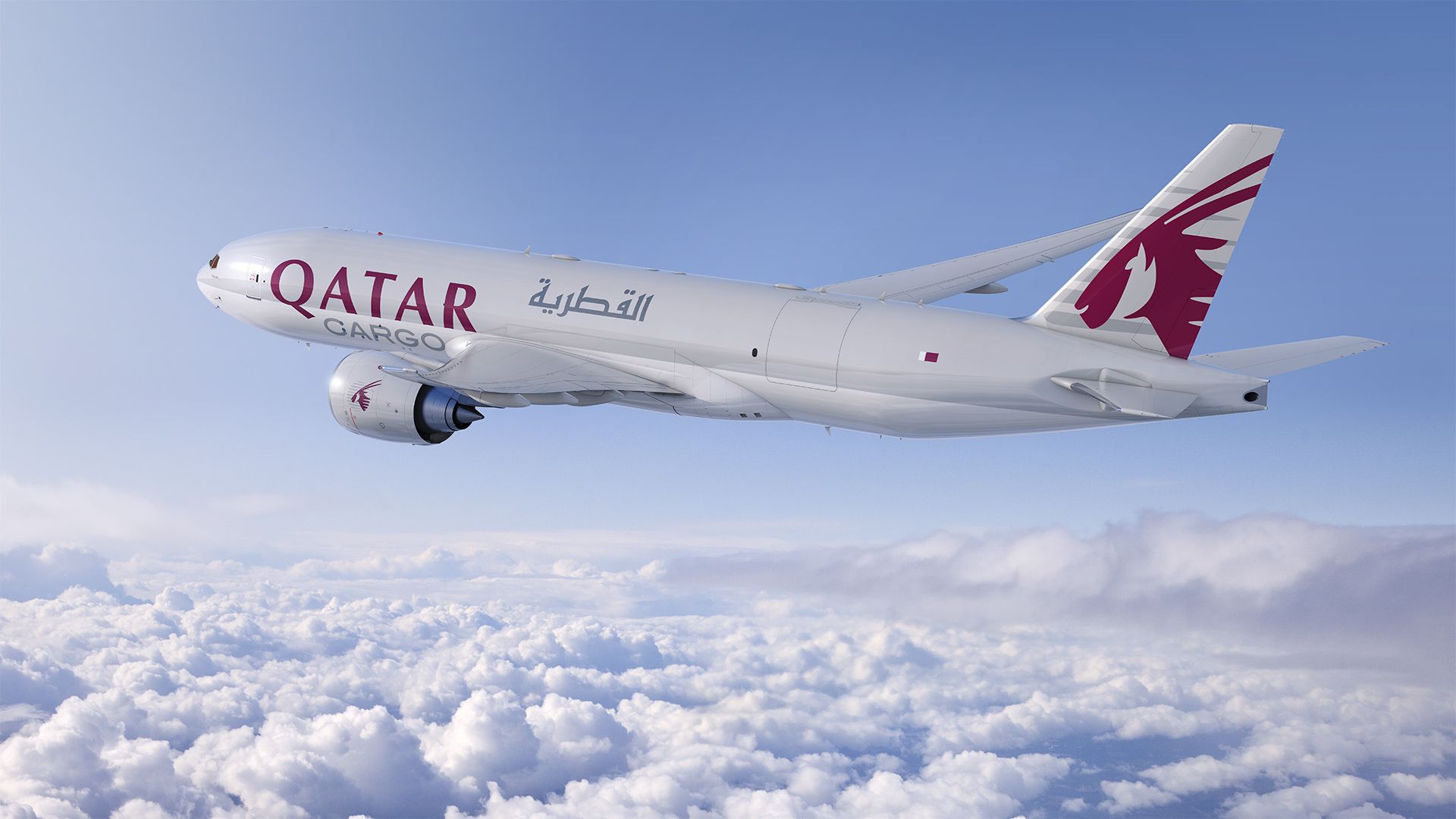
LE BOURGET, France, June 19, 2019 /PRNewswire/ -- Boeing [NYSE: BA] and China Airlines today announced the airline's intent to order up to six 777 Freighters to modernize its cargo fleet. China Airlines plans to transition to the world's largest and longest range twin-engine freighter as it launches operations from Taipei to North America and Europe ? two key markets that provide higher yields for the carrier.
The order will be reflected on Boeing's Orders and Deliveries website once it is finalized.
"Air cargo is an important part of our overall business and the introduction of these new Boeing 777 Freighters will play an integral role in our long-term growth strategy," said China Airlines Chairman Hsieh Su-Chien. "As we transition our Freighter fleet to the 777Fs from the older 747Fs, this will enable us to deliver world-class services to our customers more efficiently and reliably."
The 777 Freighter is capable of flying 4,970 nautical miles (9,200 km) with a maximum payload of 102,010 kg (224,900 lbs). The airplane will allow China Airlines to make fewer stops and reduce associated landing fees on these long-haul routes, resulting in the lowest trip cost of any large freighter and superior ton-mile economics. In addition, the 777 Freighter features market-leading capacity for a twin-engine freighter, accommodating 27 standard pallets, measuring 96 inches by 125 inches (2.5 m x 3 m) on the main deck. This allows for lower cargo handling costs and shorter cargo delivery times.
"The global air freight market is forecasted to double over the next 20 years, and the 777 Freighter's market-leading capabilities and economics will help China Airlines extend their network and grow their cargo business," said Ihssane Mounir, senior vice president of Commercial Sales and Marketing of The Boeing Company. "We are proud to expand our partnership with China Airlines, building on our successful introduction of the 777-300ER passenger jet a few years ago. We look forward to delivering new 777 Freighters into their world-class fleet."
China Airlines operates 51 Boeing airplanes. The addition of 777 Freighters will enable the carrier to streamline maintenance and parts for its 777 fleet. The carrier uses a number of Boeing Global Services solutions to support their operations, including Boeing's Airplane Health Maintenance and Maintenance Performance Toolbox on all of their 777, 747-400 and Next-Generation 737 aircraft. These data-driven platforms track real-time airplane information, providing maintenance data and decision support tools that allow technicians to quickly and correctly resolve issues. On the ground and in the air, China Airlines' entire fleet uses Jeppesen's FliteDeck Pro and access to digital navigation charts to optimize performance and enhance situational awareness.
Boeing is the world's largest aerospace company and leading provider of commercial airplanes, defense, space and security systems, and global services. The company supports commercial and government customers in more than 150 countries. Boeing employs more than 150,000 people worldwide and leverages the talents of a global supplier base. Building on a legacy of aerospace leadership, Boeing continues to lead in technology and innovation, deliver for its customers and invest in its people and future growth.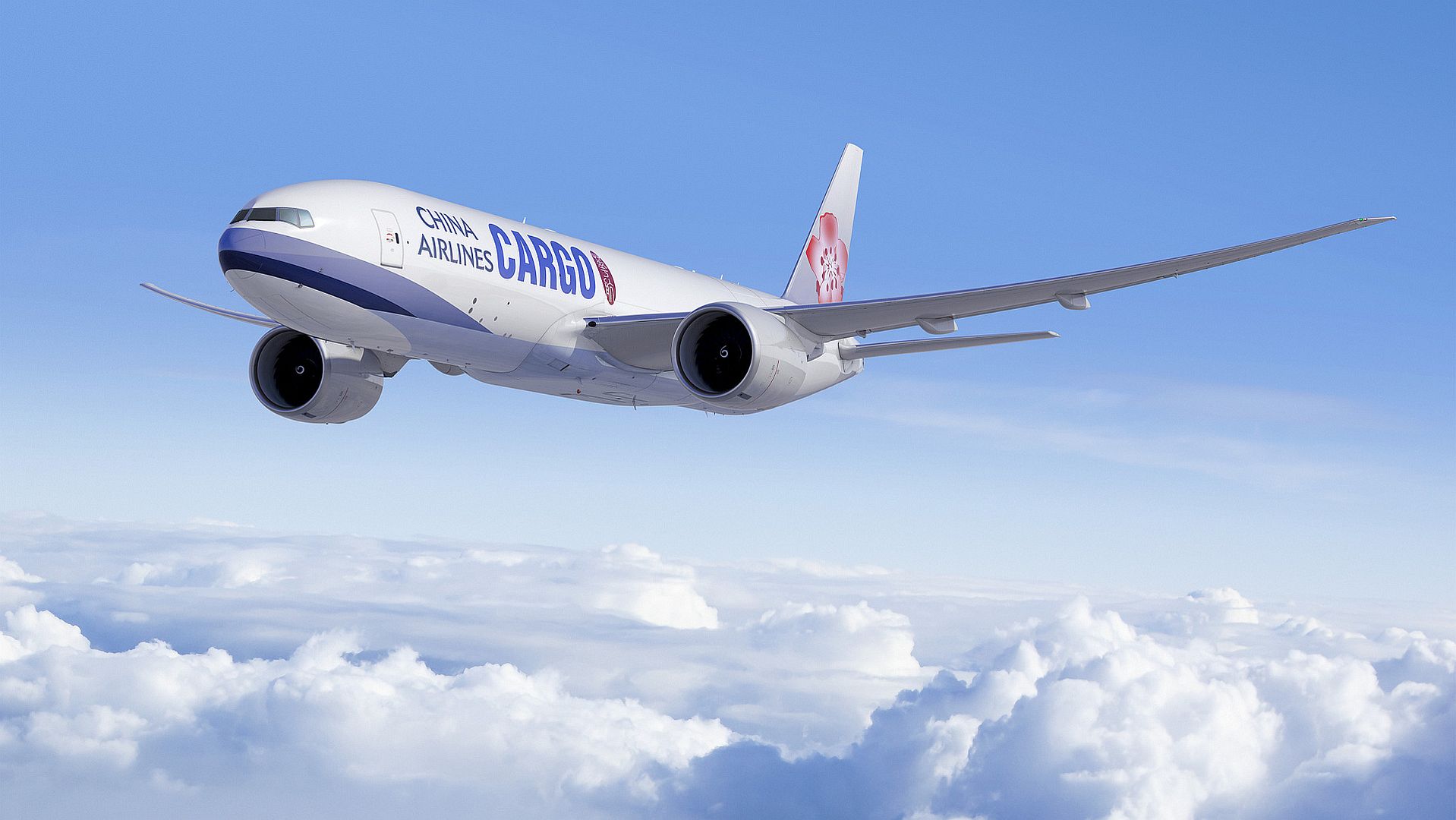
Le Bourget ? American Airlines, the world?s largest airline, will acquire 50 Airbus A321XLR aircraft, the new longer-range version of Airbus? hugely successful A321neo. The purchase agreement includes the conversion of 30 of American?s existing A321neo slots to A321XLRs and incremental orders for an additional 20 A321XLRs.
The A321XLR will have the longest range of any single-aisle commercial jetliner. The added range of up to 4,700 nm will allow airlines to operate the aircraft from U.S. East Coast airports to medium-size European cities.
As a further enhancement of the A321neo and A321LR, the A321XLR will have a maximum takeoff weight of 101 metric tonnes without sacrificing performance. The A321XLR is powered by the same engines, and has more than 90 percent commonality with the A321neo.
American, based in Fort Worth, Texas, is the largest Airbus operator in the world with 422 Airbus aircraft. Including today?s announcement, American has outstanding orders for 115 A321neos and A321XLRs from Airbus.
The A321XLR is the next evolutionary step from the A321LR which responds to market needs for even more range and payload, creating more value for the airlines. From 2023, it will deliver an unprecedented Xtra Long Range of up to 4,700nm ? 15% more than the A321LR and with 30% lower fuel burn per seat compared with previous generation competitor aircraft. For passengers, the A321XLR?s new Airspace cabin will provide the best travel experience offering seats in all classes on a single-aisle aircraft.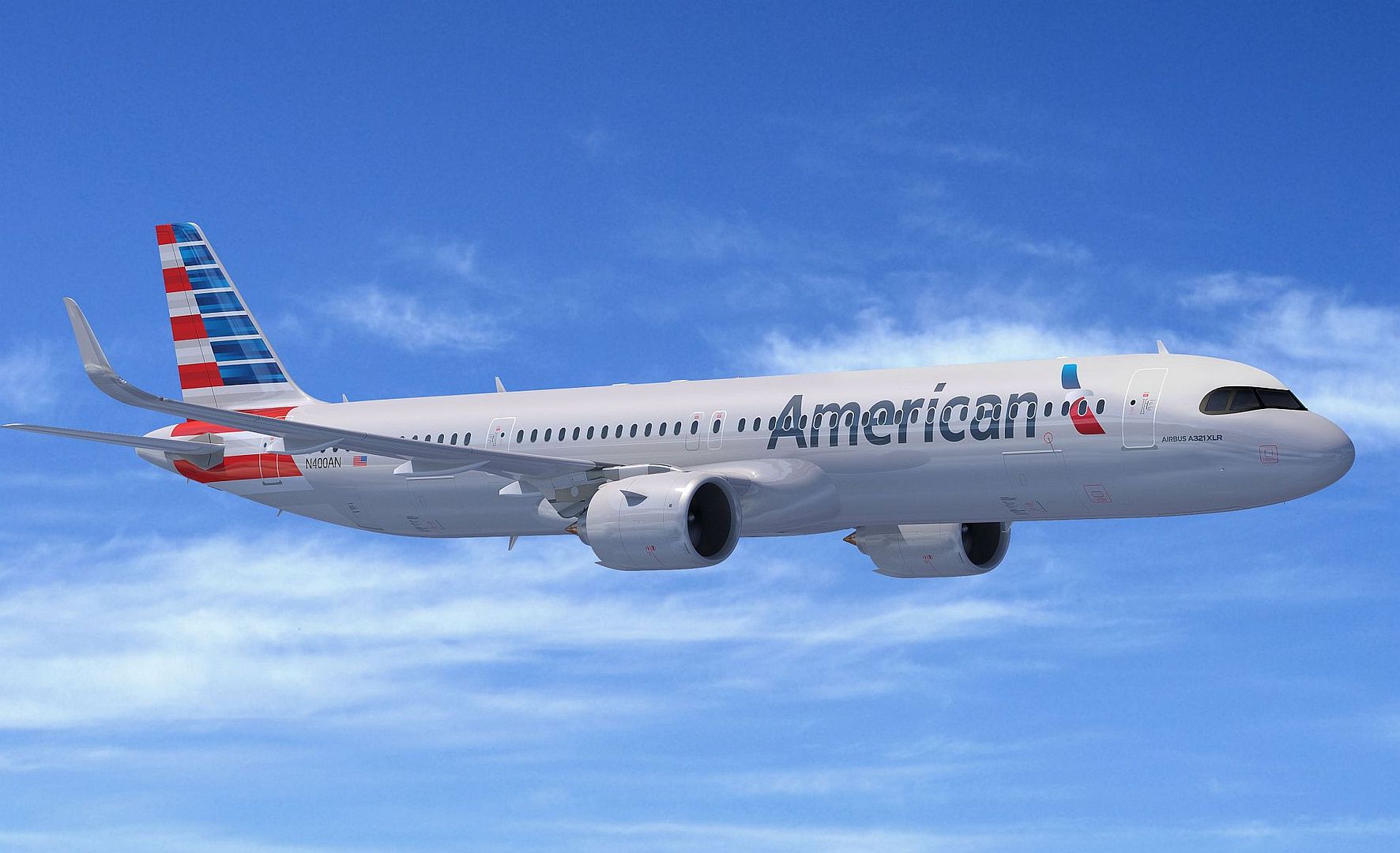
-
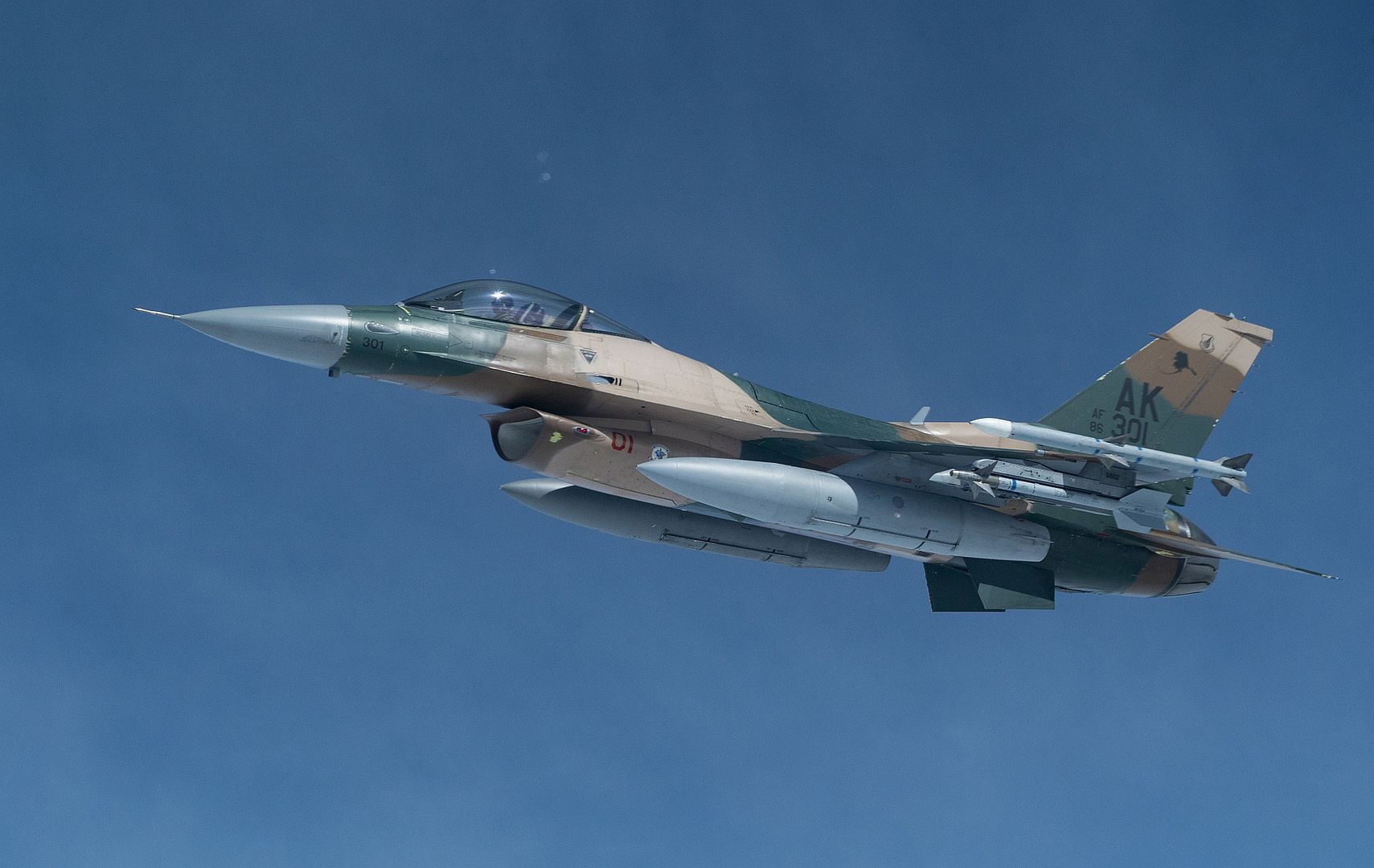
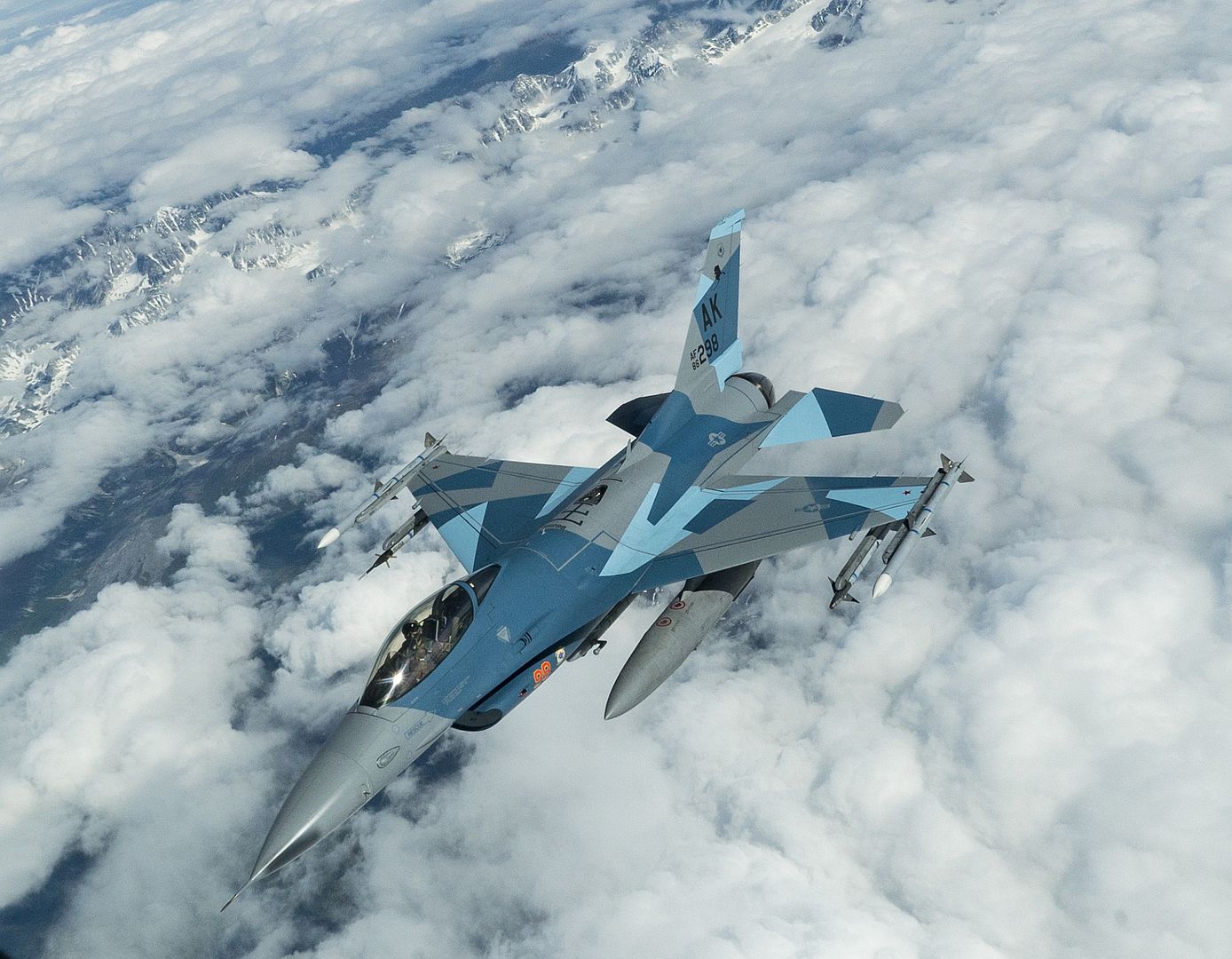
U.S. Air Force F-16 Fighting Falcons assigned to the 18th Aggressor Squadron, Eielson Air Force Base, Alaska, flie in the Joint Pacific Alaska Range Complex beside a KC-135 Stratotanker to refuel while conducting a mission for RED FLAG-Alaska 19-2, June 18, 2019. The 18th AGRS prepares combat Air Force, joint and allied aircrews through challenging, realistic threat replication, training, test support, academics and feedback. RF-A is a Pacific Air Forces-sponsored exercise which tests joint and international participants to execute multi-domain operations in a simulated combat environment. (U.S. Air Force photo's by Master Sgt. Burt Traynor)
A C-5 aircraft assigned to 436th Airlift Wing, Air Force Reserves, Dover AFB, Del. trails behind A KC-135 aircraft assigned to the 171st Air Refueling Wing, Pennsylvania Air National Guard June 19, 2019. (U.S. Air National Guard photo's by Staff Sgt. Bryan Hoover)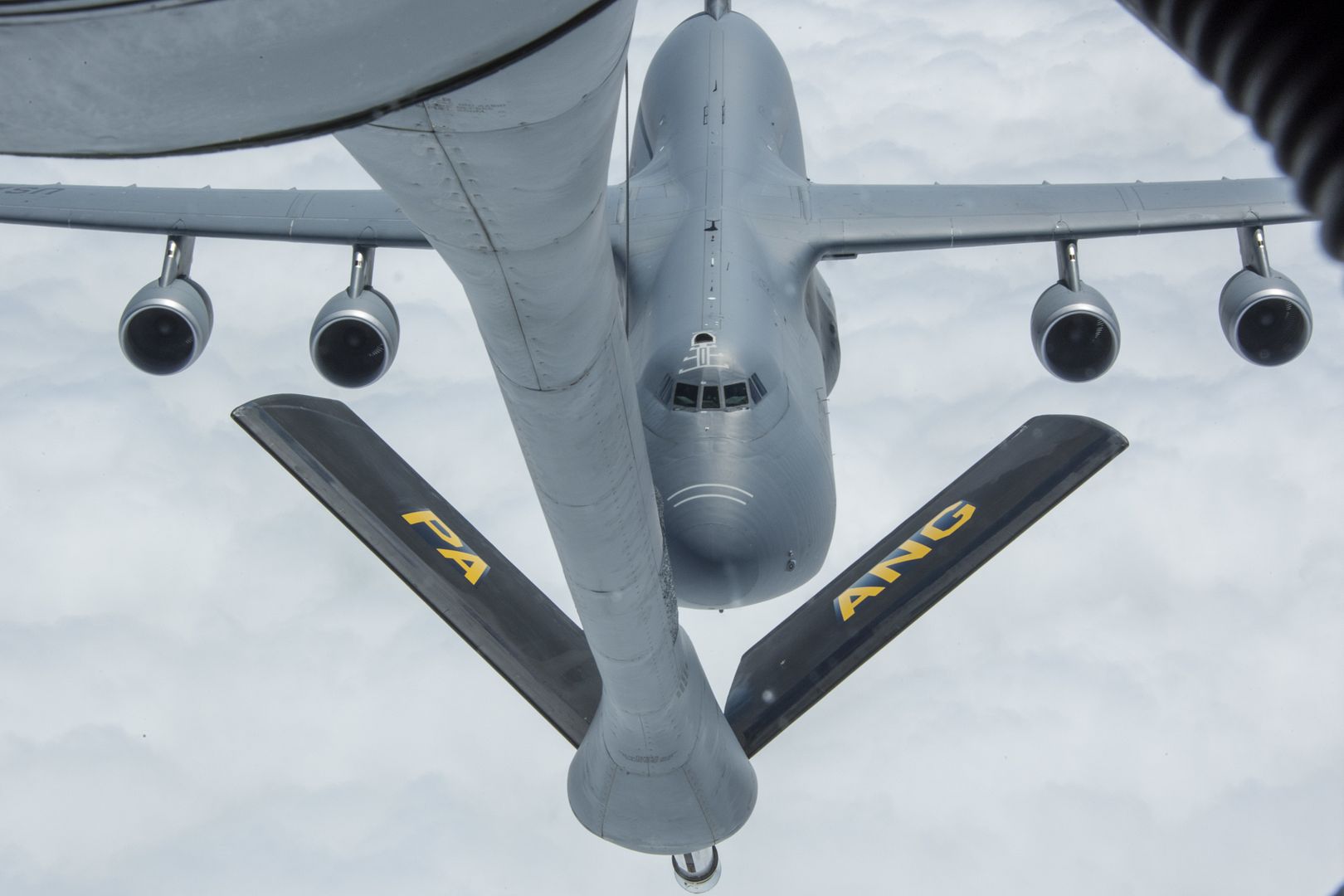
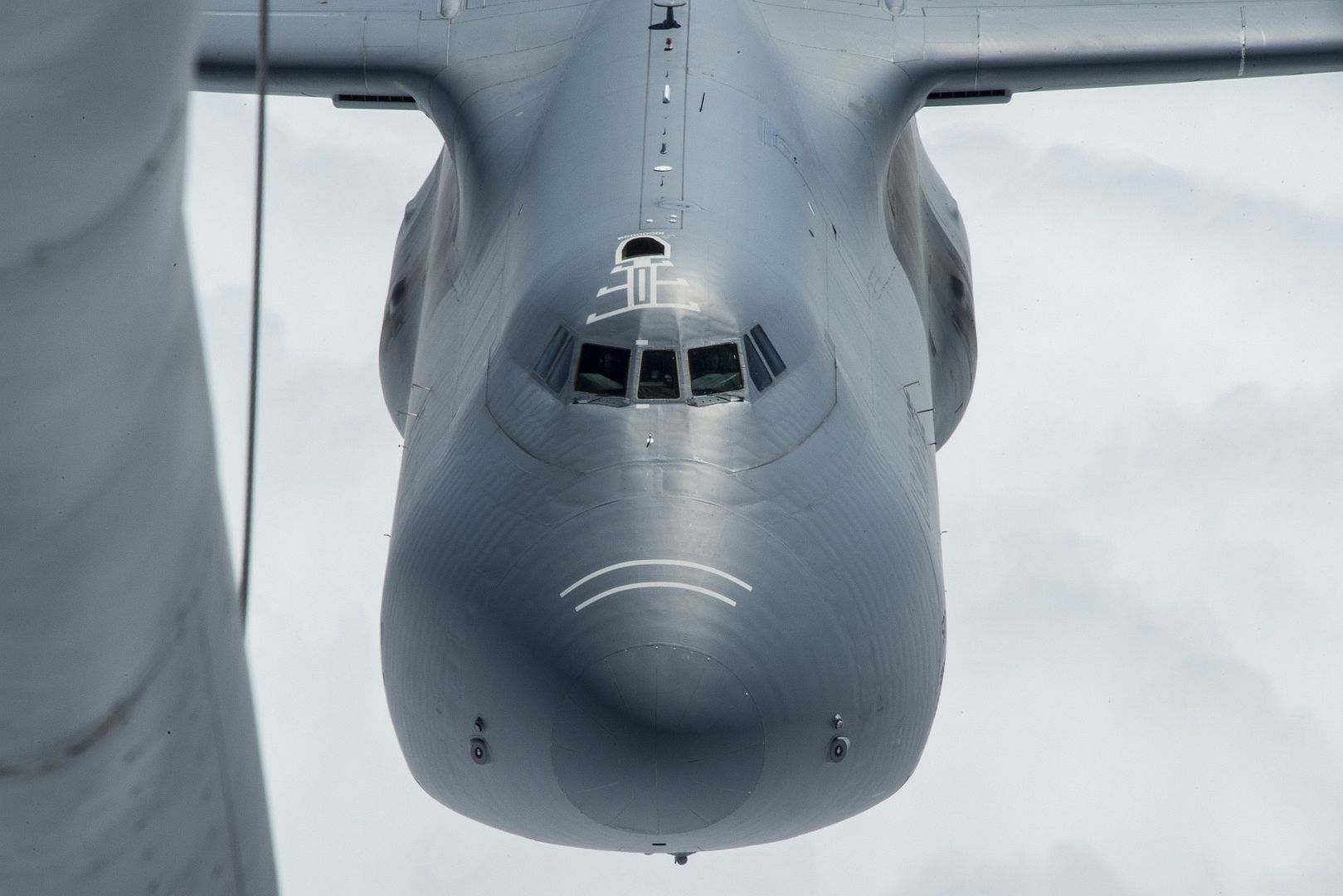
A U.S. Air Force KC-135 Stratotanker aircraft assigned to the 171st Air Refueling Wing, Pennsylvania Air National Guard provides aerial refueling for a C-5 Galaxy aircraft assigned to 436th Airlift Wing, Air Force Reserves, Dover AFB, Del., June 19, 2019. (U.S. Air National Guard photo by Staff Sgt. Bryan Hoover)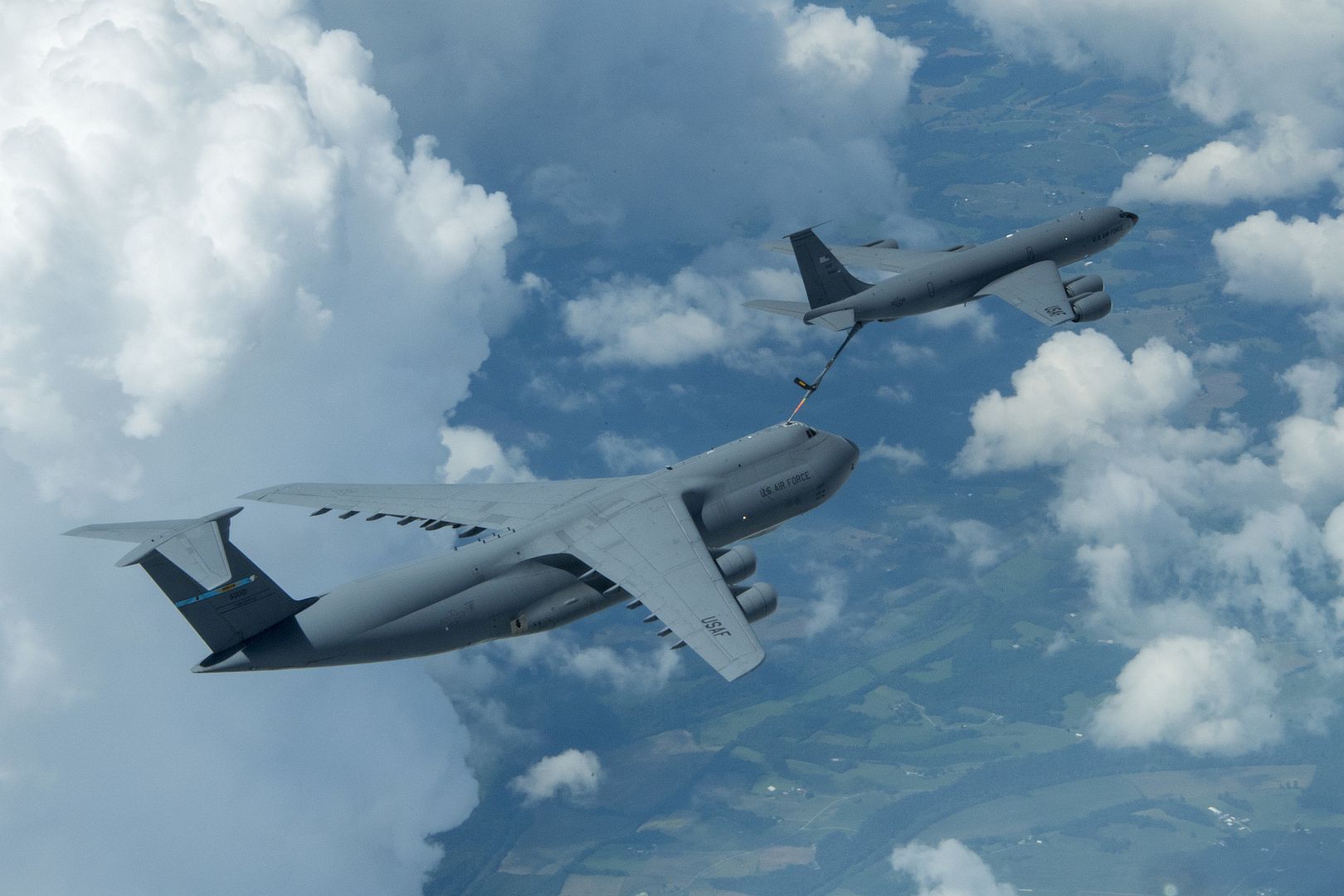
F-15E Strike Eagles assigned to the 494th Fighter Squadron take off from Royal Air Force Lakenheath, England, to participate in Exercise Baltic Operations June 20, 2019. BALTOPS 2019 is an annual, joint and multinational maritime-focused exercise, that provides a unique training opportunity designed to foster and sustain cooperative relationships that are critical to ensuring the safety of sea lanes and security on the world's interconnected oceans. (U. S. Air Force photo's by Airman 1st Class Madeline Herzog)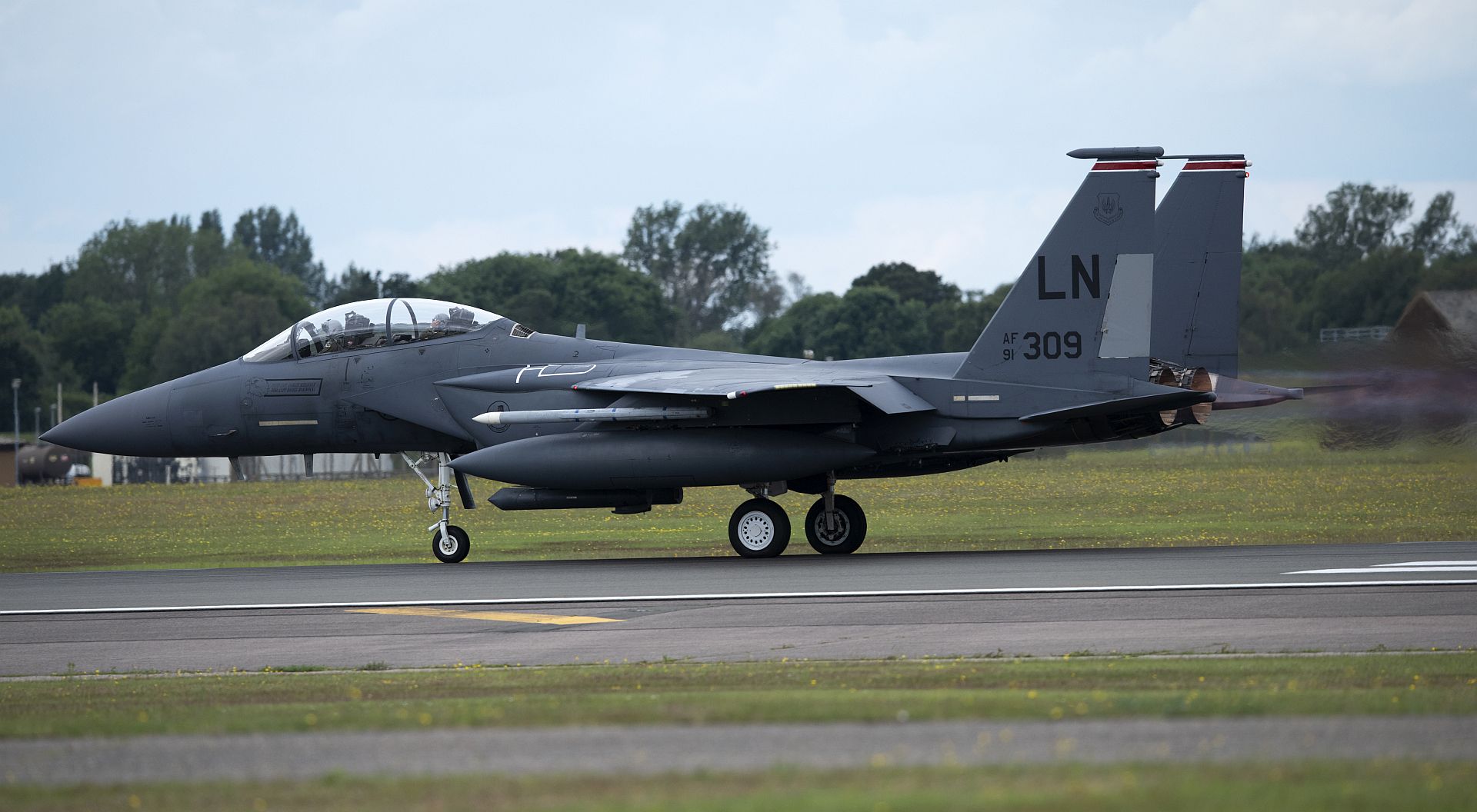
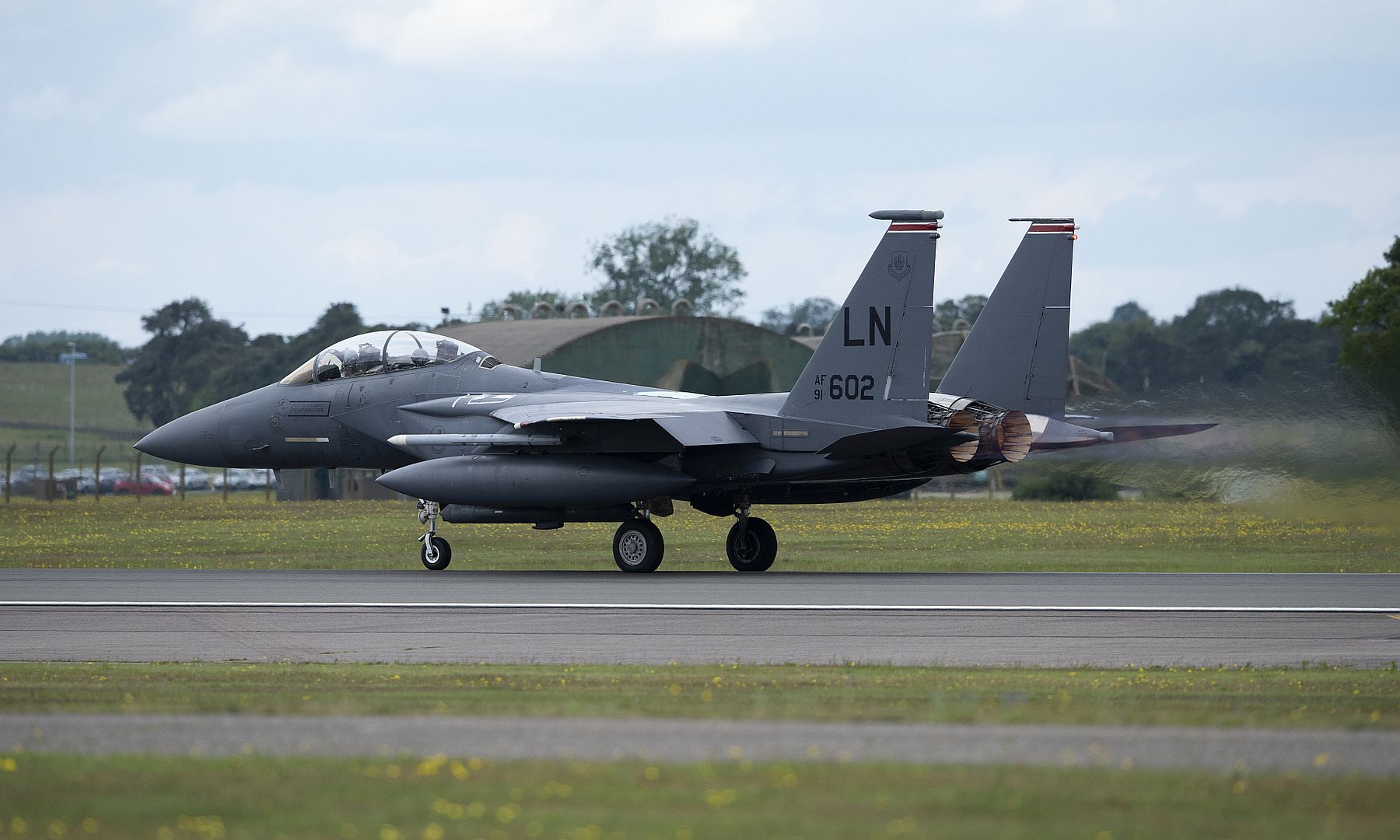
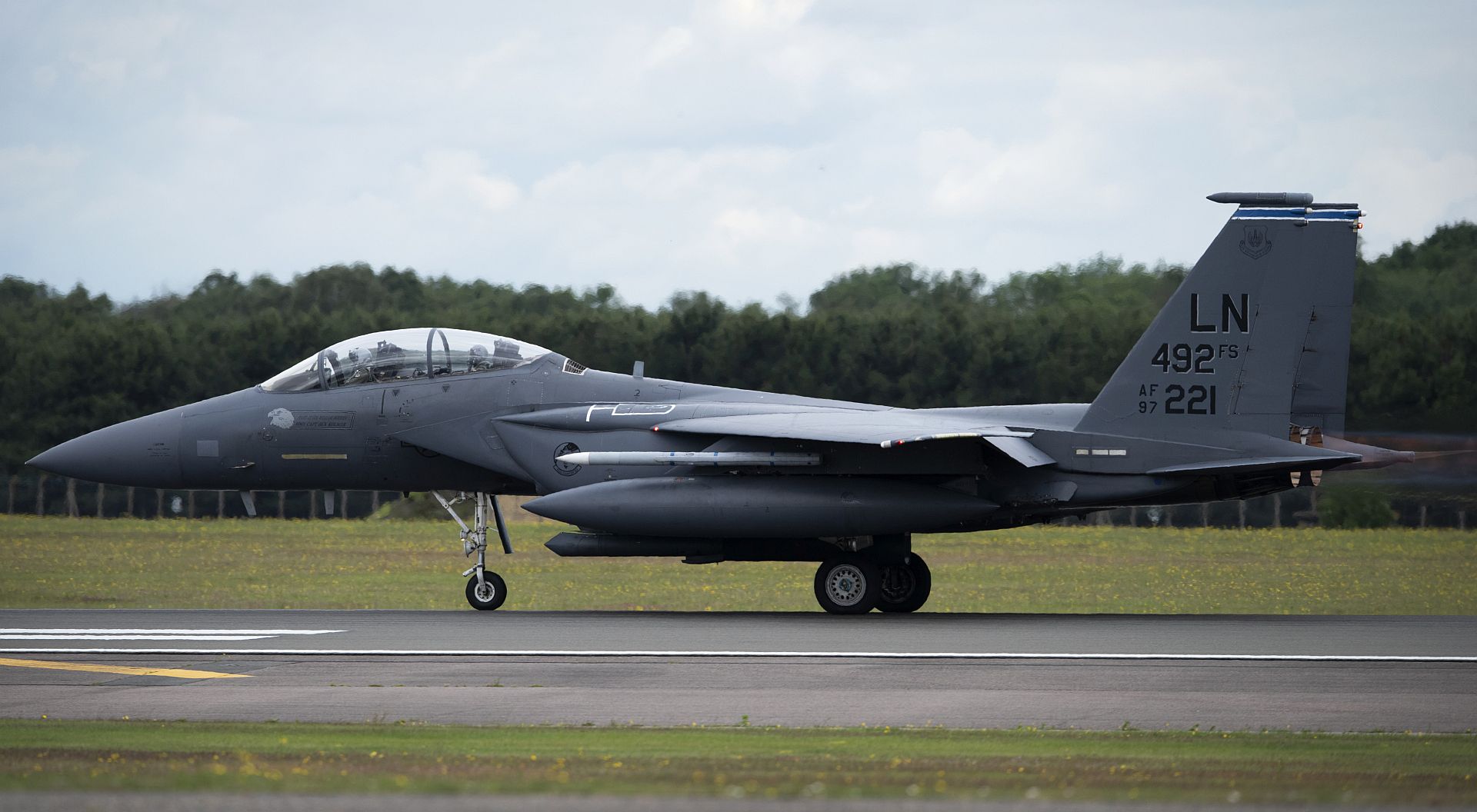
F-15E Strike Eagles assigned to the 492nd Fighter Squadron take off from Royal Air Force Lakenheath, England, to participate in Exercise Baltic Operations June 20, 2019. The exercise will incorporate maritime, ground, and air forces in order to strengthen the combined capabilities necessary for immediate crisis response and regional stability. (U. S. Air Force photo's by Airman 1st Class Madeline Herzog)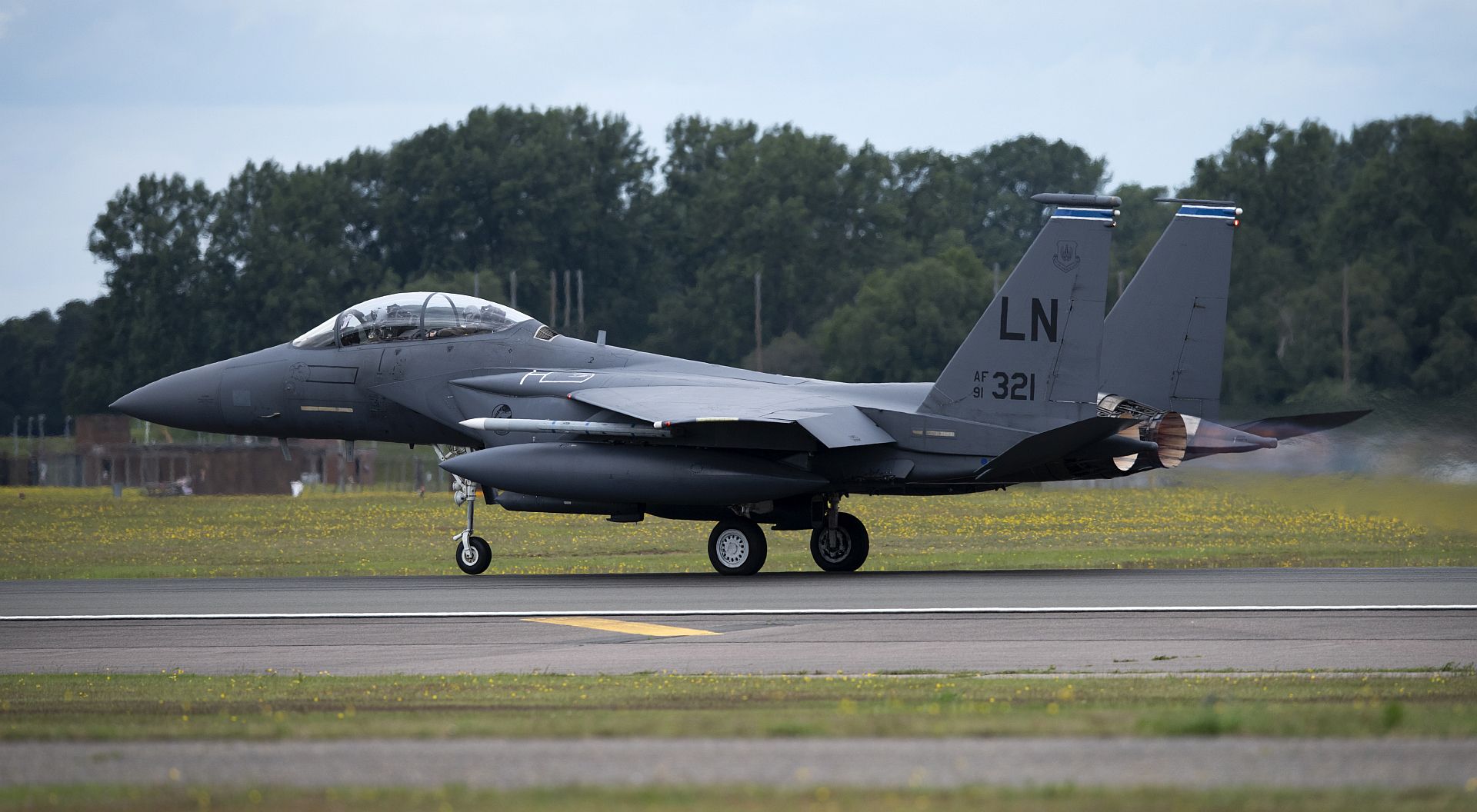
A U.S. Air Force A-10 Thunderbolt II assigned to the 51st Fighter Wing, Osan Air Base, Republic of Korea, maneuvers through the air during RED FLAG-Alaska (RF-A) 19-2 at Eielson Air Force Base, Alaska, June 17, 2019. RF-A takes place in the Joint Pacific Alaska Range Complex, which is one of the largest aerial training ranges in the world with more than 67,000 square miles of airspace. (U.S. Air Force photo by Airman 1st Class Aaron Larue Guerrisky)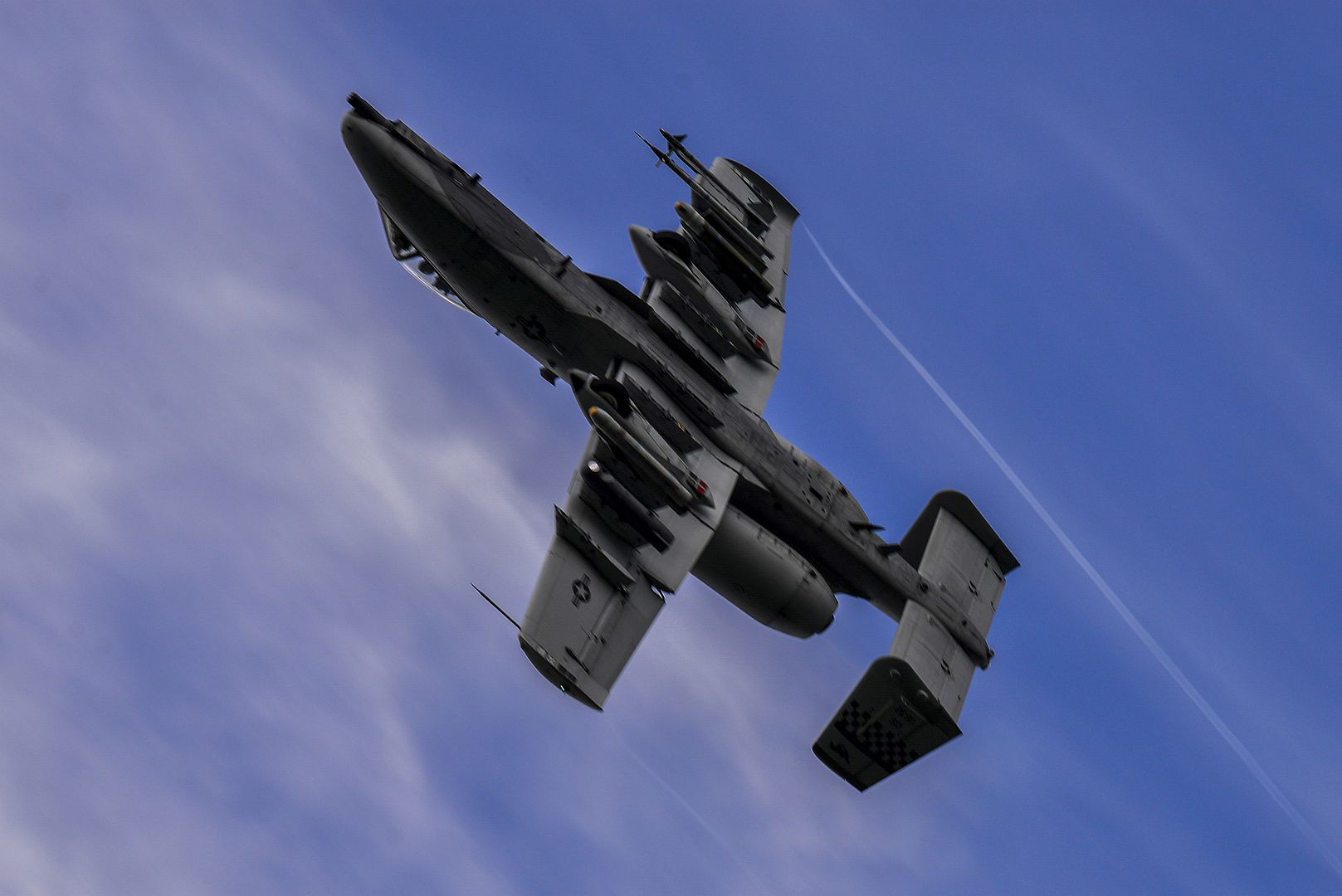
A Turkish F-4 Phantom takes off, during Exercise Anatolian Eagle June 17, 2019, from the Third Main Jet Base, Konya, Turkey. Participants in the exercise played offensive and defensive roles for the purpose of sharpening aerial warfare skills and bolstering international cooperation for military operations. (U.S. Air Force photo by Senior Airman Joshua Magbanua)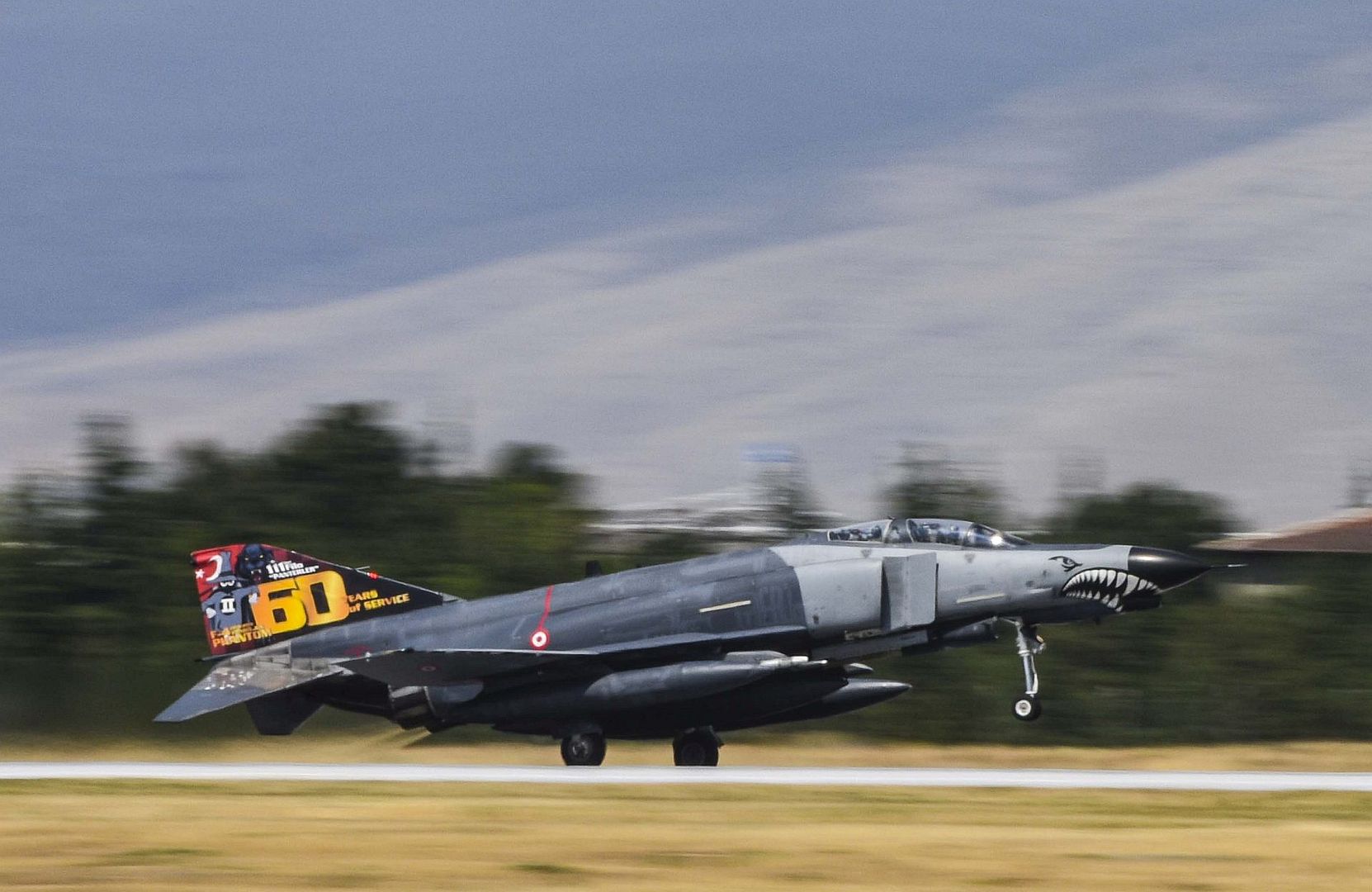
Le Bourget, Shenzhen Eastern General Aviation Company (Shenzhen Eastern GAC) has signed an agreement for one ACH160, becoming the launch customer for the VIP version of this medium helicopter in China.
The aircraft will be used to perform mainly private and business aviation (PBA) missions around the Guangdong-Hong Kong-Macau Greater Bay Area of China, which is home to approximately 70 million people and contributes to 12% of China?s GDP.
As a general aviation operator in the Greater Bay Area, Shenzhen Eastern GAC is the only general aviation company in China to participate in a pilot project that explores the easing of low-altitude airspace regulations in China. The company was also the first Chinese helicopter operator to fly between Hong Kong and the mainland. Its in-service helicopter fleet is made up of 12 aircraft, including three light twin-engine Airbus H135 helicopters.
Zhao Qi, Chairman of Shenzhen Eastern GAC, said: ?The ACH160 is the natural next addition to our Airbus fleet of H135s as we look to bolster our PBA presence in the Greater Bay area and explore new opportunities targeting the private aviation market for which we already have a welldeveloped infrastructure in place.?
?We?re honoured that Shenzhen Eastern GAC has chosen to expand its partnership with Airbus Helicopters by bringing the ACH160 to China,? said Marie Agnes Veve, head of the North Asia region and Airbus Helicopters China. ?From its stylish interior and smooth ride, to its advanced Helionix digital avionics system, the ACH160 brings the perfect combination of versatility, comfort and technology to China?s most discerning passengers and those that fly them.?
The full ACH helicopter range consists of the ACH125, ACH130, ACH135, new ACH145, ACH160 and ACH175 variants of Airbus Helicopters? comprehensive and market-leading family of light and medium models. A range of premium-design aircraft completions, including bespoke solutions, is available for all models.
The H160 is Airbus Helicopters? innovative medium twin-engine helicopter designed to create added value for customers in terms of performance, economic competitiveness, safety and comfort. Configurations being developed include offshore transportation, business and private, public services, and commercial passenger transport. Its entry into service is planned for 2020.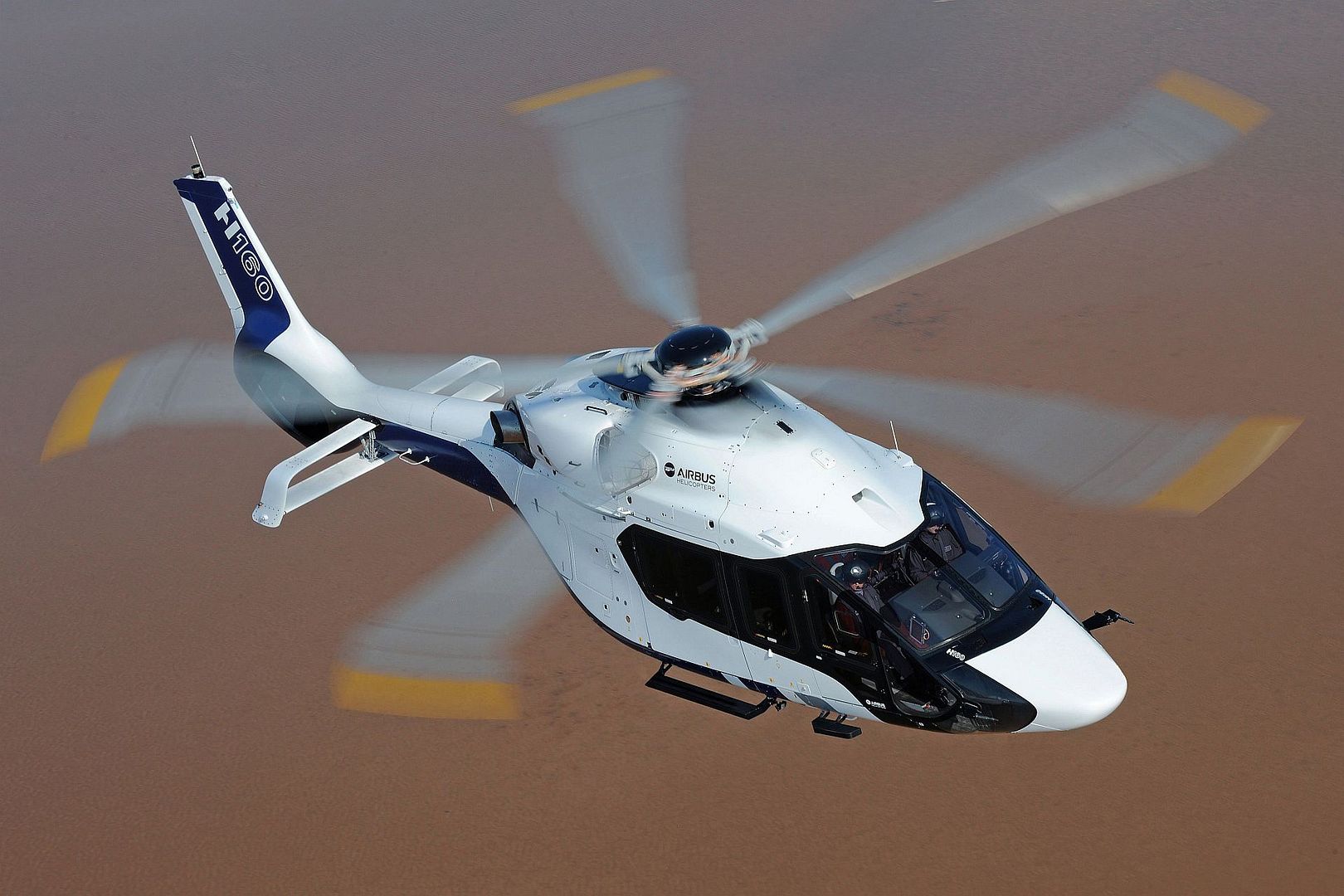
Flynas, Saudi Arabia?s first low-cost airline, has signed a Memorandum of Understanding (MoU) with Airbus for 10 A321XLR aircraft, the longest range variant of the A320. As part of the commitment, the airline will also upsize 10 of the A320neo it currently has on order to the A321neo.
Flynas operates a fleet of 30 A320ceos and 2 A320neos. Since its inception in 2007, Flynas has set ambitious growth plans to continuously develop its fleet in order to carry more passengers. In 2018 the airline carried around 6.6 million passengers on 60,000 domestic and international flights.
The A321XLR is the next evolutionary step from the A321LR which responds to market needs for even more range and payload, creating more value for the airlines. From 2023, it will deliver an unprecedented Xtra Long Range of up to 4,700nm ? 15% more than the A321LR and with 30% lower fuel burn per seat compared with previous generation competitor aircraft. This will enable operators to open new world-wide routes such as India to Europe or China to Australia, as well as further extending the Family?s non-stop reach on direct transatlantic flights between continental Europe and the Americas.
For passengers, the A321XLR?s new Airspace cabin will provide the best travel experience, while offering seats in all classes with the same high-comfort as on a long-haul wide-body, with the low costs of a single-aisle aircraft. The A320neo and its derivative aircraft family members are the world?s best-selling single aisle aircraft with over 6500 orders from more than 100 customers.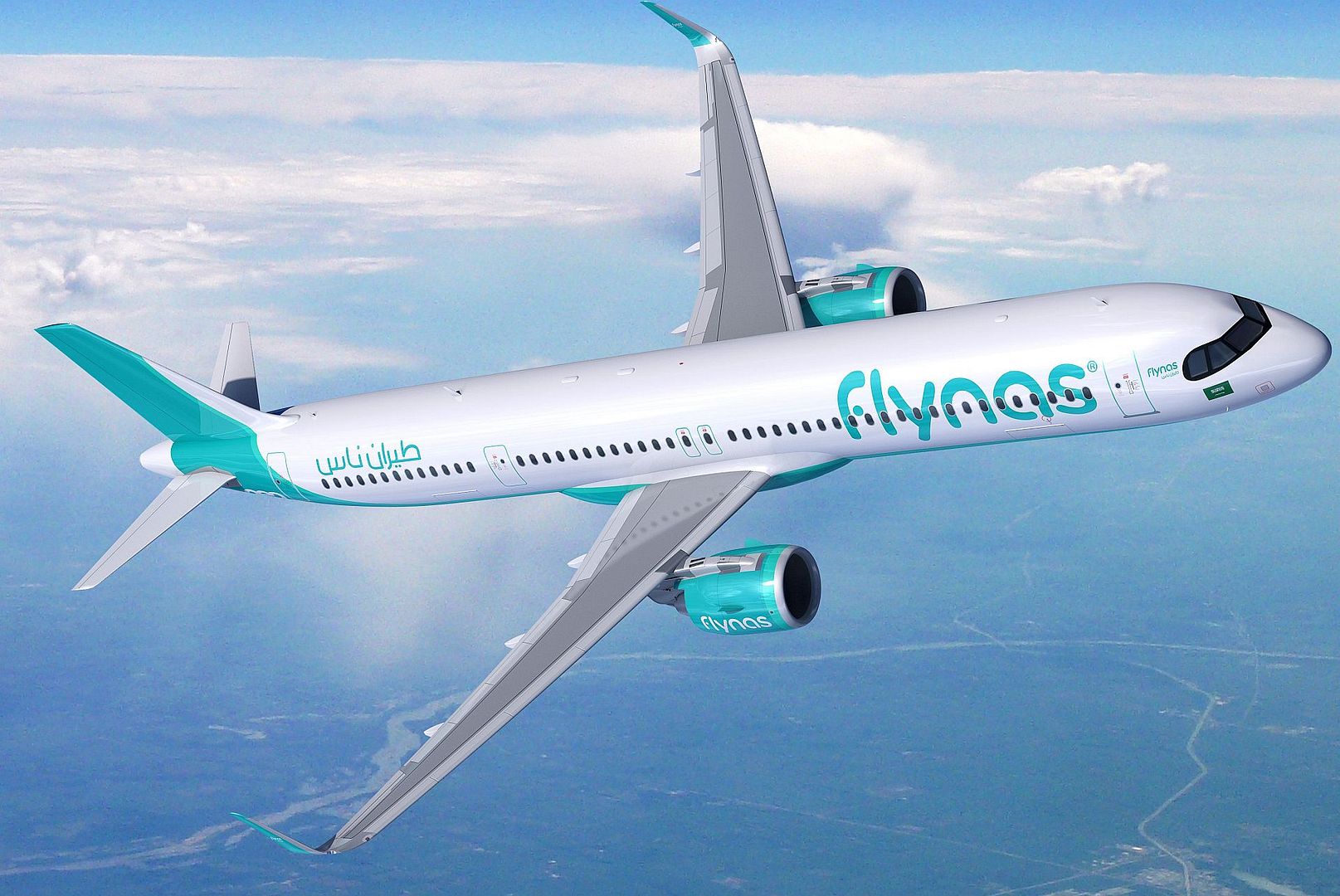
Nordic Aviation Capital (NAC), the industry?s number one regional aircraft lessor has signed a Memorandum of Understanding (MoU) for 20 A220 Family aircraft. The deal was signed at the Paris Air Show between Martin M?ller, NAC Chairman and Christian Scherer, Airbus Chief Commercial Officer.
NAC serves over 76 well established airline customers in 51 countries. The agreement represents the first major order for the A220 from a leading regional lessor confirming the versatility of the aircraft to support mainline and regional airline network expansion.
The A220 is the only aircraft purpose built for the 100-150 seat market; it delivers unbeatable fuel efficiency and widebody passenger comfort in a single-aisle aircraft. The A220 brings together state-of-the-art aerodynamics, advanced materials and Pratt & Whitney?s latest-generation PW1500G geared turbofan engines to offer at least 20 percent lower fuel burn per seat compared to previous generation aircraft. The A220 offers the performance of larger single-aisle aircraft.
With an order book of 536 aircraft at the end of May 2019, the A220 has all the credentials to win the lion?s share of the 100- to 150-seat aircraft market estimated to represent at least 7,000 aircraft over the next 20 years.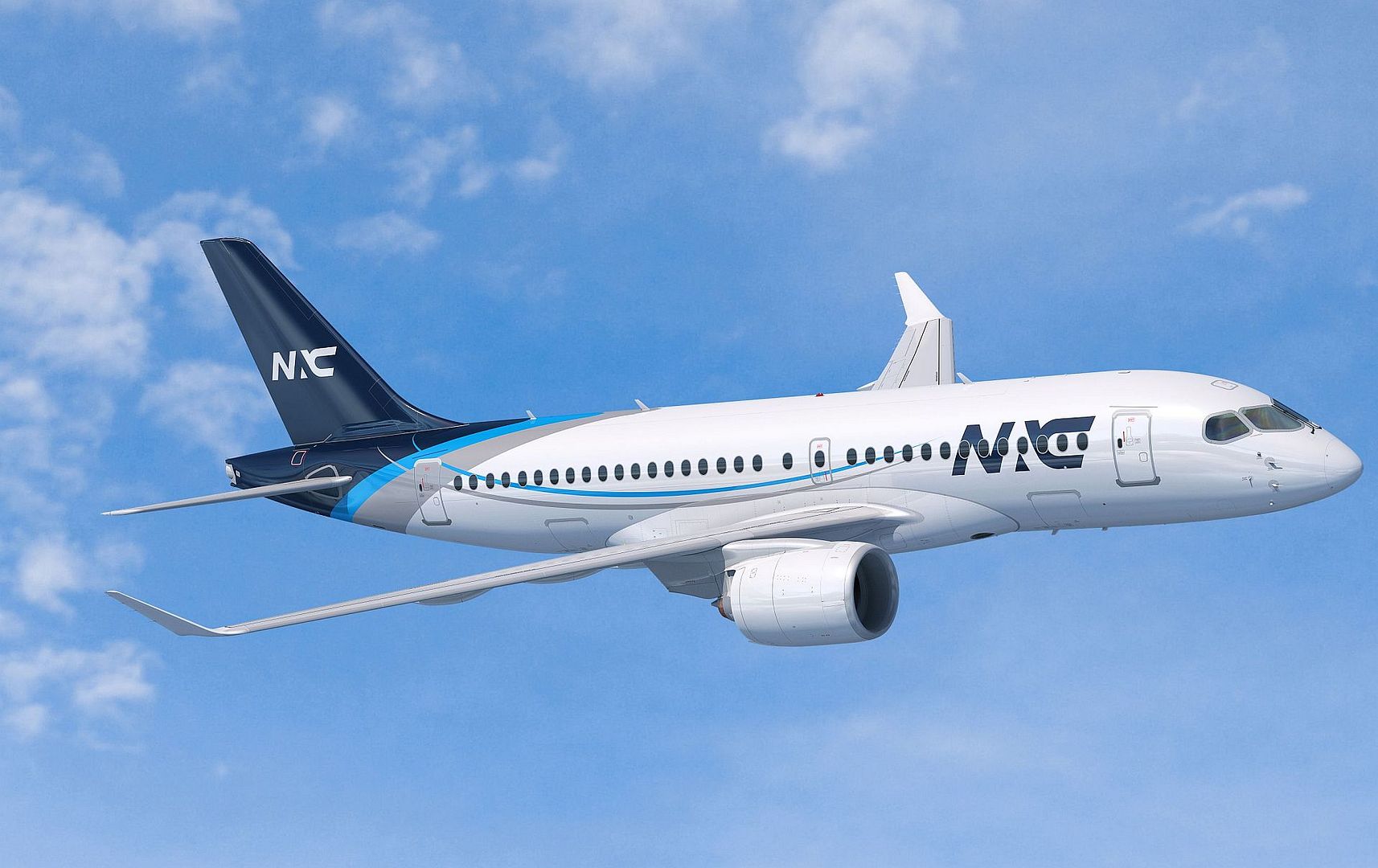
JetBlue Airways will add the A321XLR to its already large fleet of Airbus aircraft and increase its existing order for Airbus A220s. JetBlue has contracted to convert 13 existing A321neo orders into firm orders for the new A321XLR, which Airbus revealed this week at the Paris Air Show. Also, JetBlue has firmed up an order for an additional 10 A220-300 aircraft from existing options.
JetBlue, a New York-based low-cost airline that differentiates itself with a high-quality passenger experience, will integrate the A321XLR and the A220-300 into its growing network of routes to a variety of key destinations. JetBlue now operates 193 A320 and A321 aircraft, has orders for 85 A321neos, and previously ordered 60 A220-300s. In April, JetBlue converted 13 A321neo aircraft in its existing order to the LR (long range) version.
The A321XLR is the next evolutionary step from the A321LR which responds to market needs for even more range and payload, creating additional value for the airlines. From 2023, it will deliver an unprecedented Xtra Long Range of up to 4,700nm ? 15% more than the A321LR and with 30% lower fuel burn per seat compared with previous generation competitor aircraft. This will enable operators to open new world-wide routes such as India to Europe or China to Australia, as well as further extending the Family?s non-stop reach on direct transatlantic flights between continental Europe and the Americas. For passengers, the A321XLR?s new Airspace cabin will provide the best travel experience, while offering seats in all classes with the same high-comfort as on a long-haul wide-body, with the low costs of a single-aisle aircraft.
The A220 is the only aircraft purpose-built for the 100-150 seat market. It delivers unbeatable fuel efficiency and widebody comfort in a single-aisle aircraft. The A220 brings together state-of-the-art aerodynamics, advanced materials and Pratt & Whitney?s latest-generation PW1500G geared turbofan engines to offer at least 20 percent lower fuel burn per seat compared to previous generation aircraft.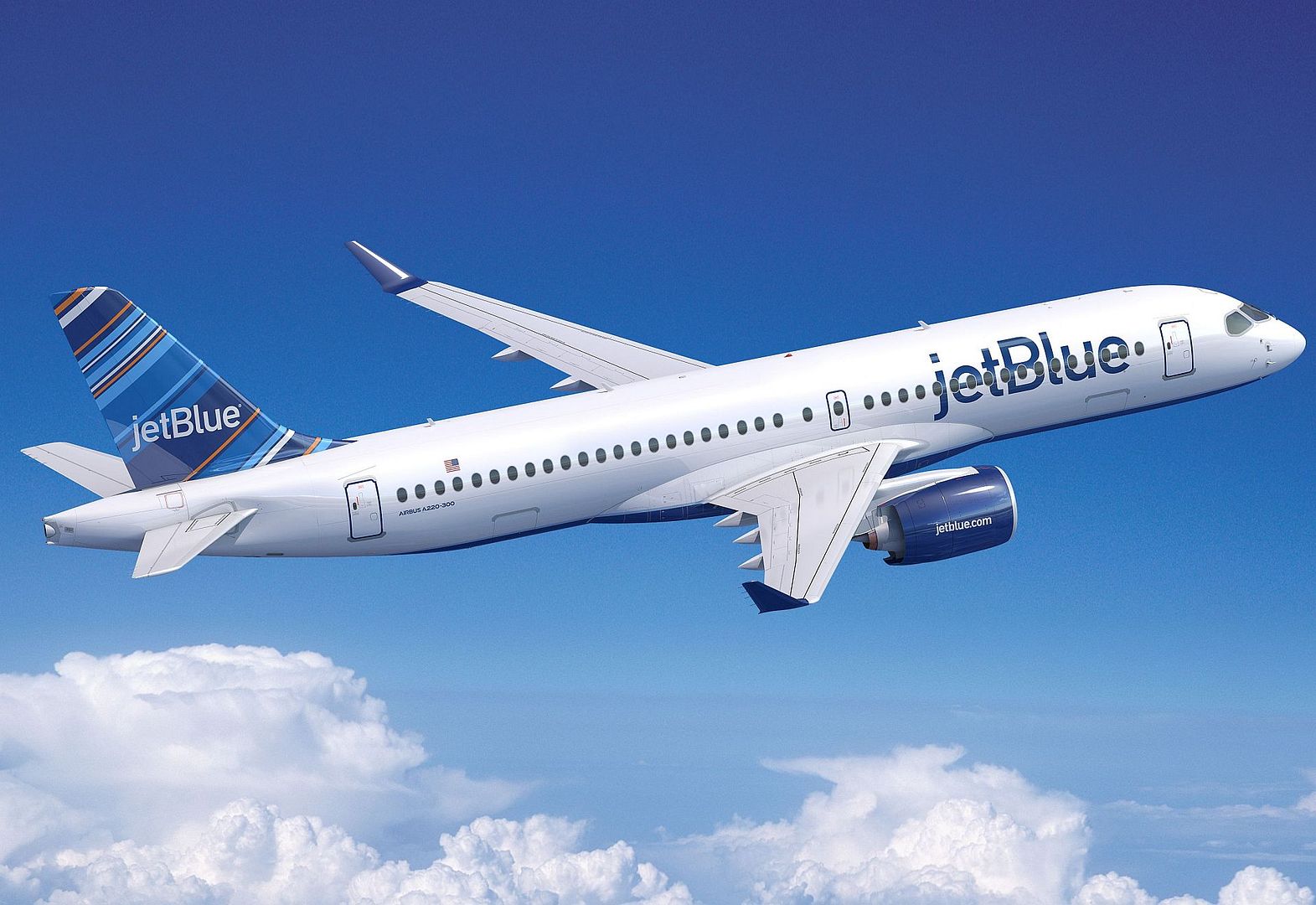
-
ORLAND AIR BASE, Norway (AFNS) --
For the first time outside the U.S., Norwegian and American F-35 Lightning II maintainers worked together on their aircraft June 17.
A team of five maintainers and four pilots from the 421st Expeditionary Fighter Squadron deployed to Norway for the historic cross-servicing event, during which the maintenance teams received and turned two American F-35As after their arrival from Finland.
The Norwegian air force already operates a fleet of 12 F-35s at Orland Air Base, and plans to eventually employ 52 of the fifth-generation aircraft throughout Norway. The visit was the first time American F-35s have landed in Norway.
?All firsts are special,? said Royal Norwegian Air Force Lt. Col. Eirik Guldvog, 132nd Air Wing executive officer and chief of staff. ?For Norway and our European allies, who are entering the fifth-generation fighter era, it?s important to both have the U.S. on board and to train with the other partners around the North Sea.
?To have multinational cooperation within these nations and to have a significant F-35-capable force in the North Atlantic, of course that is important,? Guldvog continued. ?This is the first step.?
While the visit was short, it was an opportunity to practice seamless integration in preparation for future deployments.
?Air operations are often multinational, so it?s important that we train together and find every opportunity to interact on a normal basis,? Guldvog said.
According to U.S. Air Force Capt. Brett Burnside, 421st EFS F-35 pilot, the entire endeavor felt familiar and without any significant challenges.
?Even though they are from a different country and speak a different language, they are fighter pilots as we are,? Burnside said. ?We simply connected with them on our F-35 datalink and it was just like working with any U.S. F-35 unit.?
Burnside said because Norway is a partner in the F-35 program, it?s extremely important to continue to foster this relationship. Additionally, he said Norway?s geographic location is immensely strategic as they have a large responsibility in quick reaction alert to scramble fighters to intercept hostile aircraft in the arctic region if necessary.
The now-proven ability of RNorAF?s Lightning II maintainers to successfully catch and turn American F-35s is a huge milestone for the country.
?F-35s will be the most important combat element within the Norwegian defense agencies,? Guldvog said. ?Not just the air force. It will be the most potent offensive capability in Norway.?
A fleet of F-35As is currently deployed to Europe as part of the European Deterrence Initiative, which enables the U.S. to enhance a deterrence posture, increase the readiness and responsiveness of U.S. forces in Europe, support the collective defense and security of NATO allies and bolster the security and capacity of U.S. partners.
(U.S. Air Force photo by Master Sgt. Austin M. May.)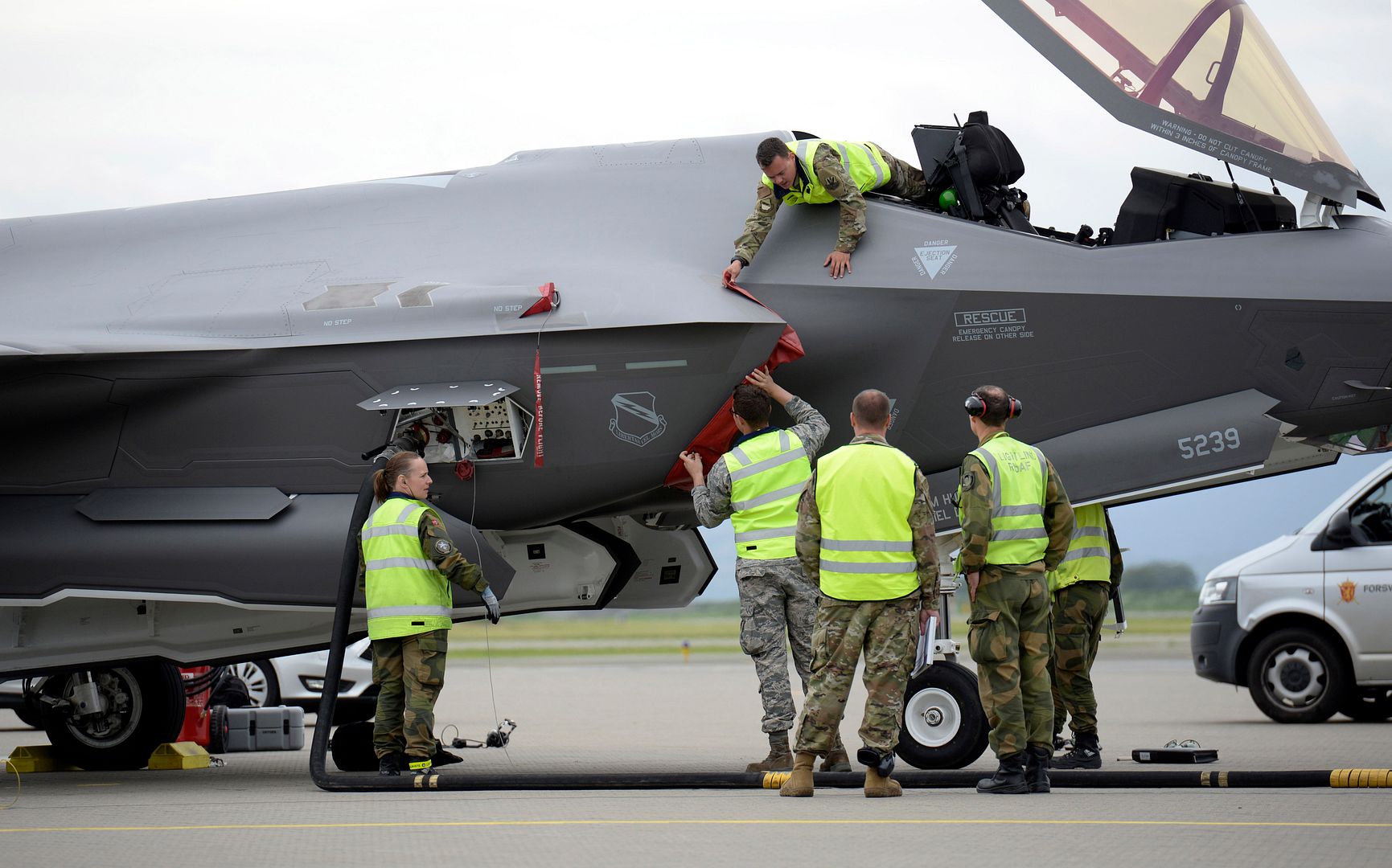
EDWARDS AIR FORCE BASE, Calif. --
In a scene reminiscent of the old days of a B-52 mothership carrying an X-15 underneath a wing, the 419th Flight Test Squadron successfully conducted the first flight test of the AGM-183A Air-Launched Rapid Response Weapon, or ARRW, at Edwards Air Force Base, California, June 12.
Much like the historic ?Balls 8? B-52, a current generation of the historic aircraft is once again contributing to the base?s test mission, this time in the realm of hypersonic weapons.
?Hypersonic weapons are defined as assets which are capable of traveling more than five times the speed of sound,? said Master Sgt. Dustin Hoover, Superintendent, Advanced Programs, 412th Maintenance Group. ?Hypersonics is a game-changing technology that amplifies many of the enduring attributes of airpower?speed, range, flexibility, and precision.?
A prototype of the ARRW was attached to a B-52 to gather test data including environmental and aircraft handling characteristics. The test gathered data on drag and vibration impacts on the weapon itself and on the external carriage equipment of the aircraft. The prototype did not have explosives, instead it was outfitted with sensors and was not released from the B-52 during the flight test.
The ARRW is one of two Air Force hypersonic weapon rapid prototyping efforts. Development of these air-launched hypersonic weapon concepts shows the Air Force is staying at the forefront of this cutting edge technology and is set to reach early operational capability by fiscal year 2022.
?We?re using the rapid prototyping authorities provided by Congress to quickly bring hypersonic weapon capabilities to the warfighter,? said Dr. Will Roper, assistant secretary of the Air Force for Acquisition, Technology and Logistics. ?We set out an aggressive schedule with ARRW. Getting to this flight test on time highlights the amazing work of our acquisition workforce and our partnership with Lockheed Martin and other industry partners.?
The success of the mission is attributed to many different organizations within the 412th Test Wing, the Air Force Test Center, as well as industry partners.
?This endeavor was the culmination of months of work to get both the aircraft and weapon prototype ready for loading and flight,? Hoover said, ?Weapon Standardization?s involvement included working with the contractor to ensure technical data was safe for use and that personnel would not be injured and the aircraft & equipment would not be damaged.?
New efforts such as hypersonic weapons tests are very complex. Testing hypersonics weapons requires the collaboration of multiple organizations across the 412th Test Wing and Air Force Test Center as well as with our industry partners. Future success depends on those relationships and it is exciting to be part of such a great team, said Lt. Col. Tom Meagher, 419th FLTS Commander and Global Power Bomber Combined Test Force Director.
?Hypersonics play a critical role in the next generation of strategic long-range strike capabilities for our nation to counter our adversaries and their threats,? he said. ?We must test these new hypersonic weapons to ensure we field the capability and technology safely, rapidly, and effectively. The warfighter depends on the test community to deliver weapons that work when they need them to, reaching targets quicker and from longer range.?
The flight test serves as the first of many flight tests with the B-52 that will expand the test parameters and capabilities of the ARRW prototype.
?It is a privilege to be involved in the early testing of new capabilities for the warfighter. We have a great team of skilled individuals working hard to bring these weapons to the field and it is humbling to be a part of it,? said Capt. Darren Montes, 419th FLTS Hypersonics Flight Commander and B-52 Test Pilot on the ARRW first flight.
?The B-52 continues to prove itself as a critical workhorse in the development of new capabilities for the nation. By virtue of the B-52?s large external carriage capacity, it is an excellent platform for testing new vehicles and weapons, supporting the current and future needs of the operator,? Montes said. ?The B-52 has a rich history of hypersonic testing, including the X-15, X-51, and many other experimental and research aircraft. This recent test and the increase in future hypersonic weapons tests continues that legacy.?
(U.S. Air Force photo's by Christopher Okula)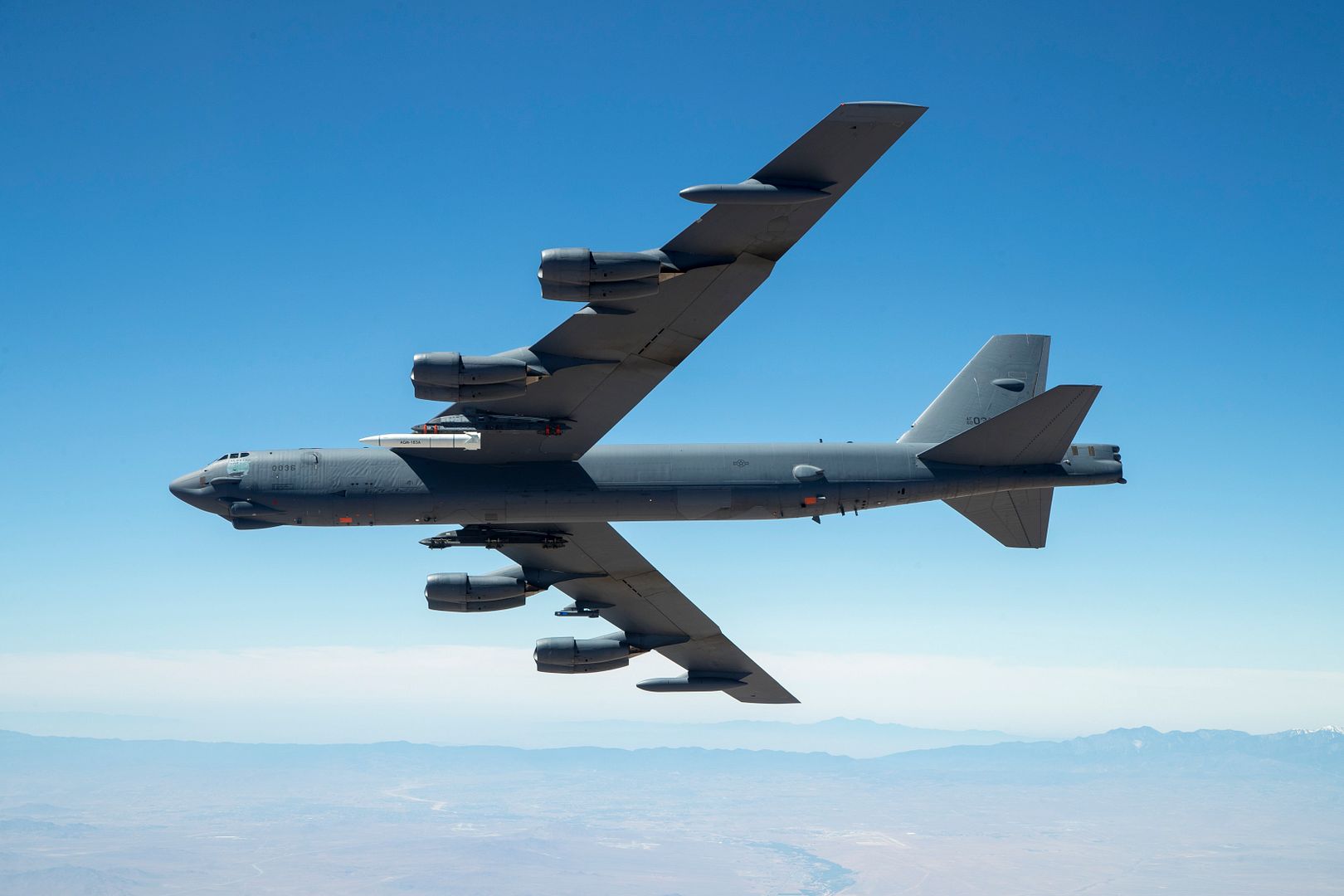
A U.S. Air Force MQ-9 Reaper flies during RED FLAG-Alaska 19-2, June 19 2019, at Eielson Air Force Base, Alaska. EXERCISE RED FLAG-Alaska exercises provide unique opportunities to integrate various forces in a realistic threat environment and dates back to 1975, when it was held at Clark Air Force Base, Philippines and called Exercise COPE THUNDER. (U.S. Air Force photo by Senior Airman Daniel Snider)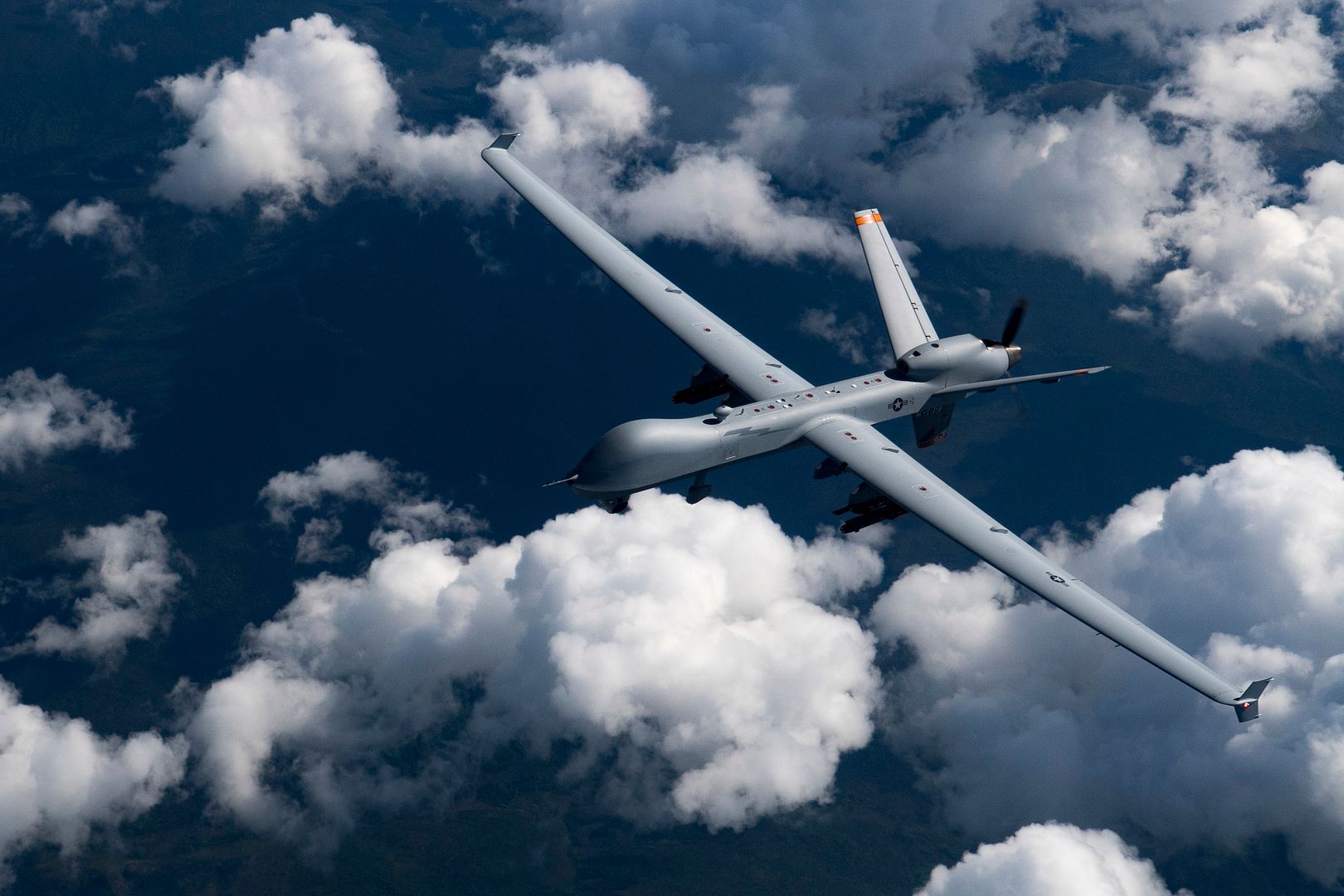
A U.S. Air Force 18th Aggressor Squadron F-16 Fighting Falcon receives fuel from an 168th Air Refueling Squadron KC-135 Stratotanker during RED FLAG-Alaska 19-2, June 17, 2019, at Eielson Air Force Base, Alaska. RF-A, a Pacific Air Forces-sponsored exercise, is designed to provide realistic training in a simulated combat environment for joint and international forces. (U.S. Air Force photo by Senior Airman Daniel Snider)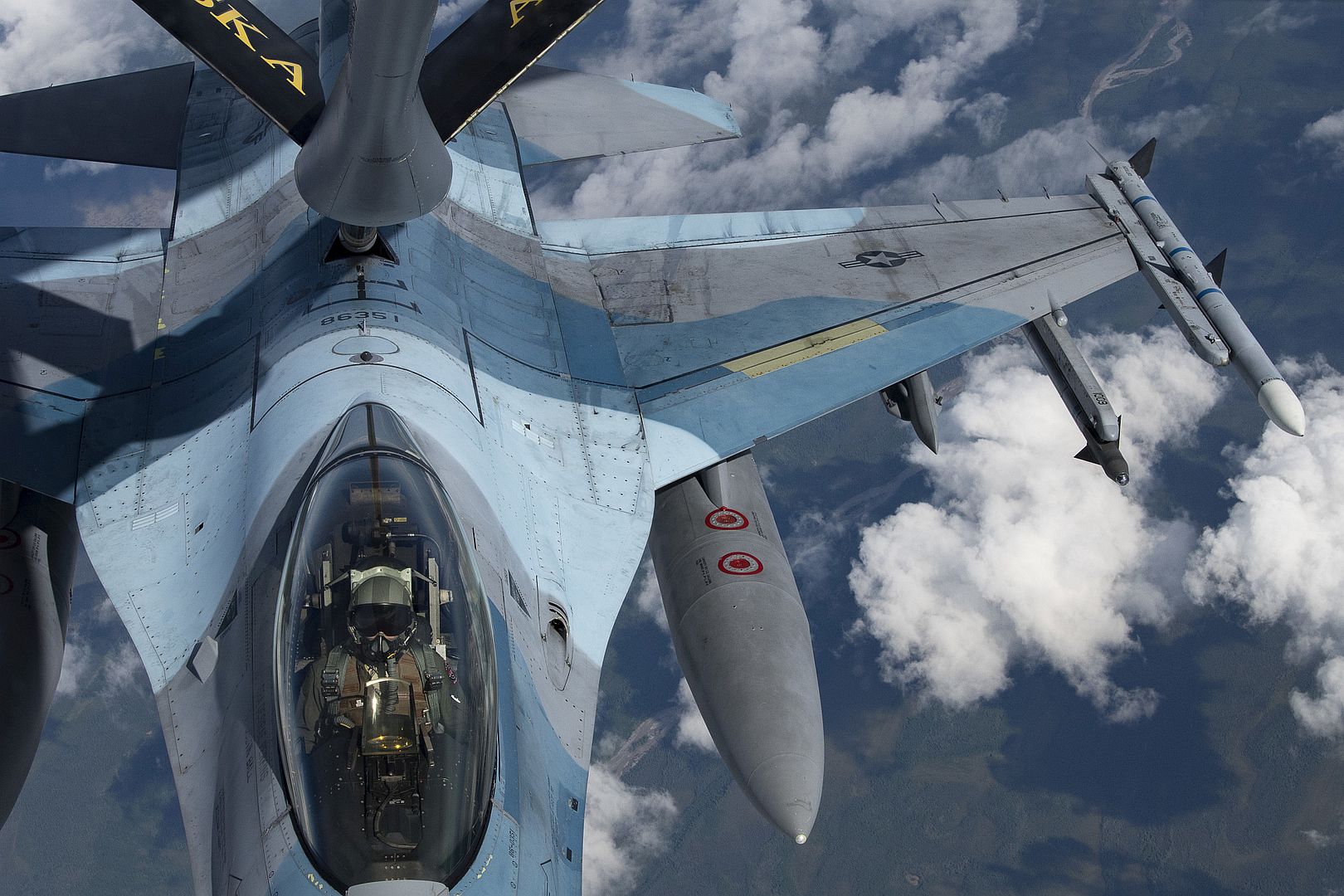
NORTH CHARLESTON, S.C., June 21, 2019 /PRNewswire/ -- EVA Air today celebrated the delivery of its first Boeing [NYSE:BA] 787-10 Dreamliner, marking the first of 20 super-efficient 787-10s the carrier plans to use on high-density routes within Asia later this summer. The airline, which is also celebrating its 30th anniversary this year, already operates a fleet of four 787-9 Dreamliners.
"The 787 Dreamliner has become the flagship of our fleet and we will leverage the airplane's unrivaled fuel efficiency, reliability and size to operate high-density markets in Asia," said Steve Lin, Chairman of EVA Air. "The 787-10 offers around 15 percent more cabin space and cargo capacity compared to our existing 787-9s and this added capability will allow us to explore new opportunities for future growth in the emerging markets within Asia Pacific. As a five-star airline, we are committed to providing world-class service and products to our customers and these new airplanes will be key to our long-term success."
Built with lightweight composite materials and powered by advanced GEnx engines, EVA Air's 787-10 is the largest member of the fuel-efficient and passenger-pleasing Dreamliner family. At 224 feet long (68 meters), EVA Air's 787-10 can serve 342 passengers in a two-class configuration, which is 38 more seats than EVA Air's 787-9 Dreamliner.
"EVA Air is an award-winning carrier and has formed a dynamic long-haul fleet. With their 777-300ERs, 787-9s and now the 787-10, EVA Air will have an incredible widebody family to serve its passengers and grow its international network for many years to come," said Ihssane Mounir, senior vice president of Commercial Sales and Marketing of The Boeing Company. "We are extremely honored that EVA is building their future around the 787 Dreamliner family and I am confident that the passenger-pleasing capabilities of the airplane will contribute immensely to the airline's reputation as a five star airline."
Powered by a suite of new technologies and a revolutionary design, the 787-10 set a new benchmark for fuel efficiency and operating economics when it entered commercial service last year. The airplane allows operators to achieve 25 percent better fuel efficiency per seat compared to the previous airplanes in its class. The 787 is currently in service with some of the world's leading airlines and has garnered orders and commitments of up to 50 airplanes thus far in 2019.
Boeing Global Service's suite of digital solutions, including Maintenance Performance Toolbox, Airplane Health Management and Jeppesen FliteDeck Pro electronic flight bag tools, continue to help EVA Air drive efficiency and improve performance across its fleet of 787 aircraft. As a customer of Boeing's Component Services Program, EVA Air has convenient access to a global support network with high-value rotable parts, components and line-replaceable units.
A member of Star Alliance, EVA Air serves international routes with approximately 565 weekly flights. Onboard the airline's new 787 Dreamliner, passengers can experience EVA Air's new Royal Laurel class seats designed by Designworks, a BMW Group company. At 23 inches wide, the new seats feature privacy panels, full lie-flat capabilities as well as enhanced in-flight entertainment systems. EVA Air also partnered with Teague, to redesign its economy class seats, which are produced by Recaro.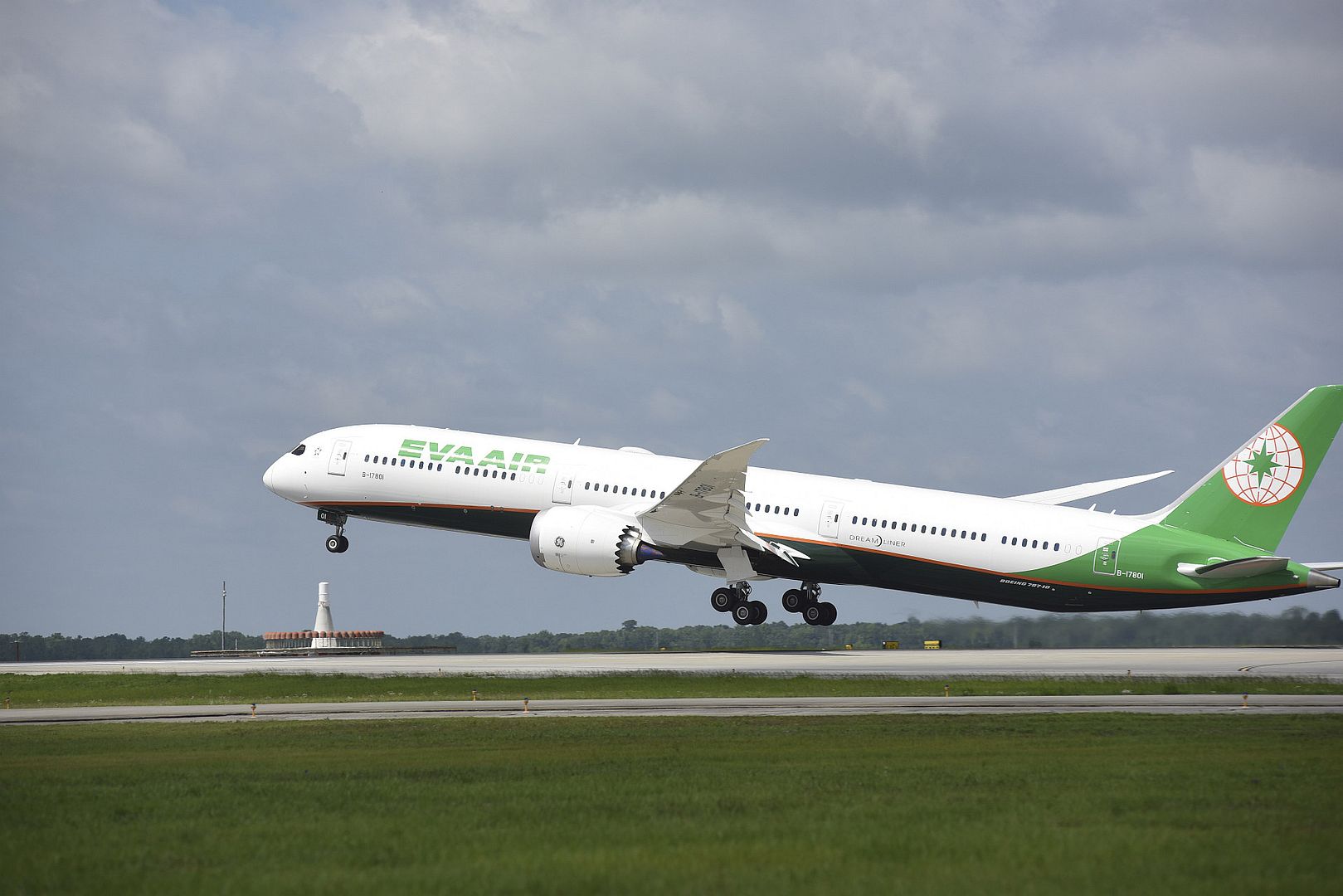
-
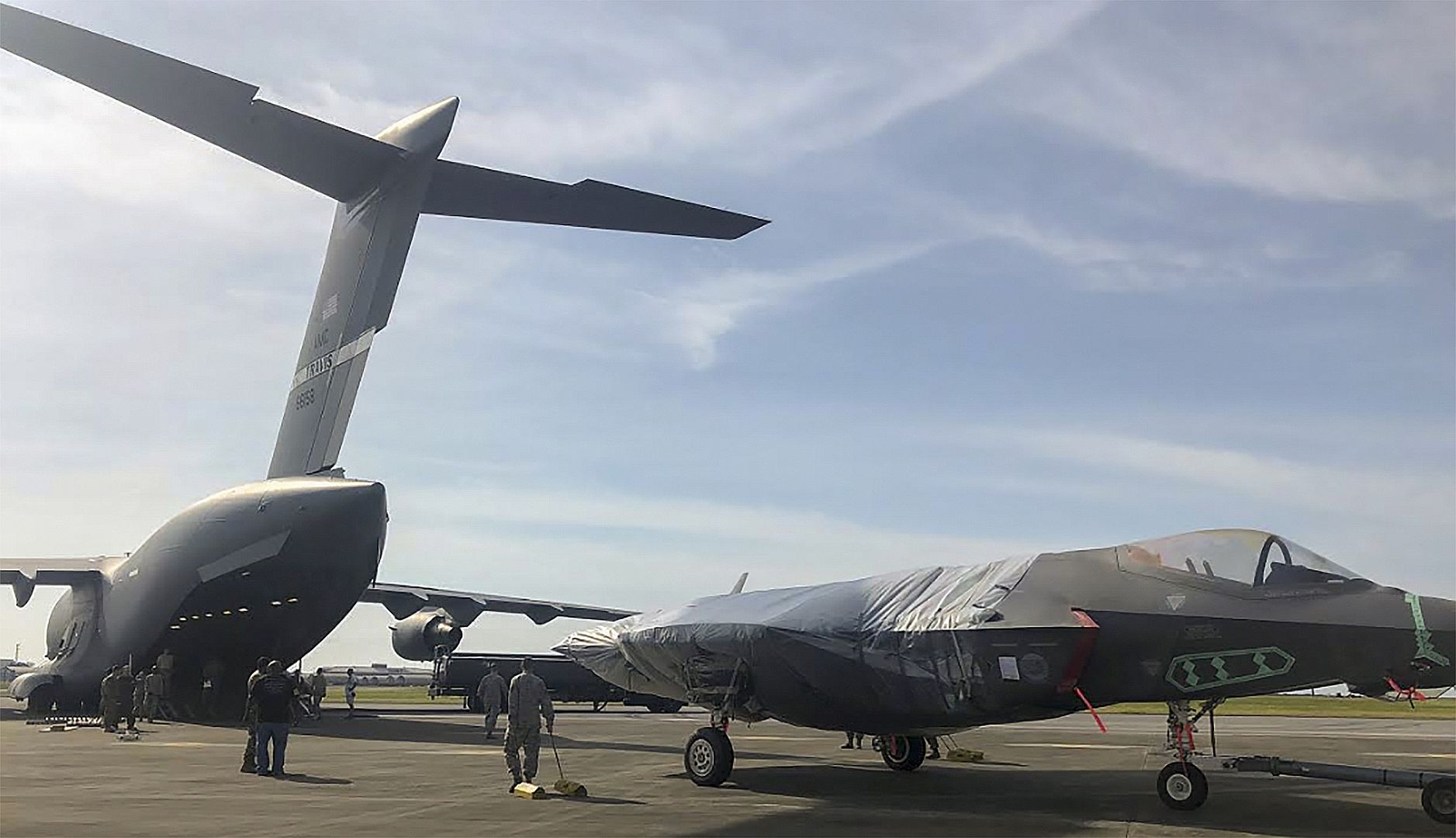
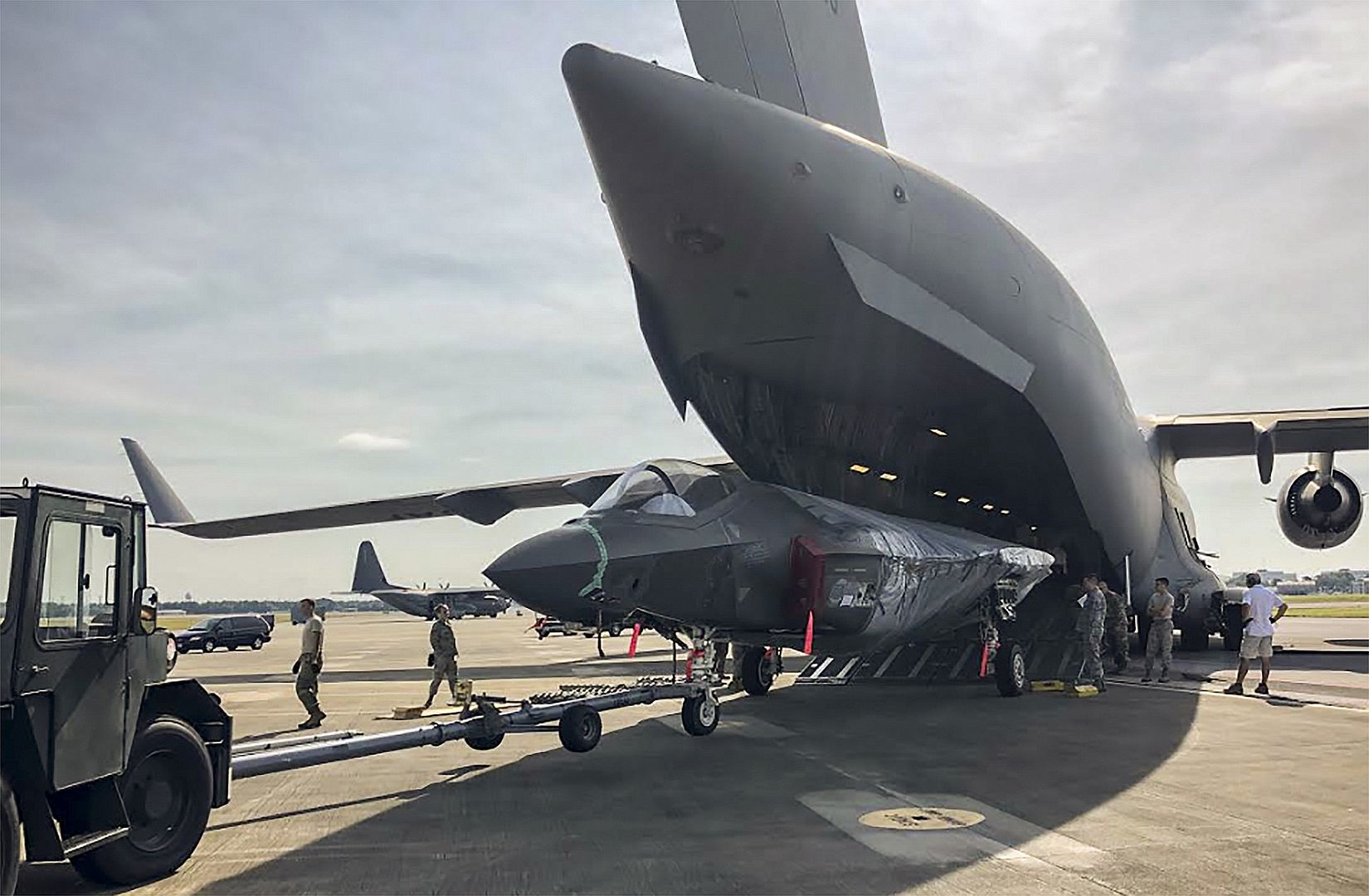
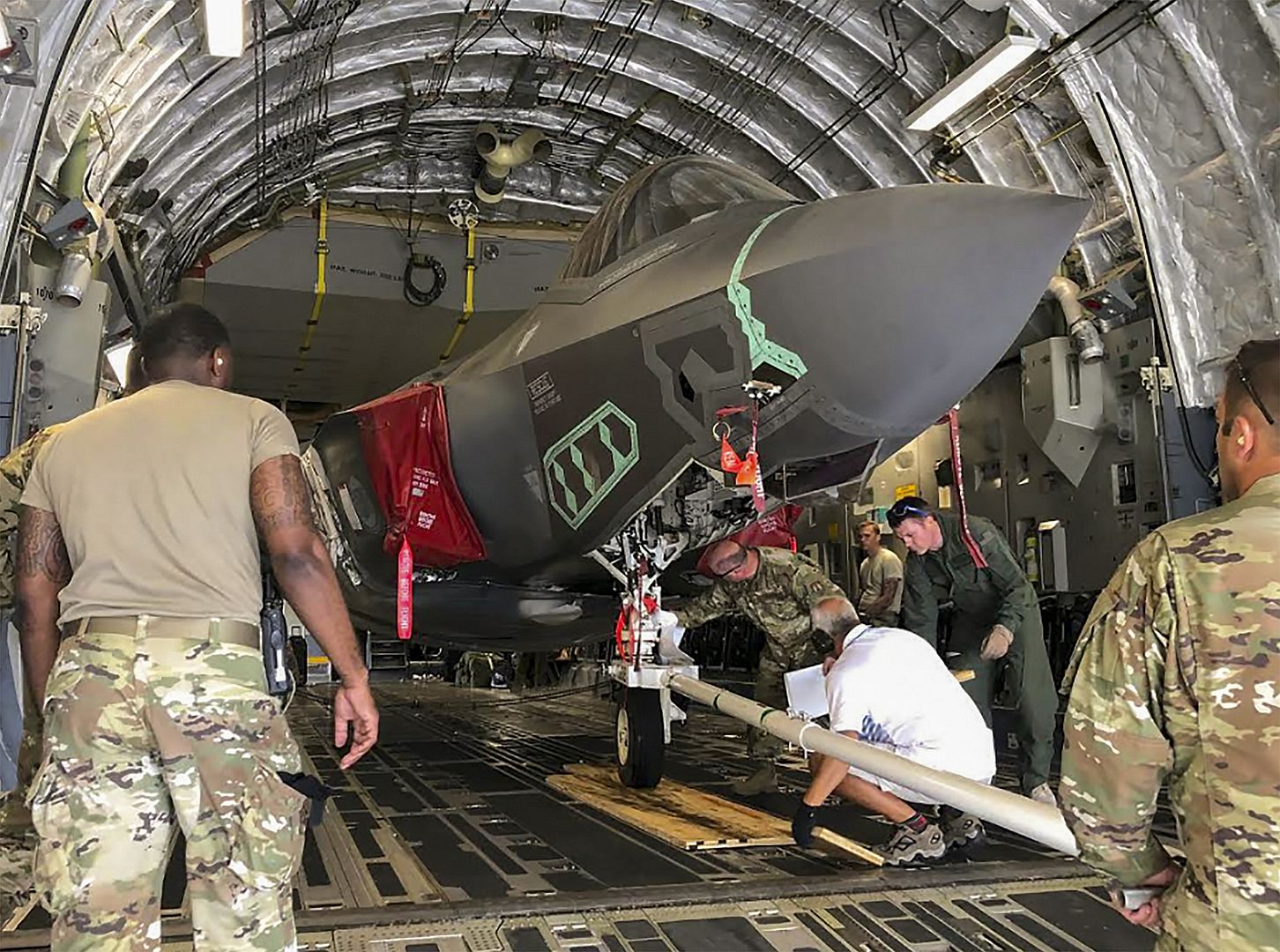
An F-35 Lightning II is pushed into a C-17 Globemaster by 96th Logistics Readiness Squadron aerial porters May 8 at Eglin Air Force Base, Fla. This was the first-ever F-35 wing removal and shipment via air transport. The $200,000 four-year project culminated in the transport of the aircraft to Hill AFB, Utah. There it will become the Air Force?s first F-35 aircraft battle damage trainer. (U.S. Air Force photo's/2nd Lt. Monica Lubis)
CHICAGO AND MOUNTAIN VIEW, June 25, 2019 ? Boeing [NYSE: BA] and Kitty Hawk Corporation today announced a strategic partnership to collaborate on future efforts to advance safe urban air mobility. The strategic partnership will bring together the innovation of Kitty Hawk?s Cora division with Boeing?s scale and aerospace expertise.
?Working with a company like Kitty Hawk brings us closer to our goal of safely advancing the future of mobility,? said Steve Nordlund, vice president and general manager of Boeing NeXt, an organization that is laying the foundation for a next-generation mobility ecosystem in which autonomous and piloted vehicles can safely coexist. ?We have a shared vision of how people, goods and ideas will be transported in the future, as well as the safety and regulatory ecosystem that will underpin that transportation.?
?Kitty Hawk was started to advance technology in flight and bring new innovations to life,? said Sebastian Thrun, co-founder and CEO of Kitty Hawk. ?I am excited about our companies working together to accelerate making safe electric flight a reality.?
The agreement with Kitty Hawk Corp. is part of Boeing's disciplined, long-term strategy of entering into value-added partnerships that enhance and accelerate growth and deliver key differentiators for customers.
Boeing is the world?s largest aerospace company and leading provider of commercial airplanes, defense, space and security systems, and global services. As the top U.S. exporter, the company supports commercial and government customers in more than 150 countries. Boeing employs more than 150,000 people worldwide and leverages the talents of a global supplier base. Building on a legacy of aerospace leadership, Boeing continues to lead in technology and innovation, deliver for its customers and invest in its people and future growth.
Kitty Hawk Corp., headquartered in Mountain View, California, builds electric transportation solutions to free people from traffic and decrease carbon footprint. The company gets its name from the beaches of Kitty Hawk, North Carolina where the Wright Brothers took flight for the first time in 1903. The company?s portfolio of vehicles includes Cora, a two-person air taxi and Flyer, a vehicle for personalized flight.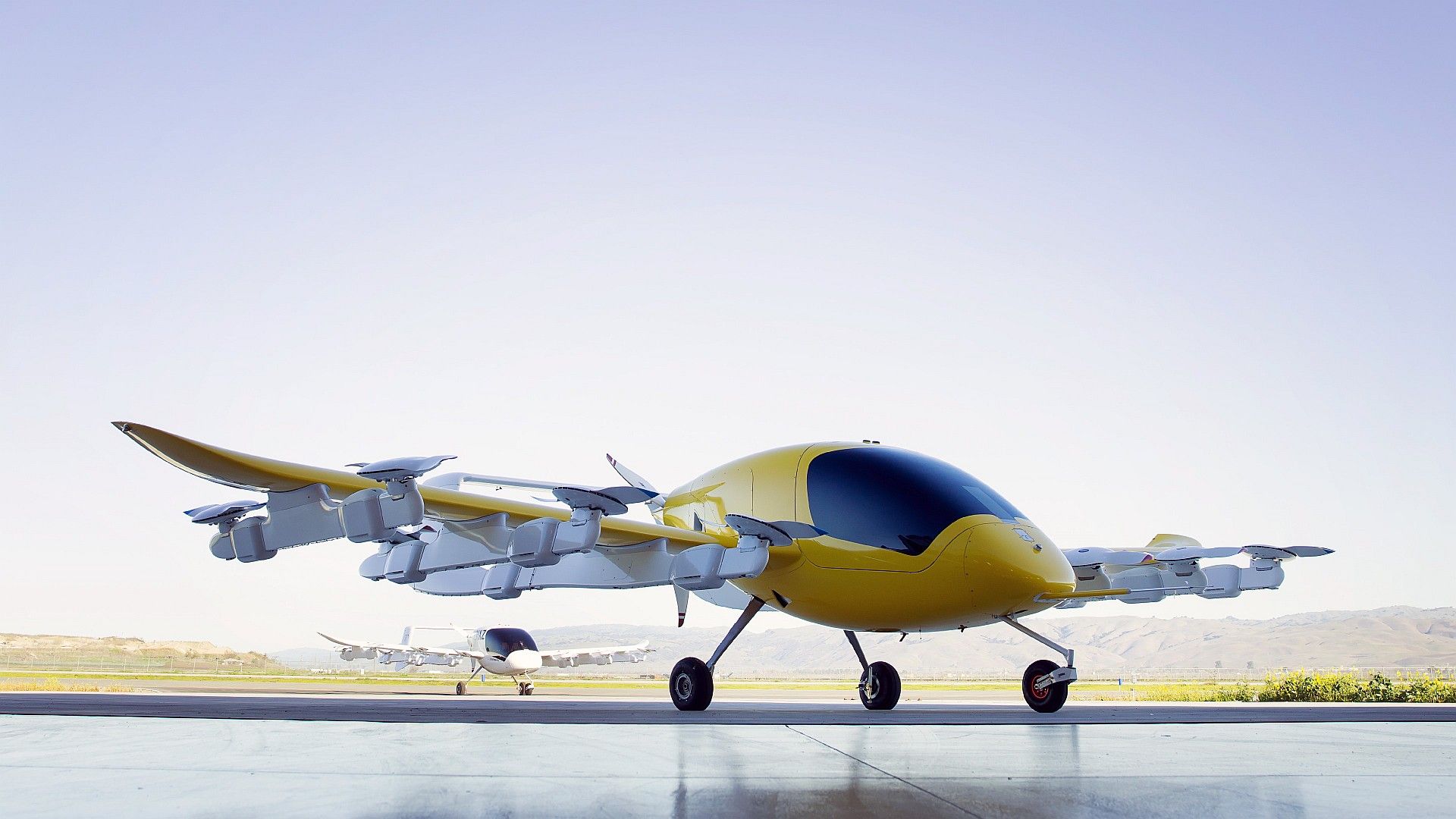
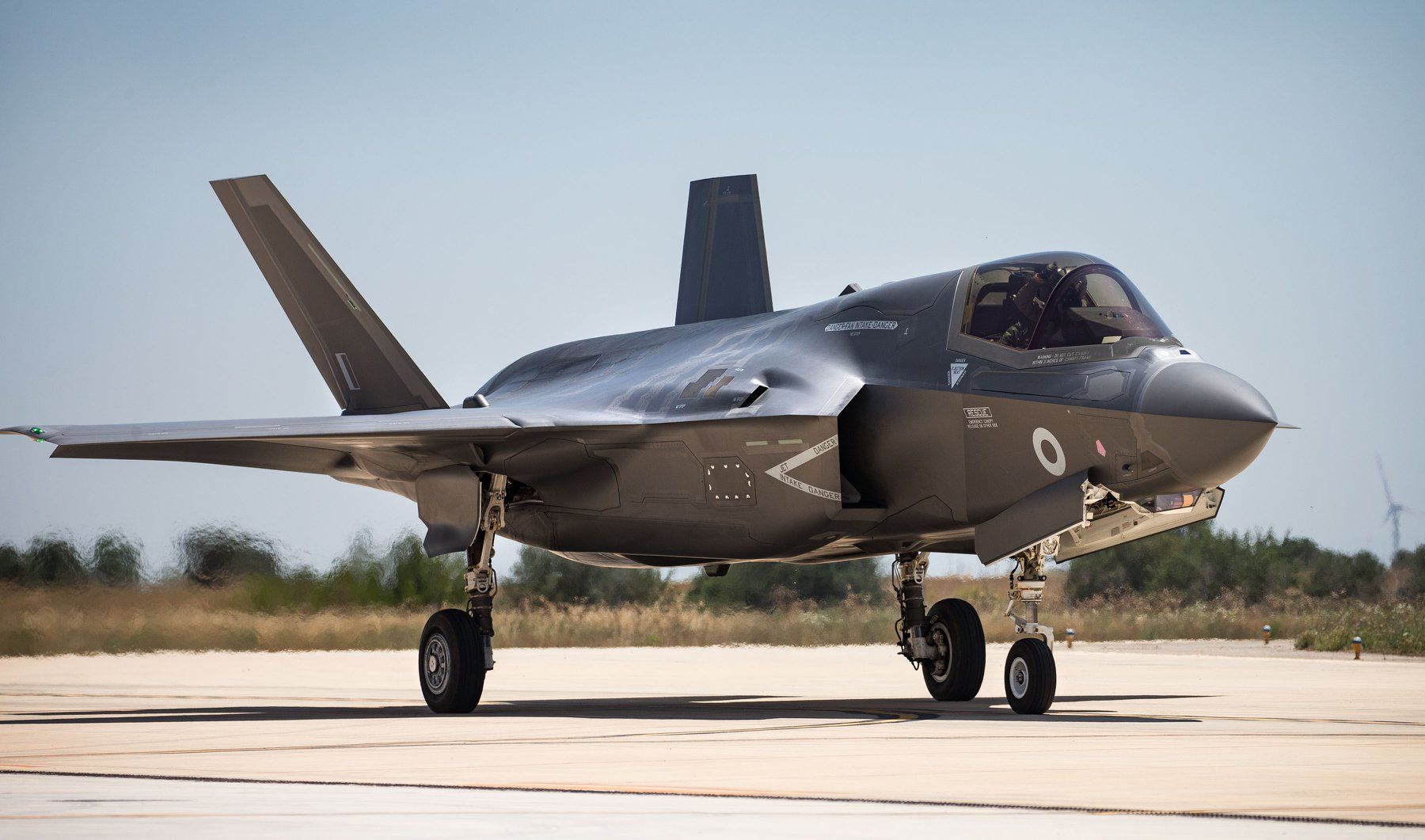
F-35s have flown alongside Typhoon aircraft on operational flights over the skies of Syria and Iraq, as part of the ongoing fight against Daesh, the Defence Secretary has confirmed.
It follows a successful training period in Cyprus, known as Exercise Lightning Dawn, aimed at building capability for the aircraft and supporting elements.
Due to the exceptional performance of the aircraft, pilots, and support staff during this time, it was decided that they were ready to make their operational debut from RAF Akrotiri, alongside the Typhoons.
Speaking at RAF Akrotiri, Defence Secretary Penny Mordaunt said:
The F-35s are the most advanced jets our country has ever possessed and will form the backbone of British air defence for decades to come.
They have passed every test their training has thrown at them with flying colours and their first real operational mission is a significant step into the future for the UK.
The first RAF F-35B operational sorties were flown on Sunday 16 June in support of Operation Shader, the UK contribution to the Global Coalition?s counter Daesh mission in Iraq and Syria. The two aircraft conducted a patrol over Syria, and UK F-35s have flown a further 12 sorties since then.
The F-35 is the first aircraft to combine radar-evading stealth technology with supersonic speeds and the ability to conduct short take-offs and vertical landings.
The Lightning force is jointly operated by the RAF and Royal Navy. With the ability to operate from land and sea, the F-35 forms a vital part of delivering a ?carrier strike? capability to the UK when combined with Britain?s new Queen Elizabeth Class aircraft carriers.
Chief of the Air Staff, Air Chief Marshal Sir Stephen Hillier, said:
This first operational mission for the UK?s F-35 Lightning confirms the impressive progress which we have made in introducing this formidable new capability into service.
It is testament to the outstanding abilities of our dedicated and highly trained air and ground crew that 617 Squadron has achieved this important milestone so quickly and so effectively.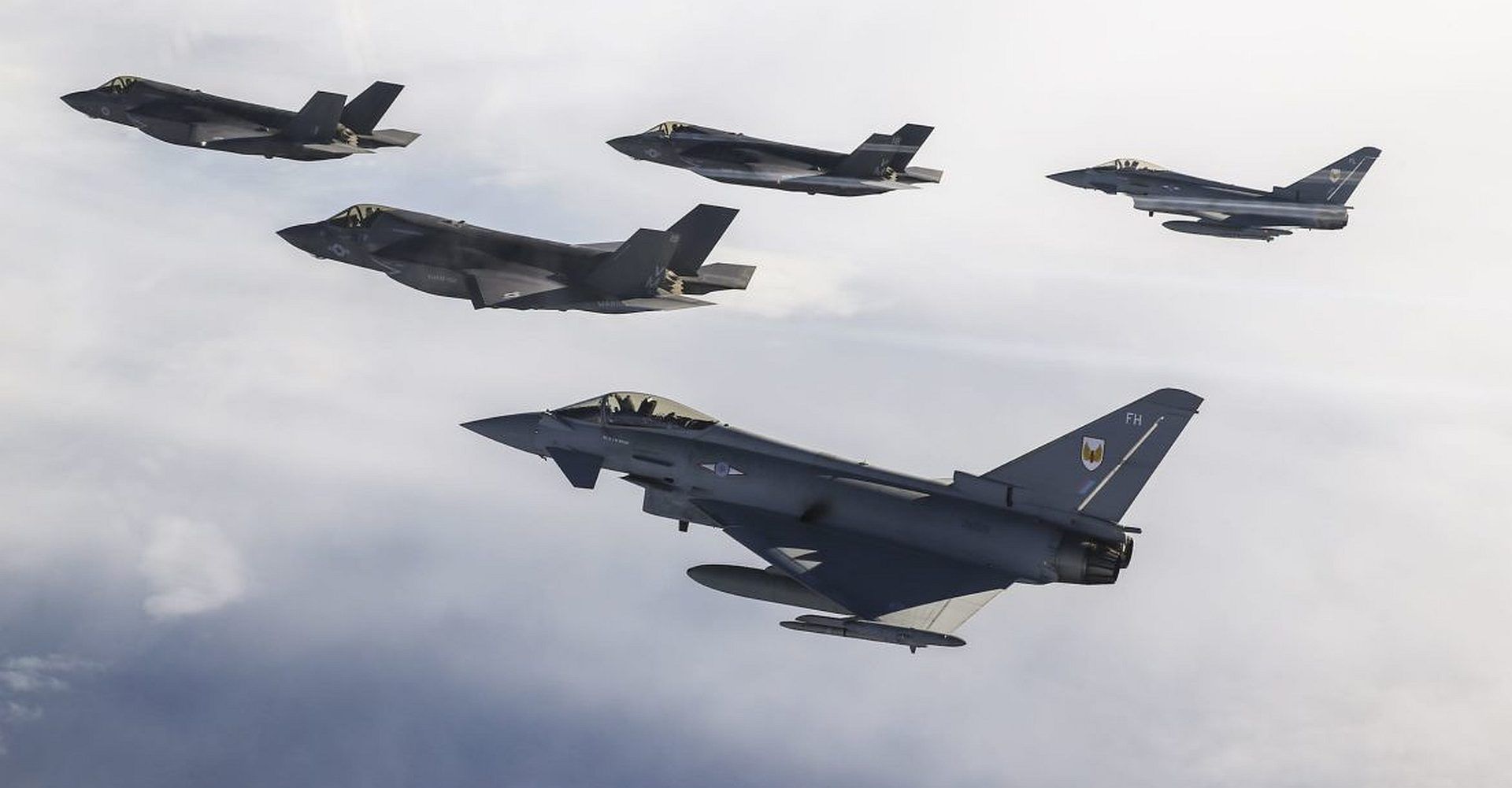
Admiral Tony Radakin CB ADC, First Sea Lord and Chief of Naval Staff, said:
It?s great to see our F35B Lightning jets already proving themselves on operations so early in their life cycle, ably demonstrating the fantastic capability these world-leading aircraft offer.
This Autumn, our aircraft carrier HMS Queen Elizabeth will return to the East Coast of the United States to conduct Operational Trials with our Lightning Force, taking this 5th generation capability to the next level as they prove their ability to operate from the sea.
For decades to come, this exciting new combination of aircraft carriers and F35B Lightnings will provide a potent, globally deployable carrier strike capability, a powerful conventional deterrent and the centrepiece of our country?s expeditionary forces.
Later in the year, 617 Squadron will embark in HMS Queen Elizabeth for the first time. The UK jets will conduct Operational Tests, alongside 17 Test and Evaluation Squadron, onboard the carrier in the USA during the WESTLANT 19 deployment, proving their capability at sea. This is vital step on the path to the first Carrier Strike Deployment planned for 2021.
The UK currently owns 17 F-35B aircraft with the reformed 617 Sqn arriving back in the UK last year. More jets are due in Britain over the coming years, including the imminent arrival of 207 Sqn at RAF Marham, and there is an overall plan to procure 138 aircraft over the life of the programme.
The programme has already generated $12.9 billion worth of orders and at peak production will support thousands of British manufacturing and engineering jobs.
UK Air Component Commander for the Middle East, Air Commodore Justin Reuter, said:
The pilots, crew and aircraft have exceeded all training objectives since deploying to Cyprus so it was only right that they made the next step on their journey.
The UK has played a vital role in liberating swathes of territory once subjected to Daesh?s cruel regime, and the deployment of our newest and most advanced jets signals our commitment to the enduring defeat Daesh in Iraq and Syria.
The Defence Secretary also used the visit to hold a meeting with her Cypriot counterpart, Savvas Angelides, to further bolster bilateral ties.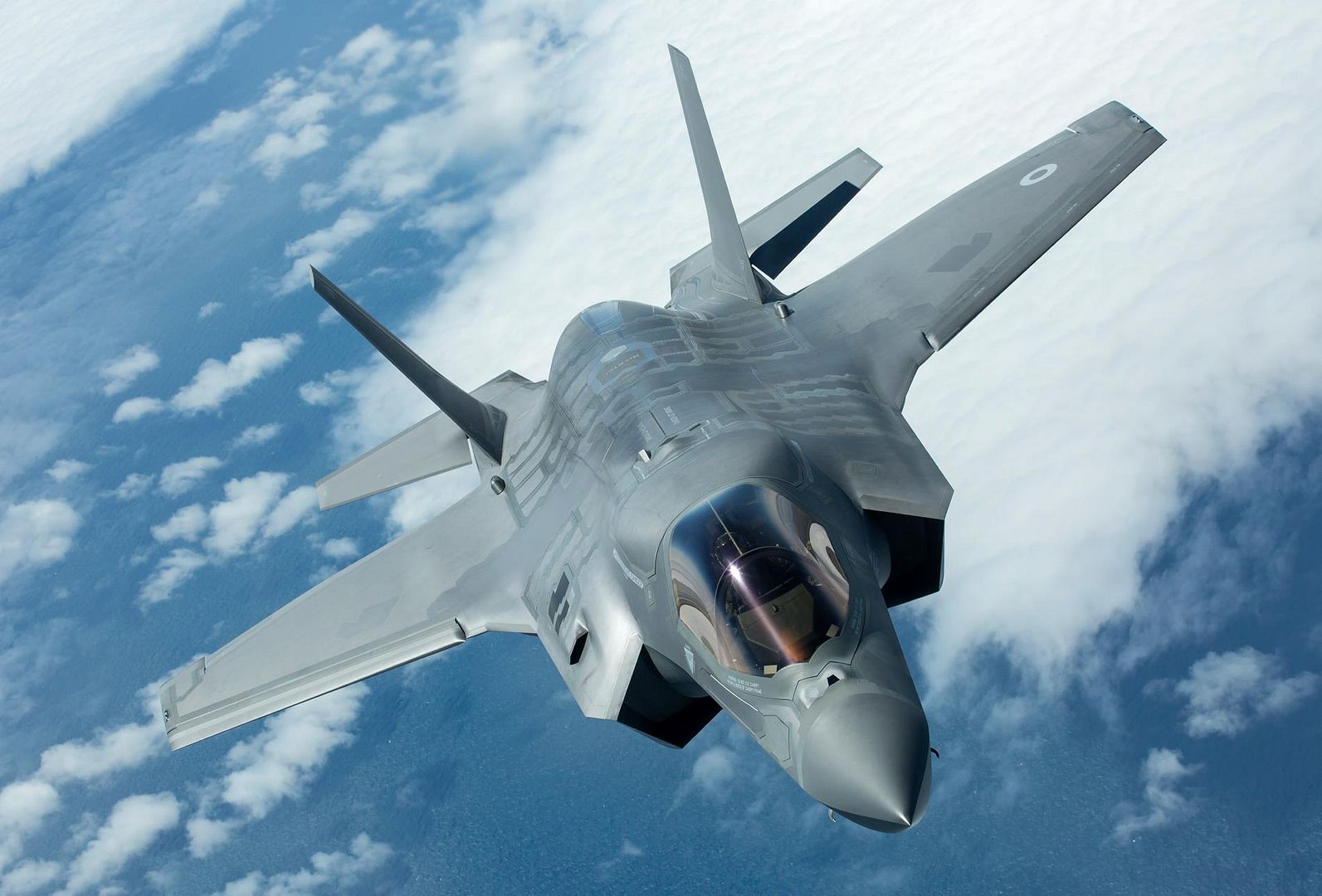
-
EASTERN MEDITERRANEAN SEA (AFNS) --
F-35 Lightning II fighter aircraft from the U.S, United Kingdom and Israel participated in Exercise Tri-Lightning over the Eastern Mediterranean Sea, June 25.
Exercise Tri-Lightning was a one-day defensive counter air exercise involving friendly and adversary aircraft from the three participating countries and consisted of active and passive air defense operations.
This exercise is a demonstration of the interoperability between the U.S., U.K. and Israel using the F-35A, F-35B and F-35I respectively.
?We build capacity with our strategic partners to harness our air component?s capabilities and skills,? said Lt. Gen. Joseph Guastella, U.S. Air Forces Central Command commander. ?The transatlantic strategic relationship between the U.S. and our allies and partners has been forged over the past seven decades and is built on a foundation of shared values, experience and vision.?
The U.S. Air Force F-35As flew from Al Dhafra Air Base, United Arab Emirates, the Royal Air Force F-35Bs flew from RAF Akrotiri, Cyprus, and the Israeli Air Force F-35Is flew from Nevatim Air Base, Israel.
?Tri-Lightning was an exercise which had been planned for months and it provided an outstanding opportunity for the squadron to operate and learn from our fellow F-35 community,? said U.K. Wing Commander John Butcher, Squadron 617 commanding officer. ?In addition it allowed us to share and gain valuable experience that we will be able to exploit during future training and potentially operational deployments, whether embedded on the Queen Elizabeth or from overseas air bases.?
The F-35s from the three nations played as primary friendly, or blue, force players in this exercise while a variety of other aircraft played the aggressor roles, simulating realistic combat situations between the advanced F-35s and previous generation fighters.
?The exercise today reflects the close cooperation between the participating nations, said Brig. Gen. Amnon Ein-Dar, Israel Chief of Air Staff. ?This training opportunity between Israel, the U.S. and Britain, strengthens shared capabilities and overall cooperation amongst allies.?
(U.S. Air Force photo by Staff Sgt. Keifer Bowes)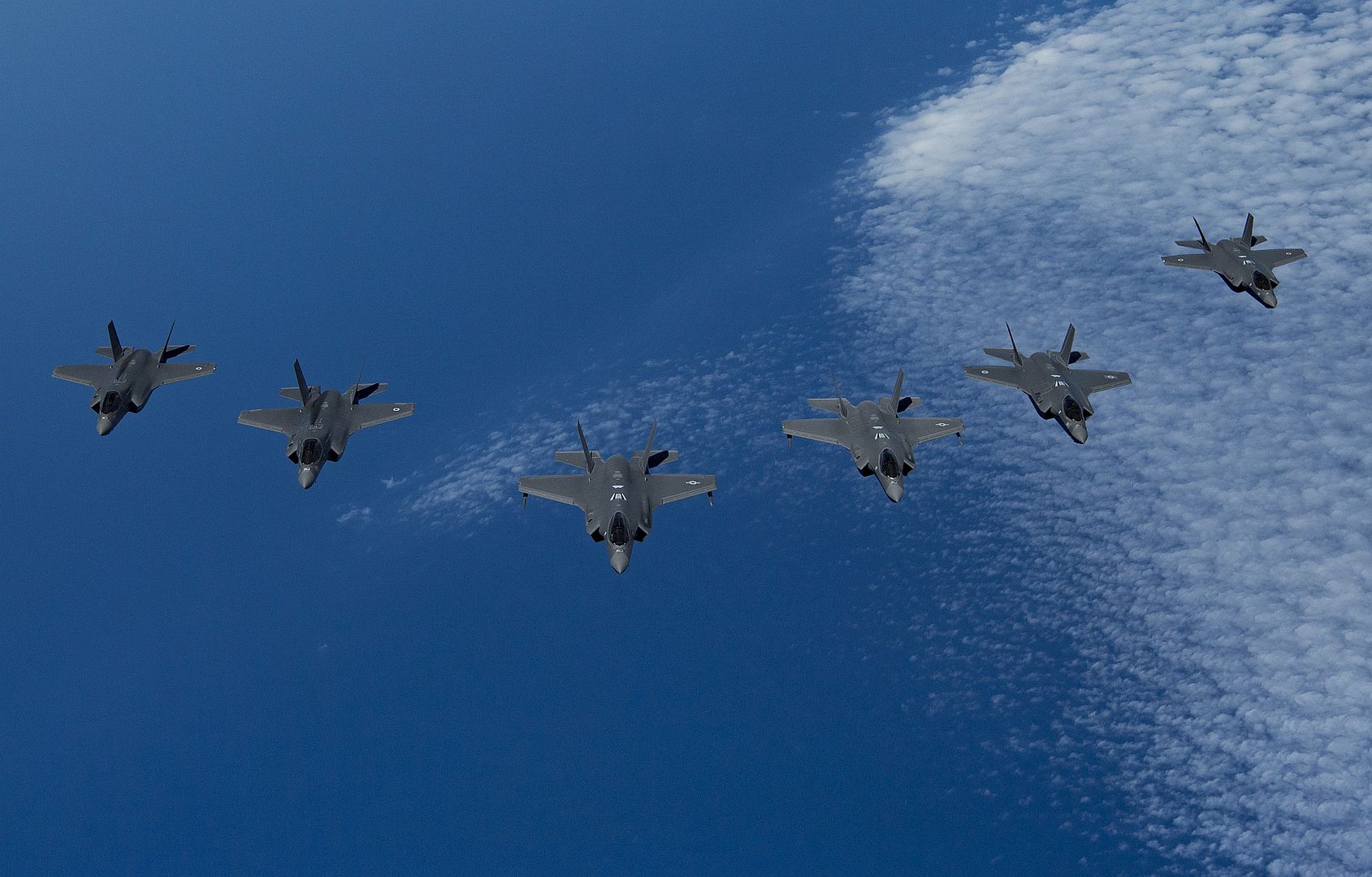
A KC-10 Extender from the 908th Expeditionary Refueling Squadron takes off before Exercise Tri-Lightning June 25, 2019, at Al Dhafra Air Base, United Arab Emirates. This exercise is intended to enhance capability and interoperability among the F-35 variants from the U.S. Air Force, Royal Air Force and Israeli Air Force. This is the first-ever exercise where the three nations are conducting aviation training with the same airframe at the same time. (U.S. Air Force Photo by Staff Sgt. Chris Thornbury)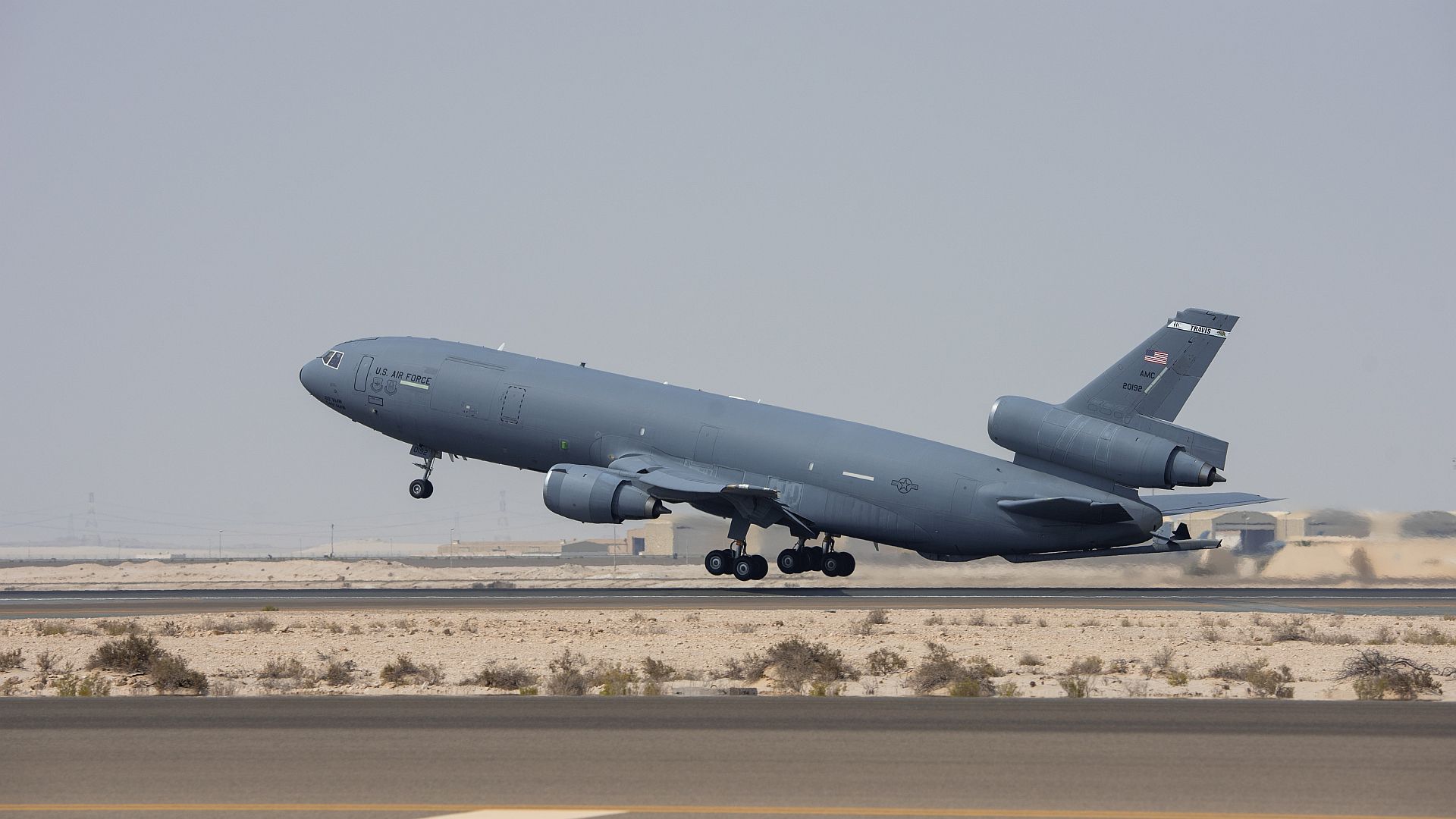
An F-15E Eagle from the 493rd Expeditionary Fighter Squadron taxis to the runway at Al Dhafra Air Base, United Arab Emirates, before Exercise Tri-Lightning June 25, 2019. The U.S. Air Force F-15E?s assigned to ADAB took part as simulated adversary aircraft in Exercise Tri-Lightning, a defensive counter air exercise over the Eastern Mediterranean involving the U.S., U.K., and Israel. This type of exercise is intended to improve interoperability and coordination in air operations. (U.S. Air Force Photo's by Staff Sgt. Chris Thornbury)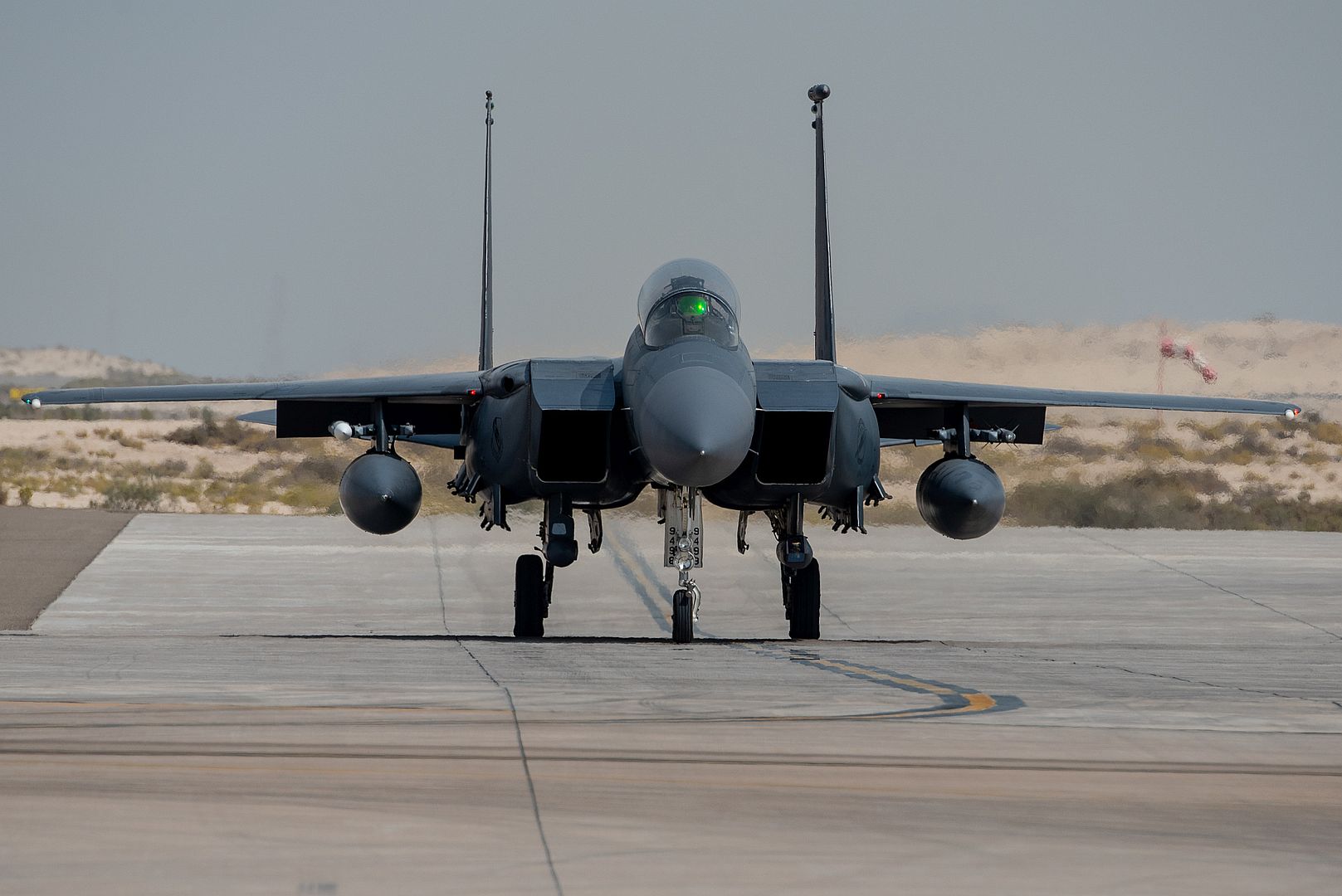
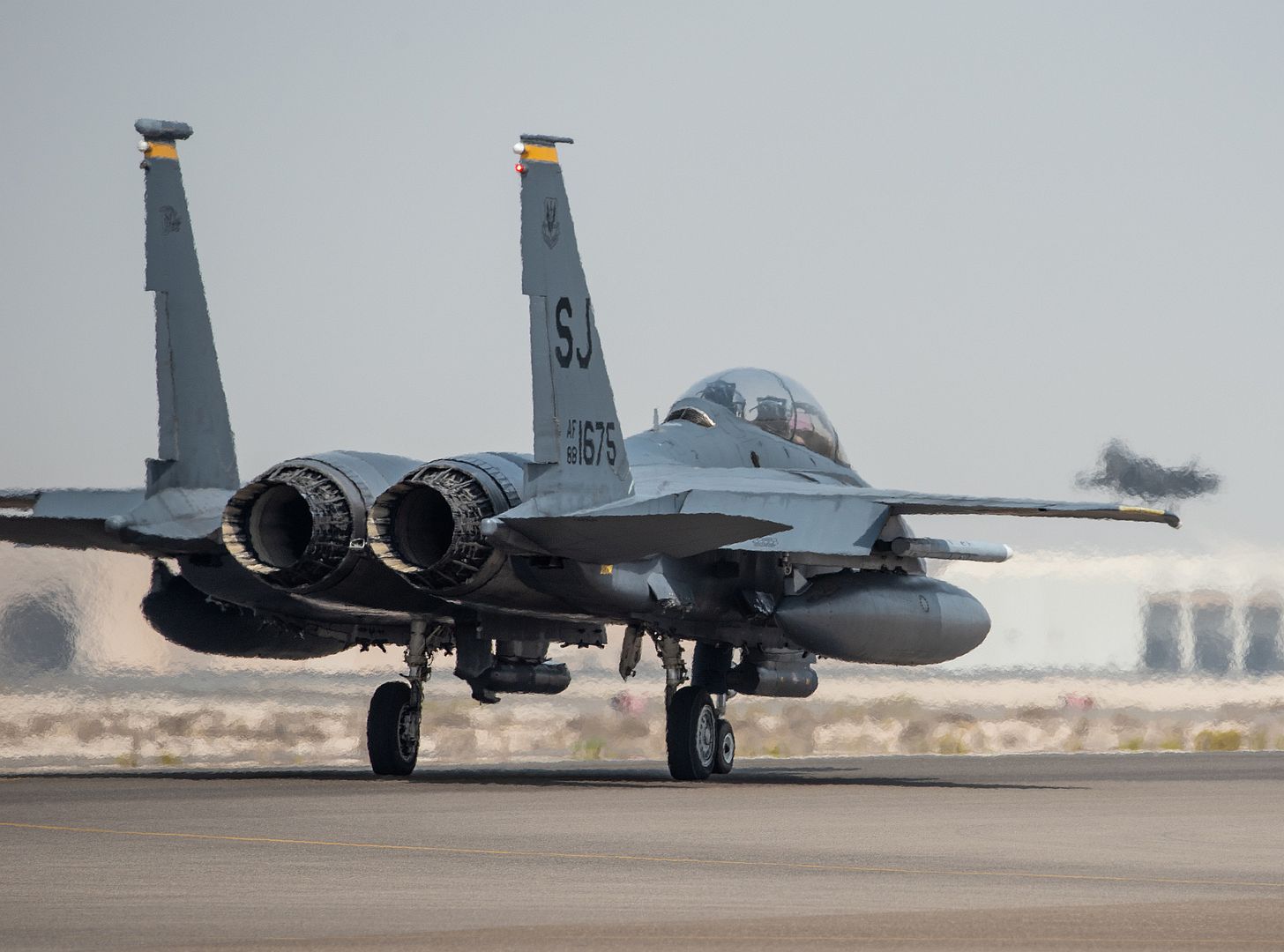
The 965th Airborne Air Control Squadron had an Airborne Warning and Control System dedication day June 24, at Tinker Air Force Base, Oklahoma. This dedication inspires ownership, improves partnership, and continues to strengthen the vital bond between aircrew and maintenance professionals at the point of execution. "What makes today special is that we get to carry on traditions that were started with the inception of flight and honed over the years,? said Lt. Col. Walter Goss, the commander of the 965th AACS.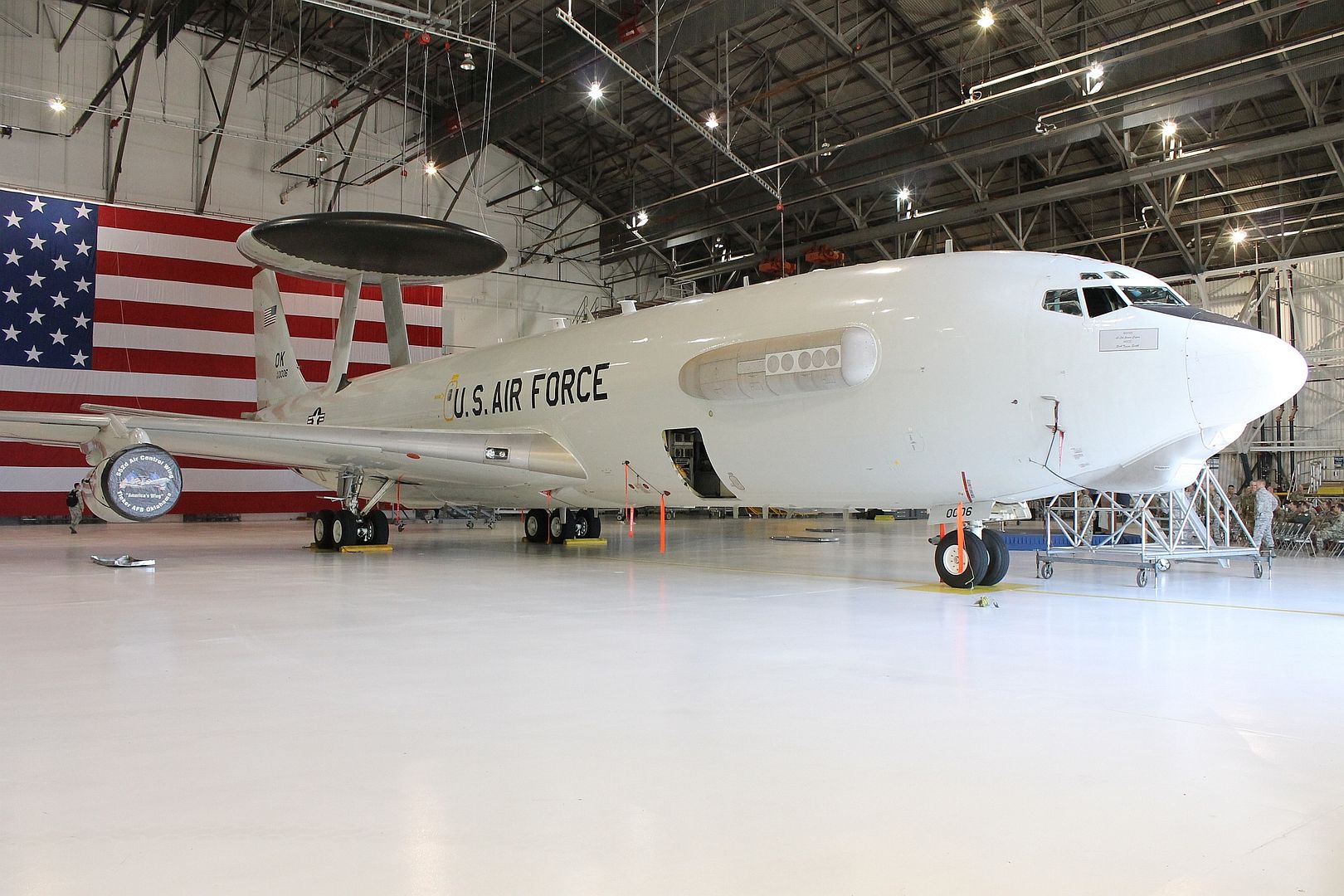
NAVAL SUPPORT ACTIVITY SOUDA BAY, Greece (June 24, 2019) A U.S. Marine MV-22 Osprey attached to attached to the 22nd Marine Expeditionary Unit sits on the flight line at Naval Support Activity Souda Bay, Greece, June 24, 2019. NSA Souda Bay is an operational ashore base that enables U.S., allied, and partner nation forces to be where they are needed and when they are needed to ensure security and stability in Europe, Africa, and Southwest Asia. (Photo by Mass Communication Specialist 2nd Class Kelly M. Agee/Released)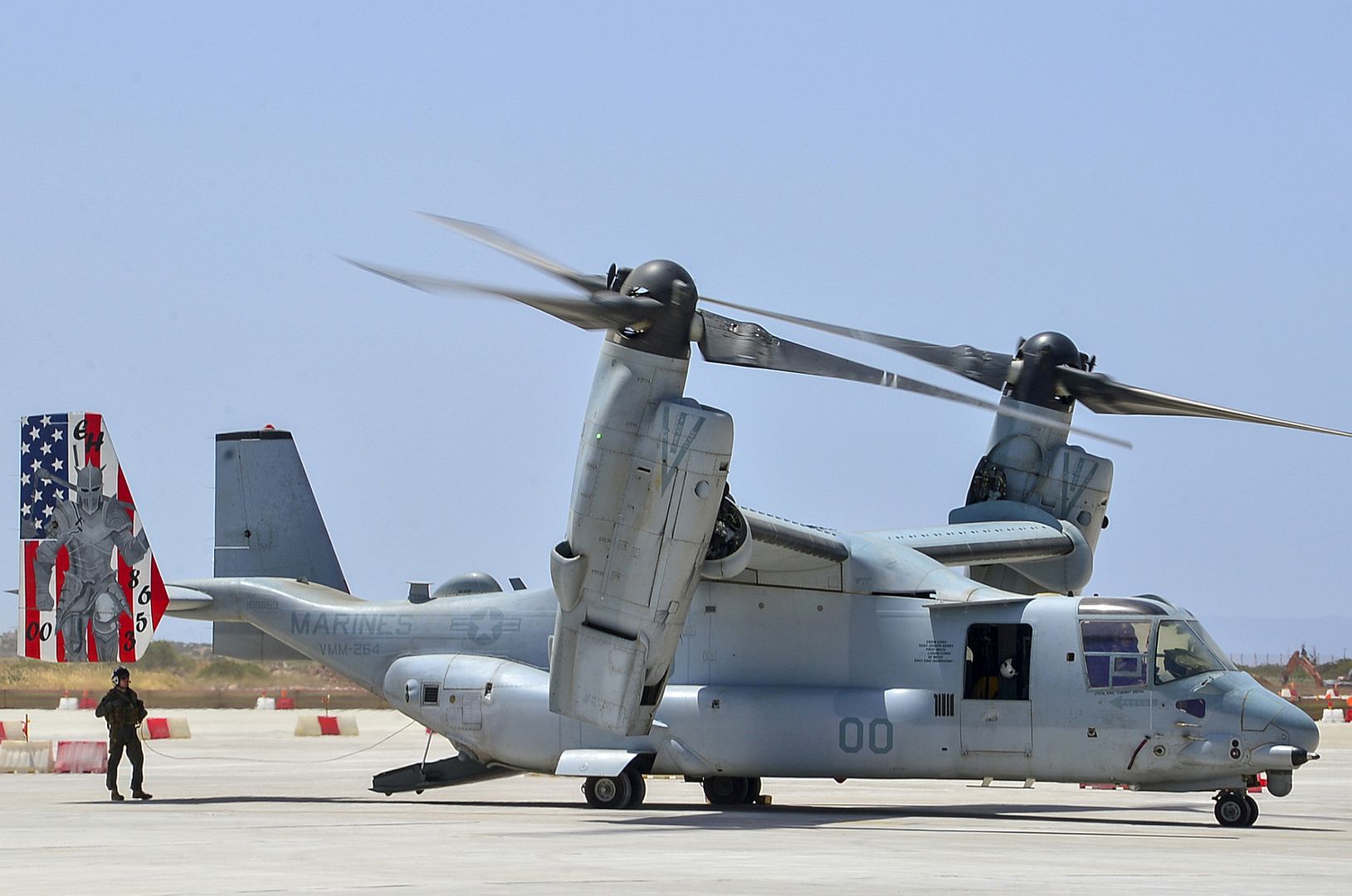
SEATTLE, June 26, 2019 ? Boeing [NYSE:BA] today delivered the first 787-9 Dreamliner for Turkish Airlines, which plans to use the airplane's fuel efficiency, range, reliability and size to operate new non-stop international routes such as Bali, Bogota-Panama, Washington and Atlanta.
?Turkish Airlines has been committed to continuously expanding its range of services on and off-ground as it grows in reach and flies to more international destinations than any other carrier in the world. With this goal in mind, we?re thrilled to reach new horizons with the addition of the 787-9 Dreamliner to our fleet flying from our new home, Istanbul Airport,? said M. ?lker Ayc?, Turkish Airlines? Chairman of the Board and the Executive Committee. ?The aircraft?s advanced technology, fuel efficiency, and passenger-centric cabin design will all help us remain the first choice for travellers and provide our loyal flyers across the globe with a best-in-class experience for years to come.?
More than 80 customers around the world have ordered more than 1,400 Dreamliners since the program?s introduction, making it the fastest-selling widebody jet in history. The 787 Dreamliner allows airlines to reduce fuel use and emissions by 20 to 25 percent and serve far-away destinations. The combination of fuel efficiency and long range has helped airlines flying the 787 family of airplanes save more than 36 billion pounds (16 billion kilograms) of fuel and open more than 235 non-stop routes.
As part of the 787 Dreamliner family, the 787-9 is powered by a suite of new technologies and a revolutionary design. It can fly 7,635 nautical miles (14,140 km) in addition to carrying more cargo and allowing airlines to profitably grow routes. The airplane allows operators to achieve better fuel efficiency per seat compared to the previous airplanes in its class.
Turkish Airlines? Dreamliner has seating capacity for 300 passengers, including 270 economy class seats and 30 business class seats. The carrier?s 787 includes long haul economy class seats and business class monuments produced in Turkey by Turkish suppliers.
?Turkish Airlines? growth has been remarkable in recent years, both in expanding flight options and supporting Turkey?s aviation industry. We are honored that Turkish Airlines is embarking on its next chapter of expansion with the 787 Dreamliner,? said Ihssane Mounir, senior vice president of Commercial Sales and Marketing for The Boeing Company. ?We are confident that the Dreamliner?s unmatched fuel efficiency, performance and passenger-pleasing comforts will contribute to the airline's reputation as a five-star airline.?
About Boeing:
Boeing is the world's largest aerospace company and leading provider of commercial airplanes, defense, space and security systems, and global services. The company supports commercial and government customers in more than 150 countries. Boeing employs more than 150,000 people worldwide and leverages the talents of a global supplier base. Building on a legacy of aerospace leadership, Boeing continues to lead in technology and innovation, deliver for its customers and invest in its people and future growth. www.boeing.com
About Turkish Airlines
Based in Istanbul, Turkish Airlines carried 75,2 million passengers last year. The national flag carrier of Turkey currently operates direct flights to 311 destinations in 124 countries, as the only airline that flies to more countries and international destinations in the world. Turkish Cargo, the successful sub-brand of Turkish Airlines, is the world's fastest-growing air cargo carrier considering the cargo volumes, new flight destinations, and expanding cargo fleet. It serves customers in more than 300 destinations including 88 dedicated direct cargo flights in over 120 countries.
-
U.S. Air Force fourth and fifth-generation aircraft fly in an echelon formation with a Royal Air Force Typhoon and a French Rafale in support of exercise Point Blank 19-2, over the North Sea, June 27, 2019. The objective of the exercise is to prepare coalition warfighters for a highly contested fight against near-peer adversaries by providing a multi-dimensional battle-space to conduct advanced training in support of US, UK and French national interests. (U.S. Air Force photo/ Tech. Sgt. Matthew Plew)
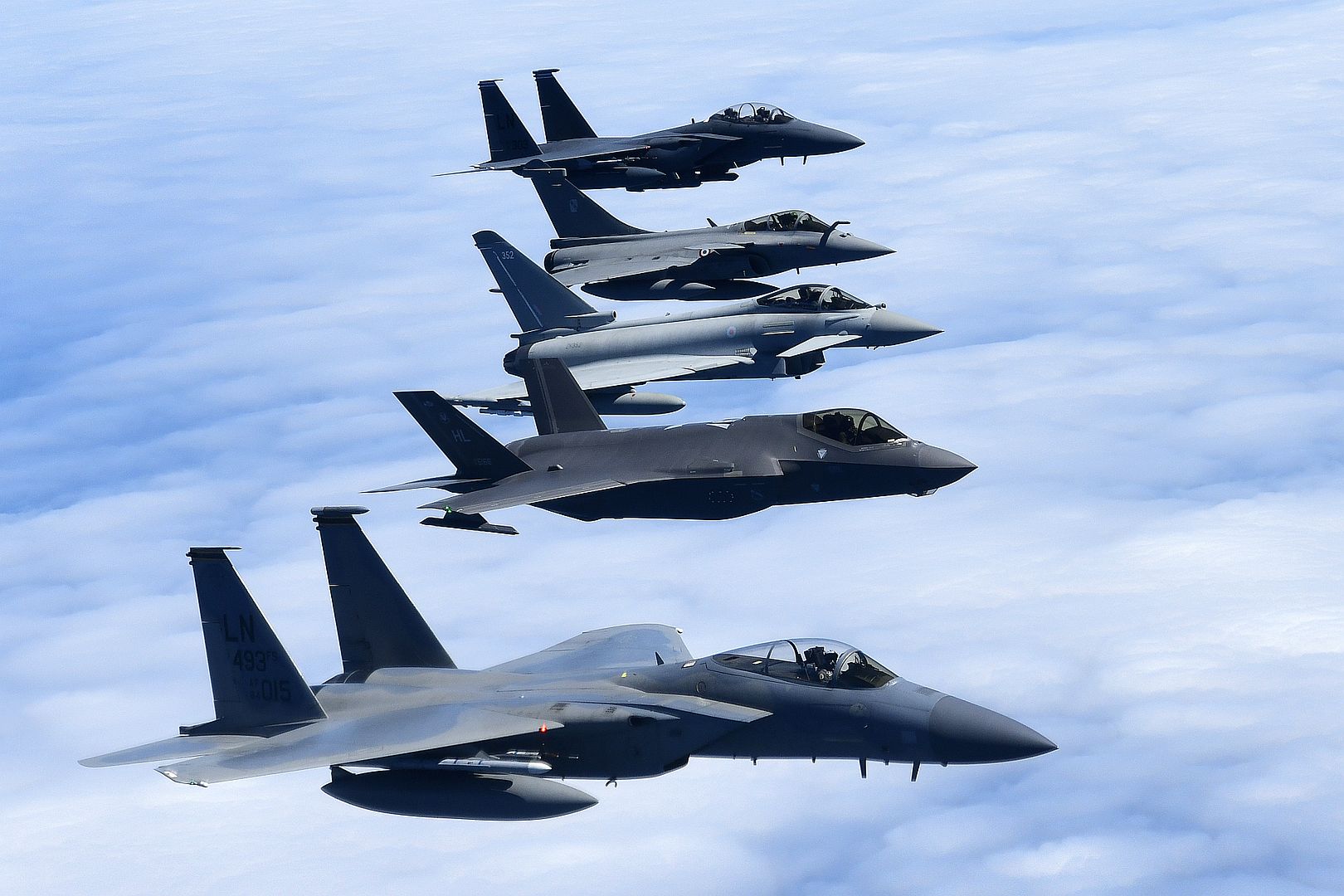
U.S. Air Force fourth and fifth-generation aircraft fly in an echelon formation with a Royal Air Force Typhoon in support of exercise Point Blank 19-2, over the North Sea, June 27, 2019. The objective of the exercise is to prepare coalition warfighters for a highly contested fight against near-peer adversaries by providing a multi-dimensional battle-space to conduct advanced training in support of US, UK and French national interests. (U.S. Air Force photo/ Tech. Sgt. Matthew Plew)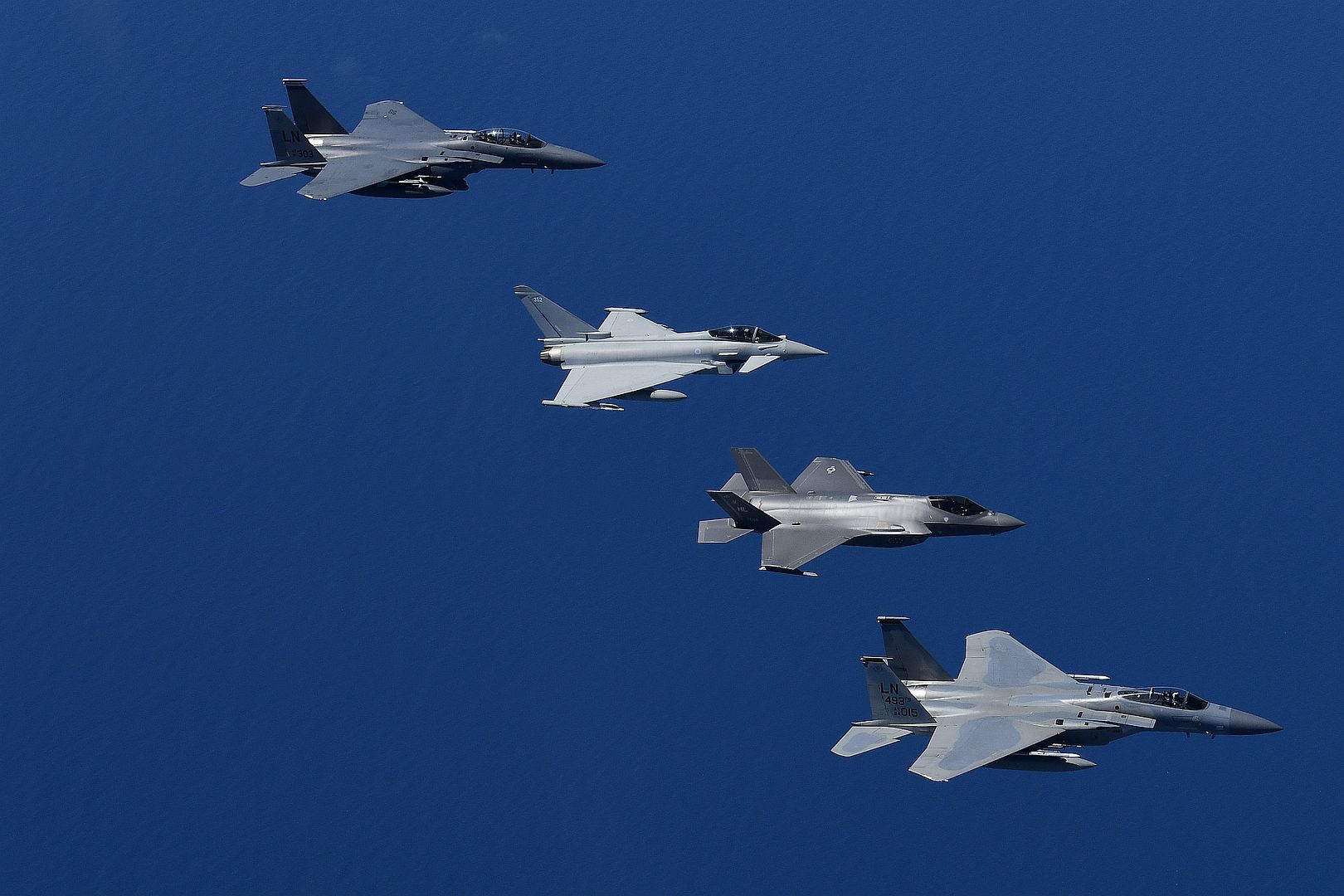
An F-15C Eagle assigned to the 493rd Fighter Squadron conducts aerial operations in support of exercise Point Blank 19-2, over the North Sea, June 27, 2019. The objective of the exercise is to prepare coalition warfighters for a highly contested fight against near-peer adversaries by providing a multi-dimensional battle-space to conduct advanced training in support of US, UK and French national interests. (U.S. Air Force photo/ Tech. Sgt. Matthew Plew)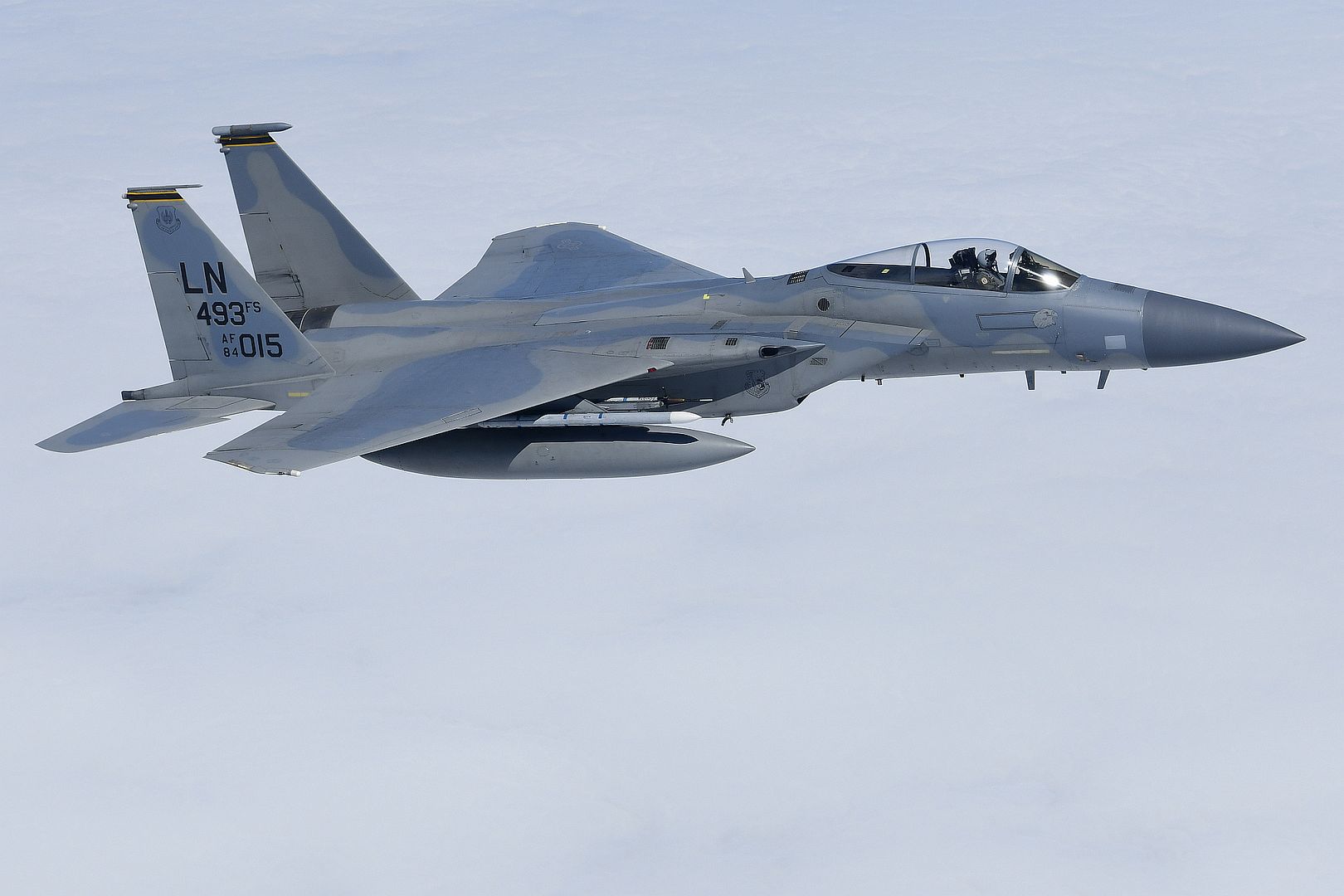
F-15 aircraft assigned to the 48th Fighter Wing conduct aerial operations in support of exercise Point Blank 19-2, over the North Sea, June 27, 2019. The objective of the exercise is to prepare coalition warfighters for a highly contested fight against near-peer adversaries by providing a multi-dimensional battle-space to conduct advanced training in support of US, UK and French national interests. (U.S. Air Force photo/ Tech. Sgt. Matthew Plew)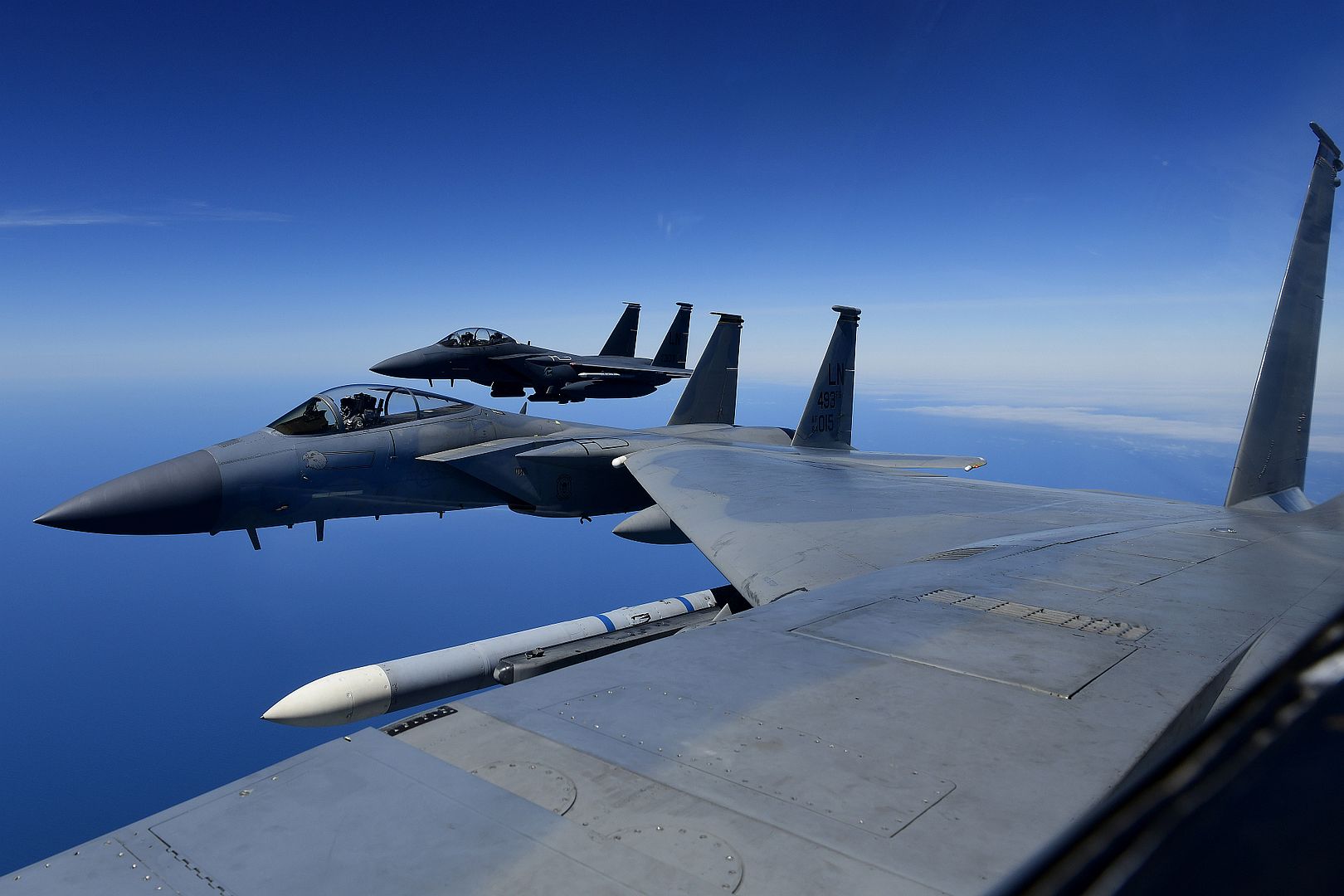
A French Air Force Rafale takes off to participate in exercise Point Blank at Royal Air Force Lakenheath, England, June 27, 2019. Training exercises with NATO allies reinforce and enhance deterrence and combined defense capabilities. (U.S. Air Force photo by Airman 1st Class Rhonda Smith)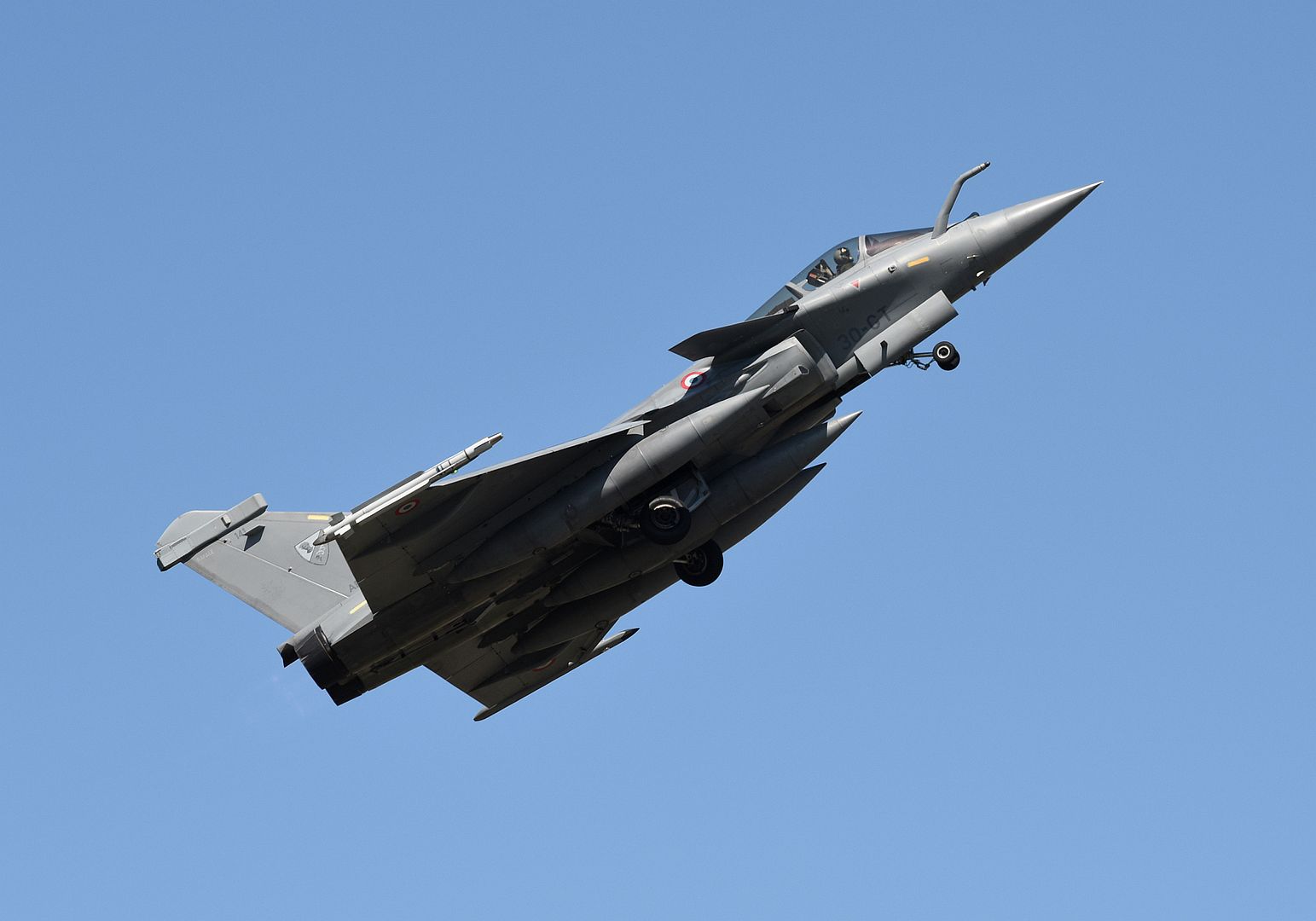
A 492nd Fighter Squadron F-15E Strike Eagle takes off during exercise Point Blank 19-2 at Royal Air Force Lakenheath, England, June 27, 2019. This trilateral exercise provides a low-cost initiative designed to increase the tactical proficiency of participating air forces. (U.S. Air Force photo by Airman 1st Class Rhonda Smith)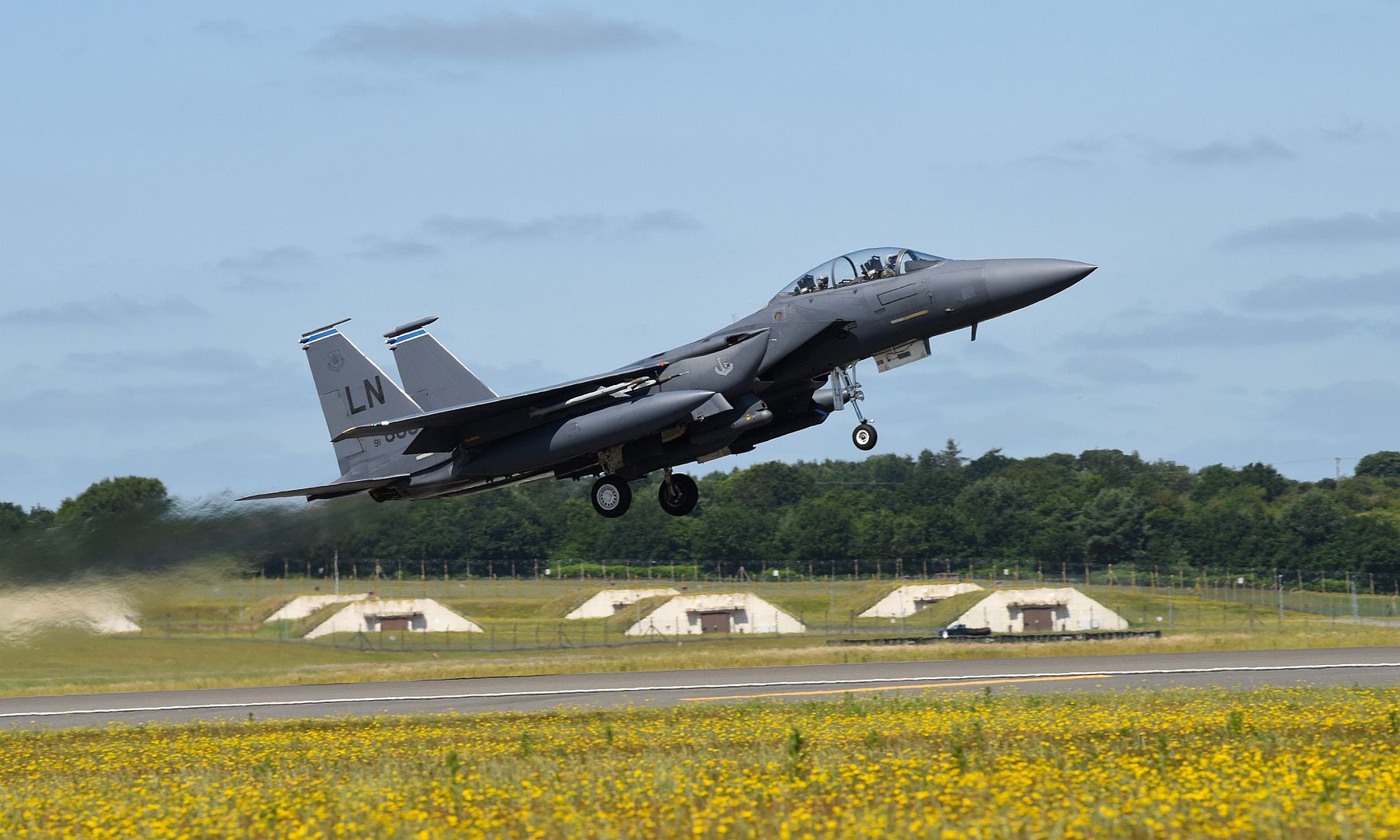
A French Air Force Rafale takes off during exercise Point Blank 19-2 at Royal Air Force Lakenheath, England, June 17, 2019. Point Blank is a trilateral exercise focused on fourth and fifth-generation aircraft integration. (U.S. Air Force photo by Staff Sgt. Alex Fox Echols III/Released)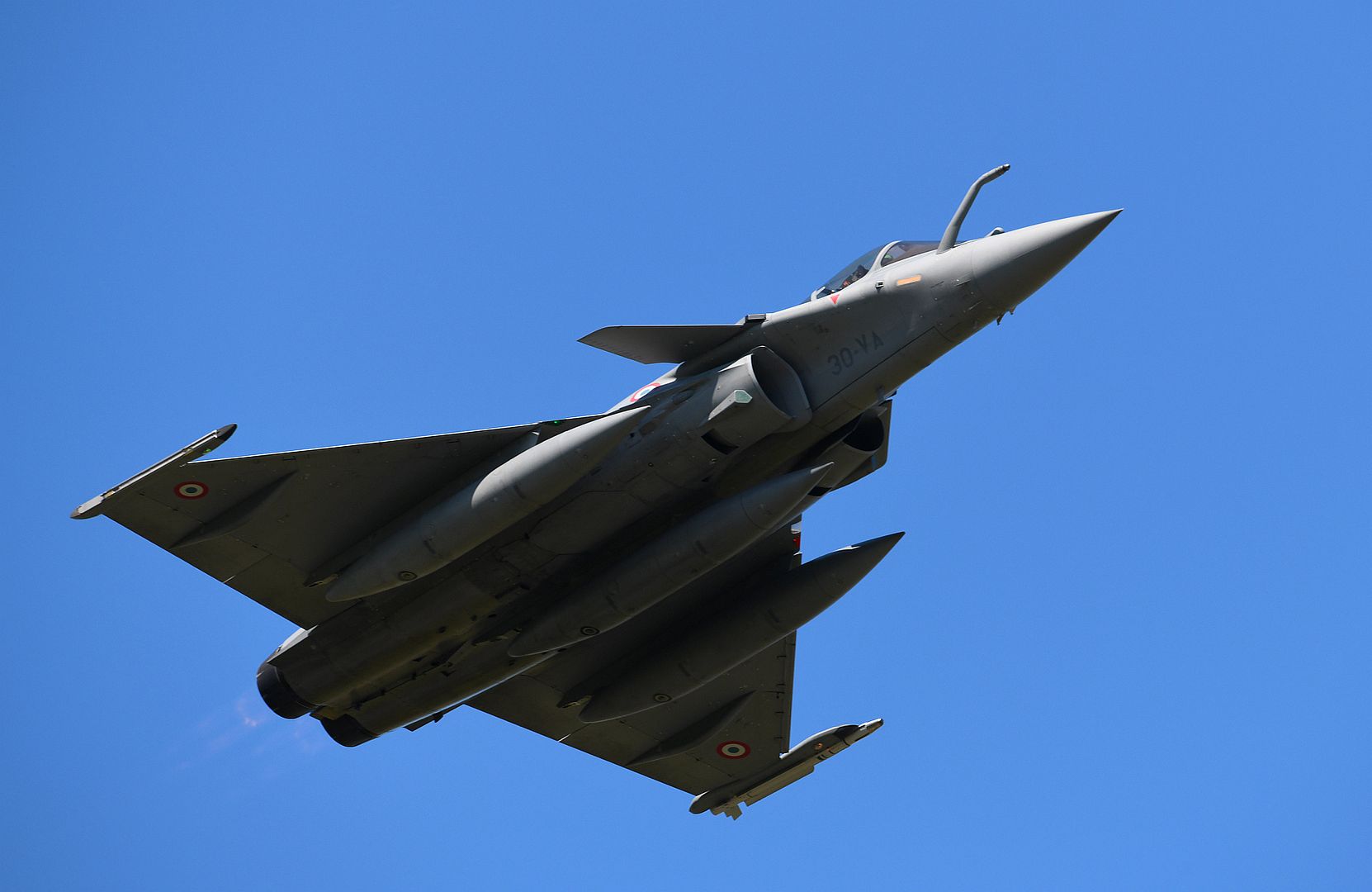
A U.S. Air Force F-15C Eagle, assigned to the 493rd Fighter Squadron, takes off during exercise Point Blank 19-2 at Royal Air Force Lakenheath, England, June 17, 2019. Routine multinational training exercises like Point Blank increase participating air force?s ability to integrate with other allied nations. (U.S. Air Force photo by Staff Sgt. Alex Fox Echols III/Released)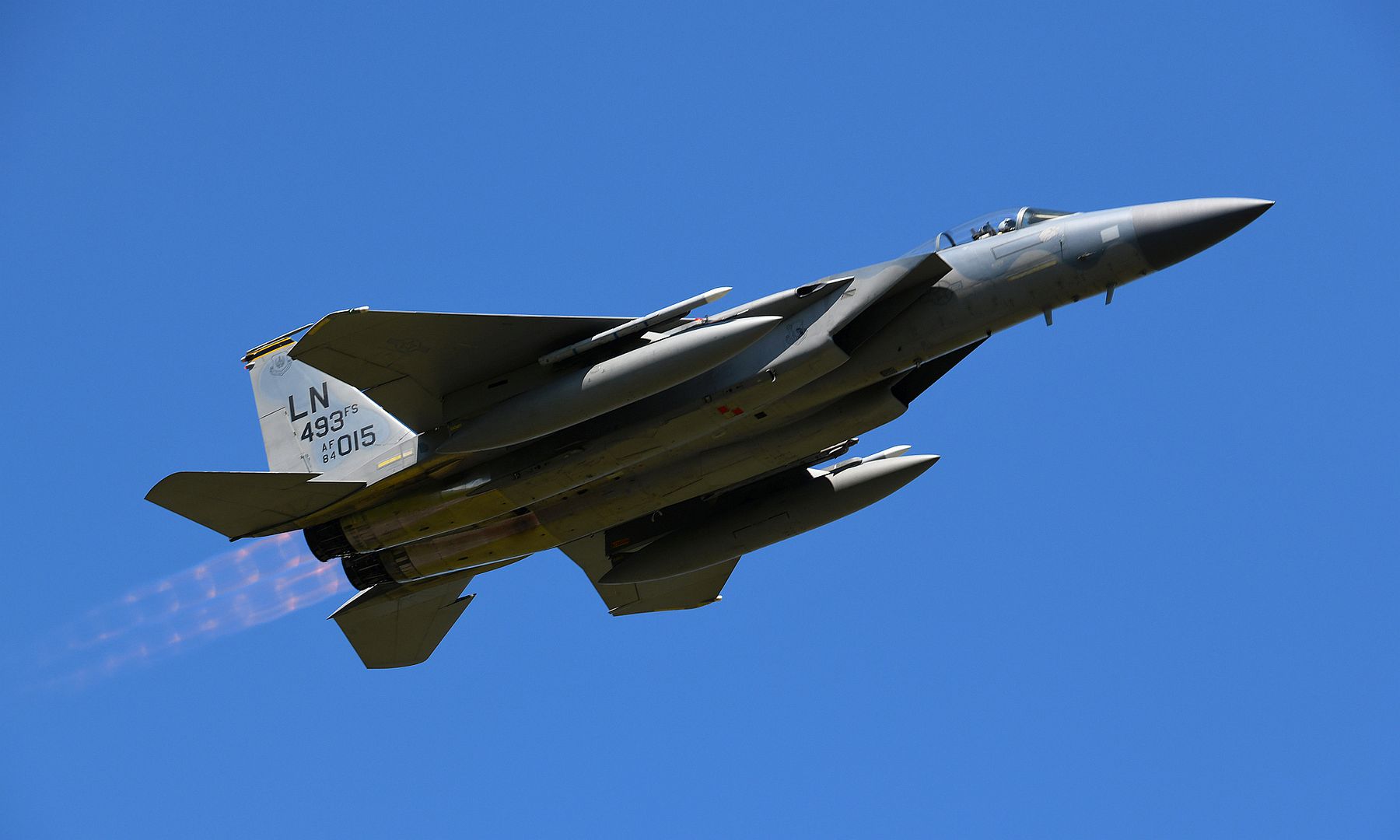
A French Air Force pilot climbs into a Rafale during exercise Point Blank 19-2 at Royal Air Force Lakenheath, England, June 17, 2019. More than 50 aircraft from three nations, U.S., France, and the UK, participated in the exercise promoting interoperability. (U.S. Air Force photo by Staff Sgt. Alex Fox Echols III/Released)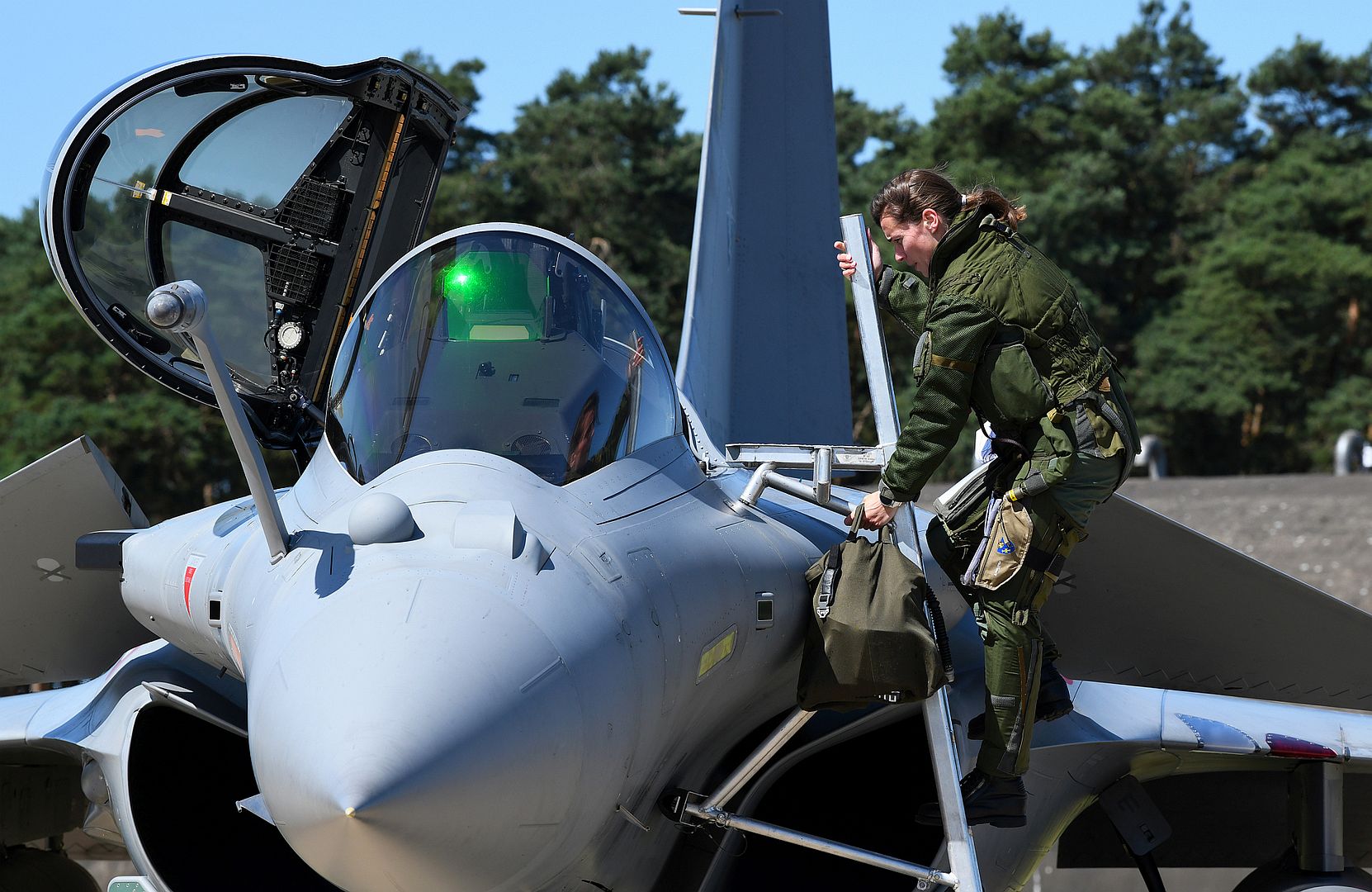
A French Air Force pilot prepares a Rafale for takeoff during exercise Point Blank 19-2 at Royal Air Force Lakenheath, England, June 17, 2019. During this trilateral exercise, participating air forces are enhancing professional relationships and improving overall coordination with allies and partner militaries during times of crisis. (U.S. Air Force photo by Staff Sgt. Alex Fox Echols III/Released)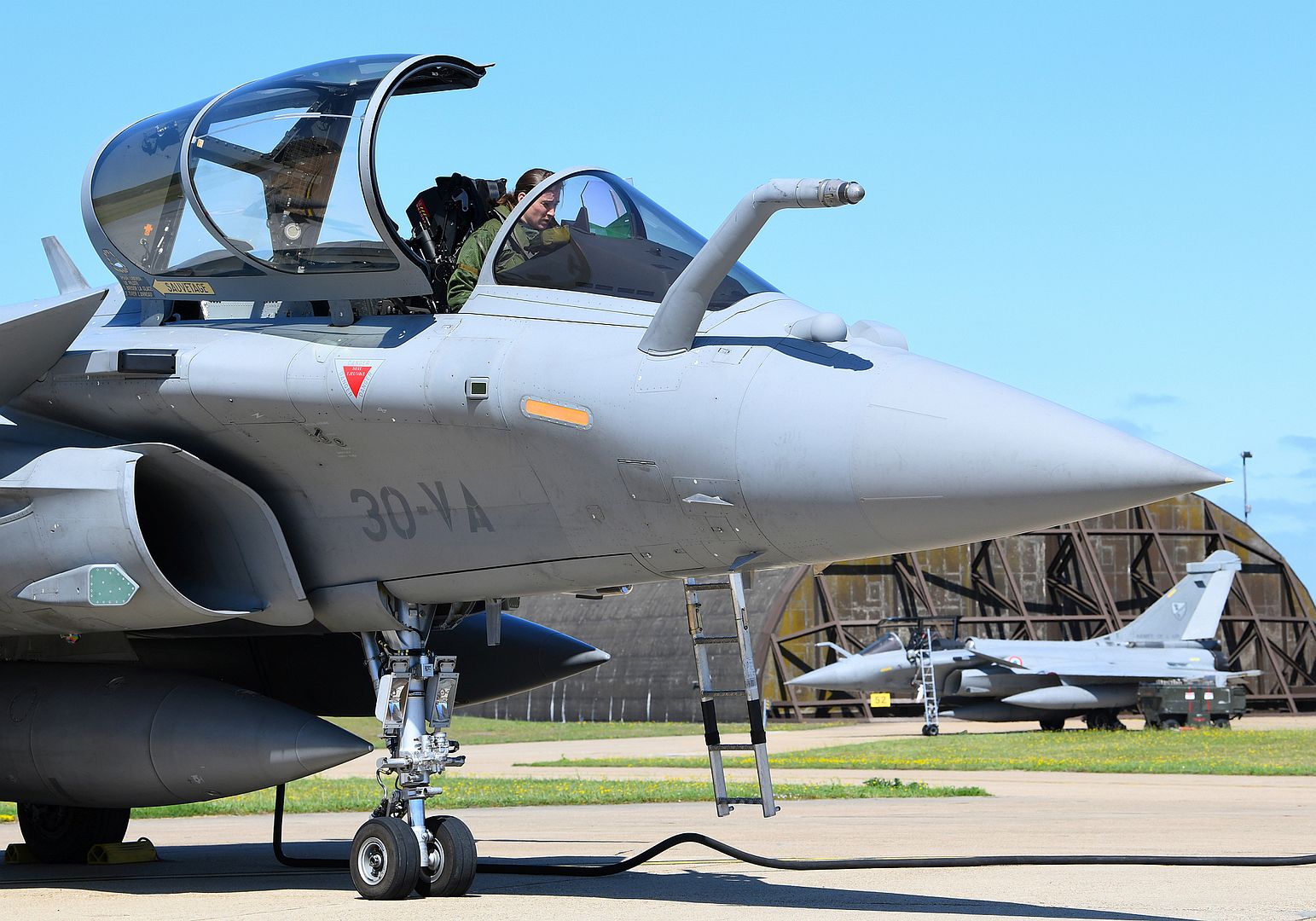
An F-15E Strike Eagle taxis past a French Air Force Rafale during exercise Point Blank 19-2 at Royal Air Force Lakenheath, England, June 17, 2019. More than 50 aircraft from three nations, U.S., France, and the UK, participated in the exercise promoting interoperability. (U.S. Air Force photo by Staff Sgt. Alex Fox Echols III/Released)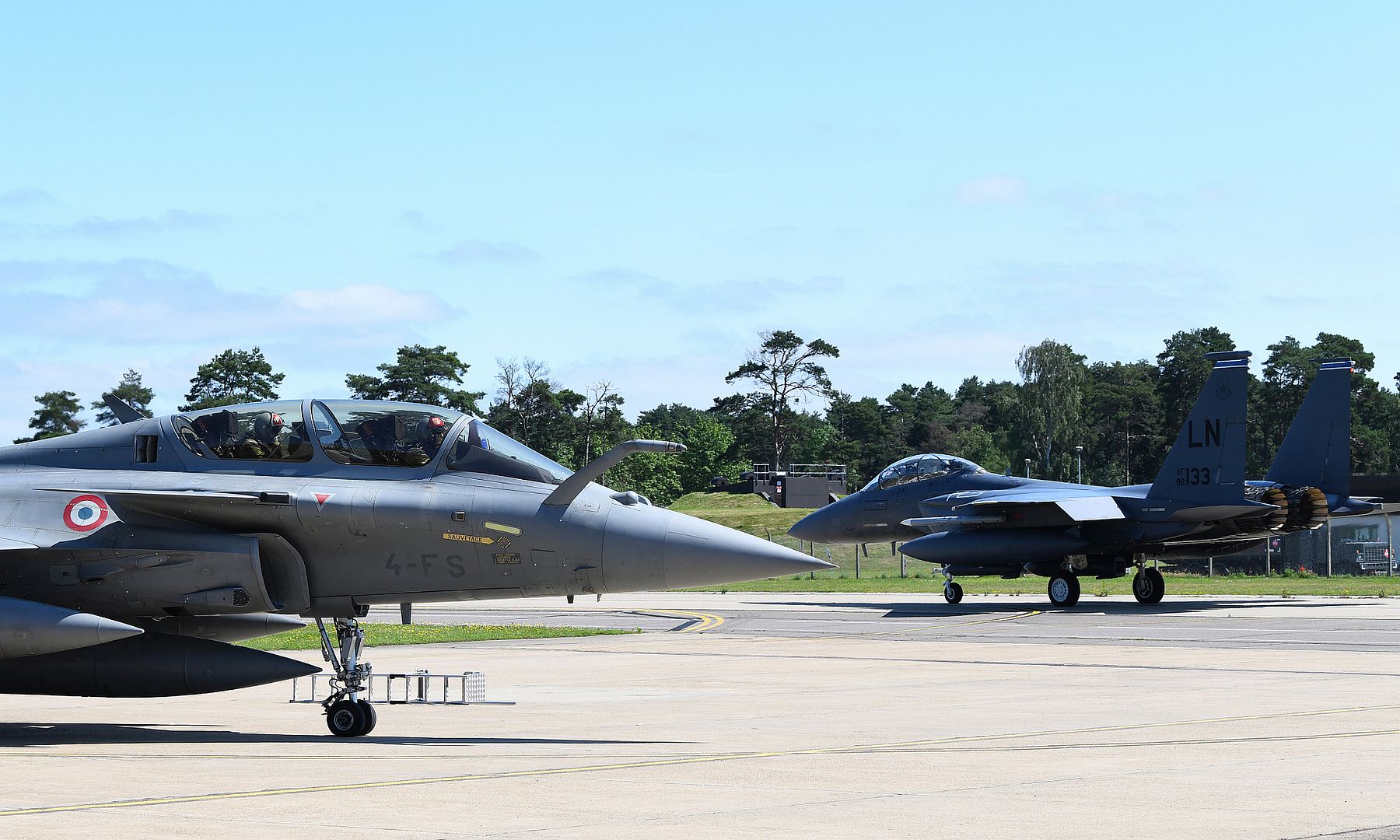
-
An F-15D Eagle assigned to the 493rd Fighter Squadron taxis past an F-15E Strike Eagle from the 492nd FS and an F-15C Eagle from the 493rd FS at Royal Air Force Lakenheath, England, during exercise Point Blank 19-2, June 27, 2019. U.S. personnel from RAF Lakenheath and RAF Mildenhall, along with military members from the U.K. and France participated in the exercise, promoting multinational cooperation. (U.S. Air Force photo by Master Sgt. Eric Burks)
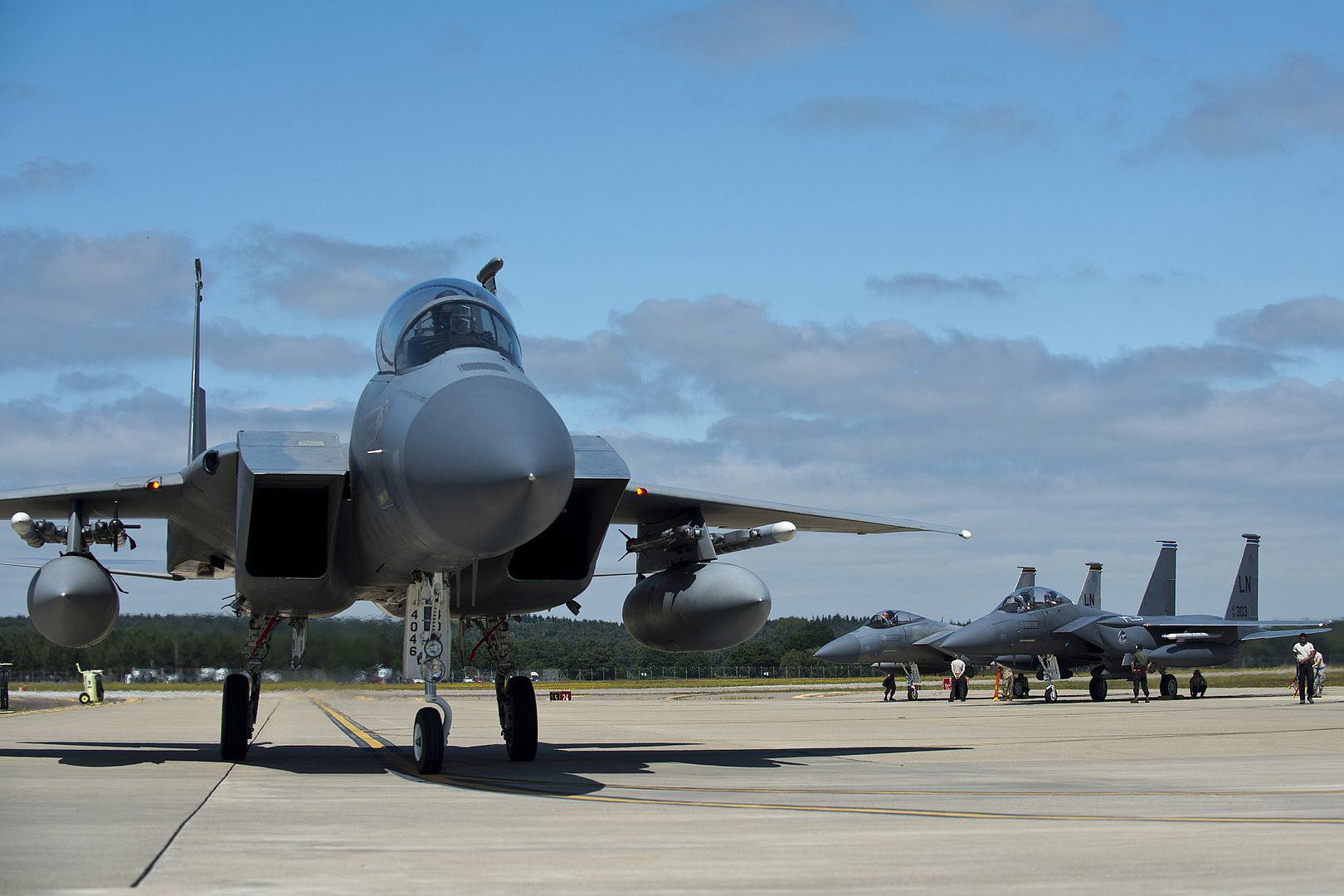
F-15E Strike Eagles from the 492nd and 494th Fighter Squadrons return to Royal Air Force Lakenheath, England, following a sortie in support of exercise Point Blank 19-2, June 27, 2019. U.S. personnel from RAF Lakenheath and RAF Mildenhall, along with military members from the U.K. and France participated in the exercise, promoting multinational cooperation. (U.S. Air Force photo by Master Sgt. Eric Burks)
An F-15D Eagle assigned to the 493rd Fighter Squadron takes off from Royal Air Force Lakenheath, England, in support of exercise Point Blank 19-2, June 27, 2019. The objective of the exercise is to prepare coalition warfighters for a highly contested fight against near-peer adversaries by providing a multi-dimensional battle-space to conduct advanced training in support of U.S. and European interests. (U.S. Air Force photo by Master Sgt. Eric Burks)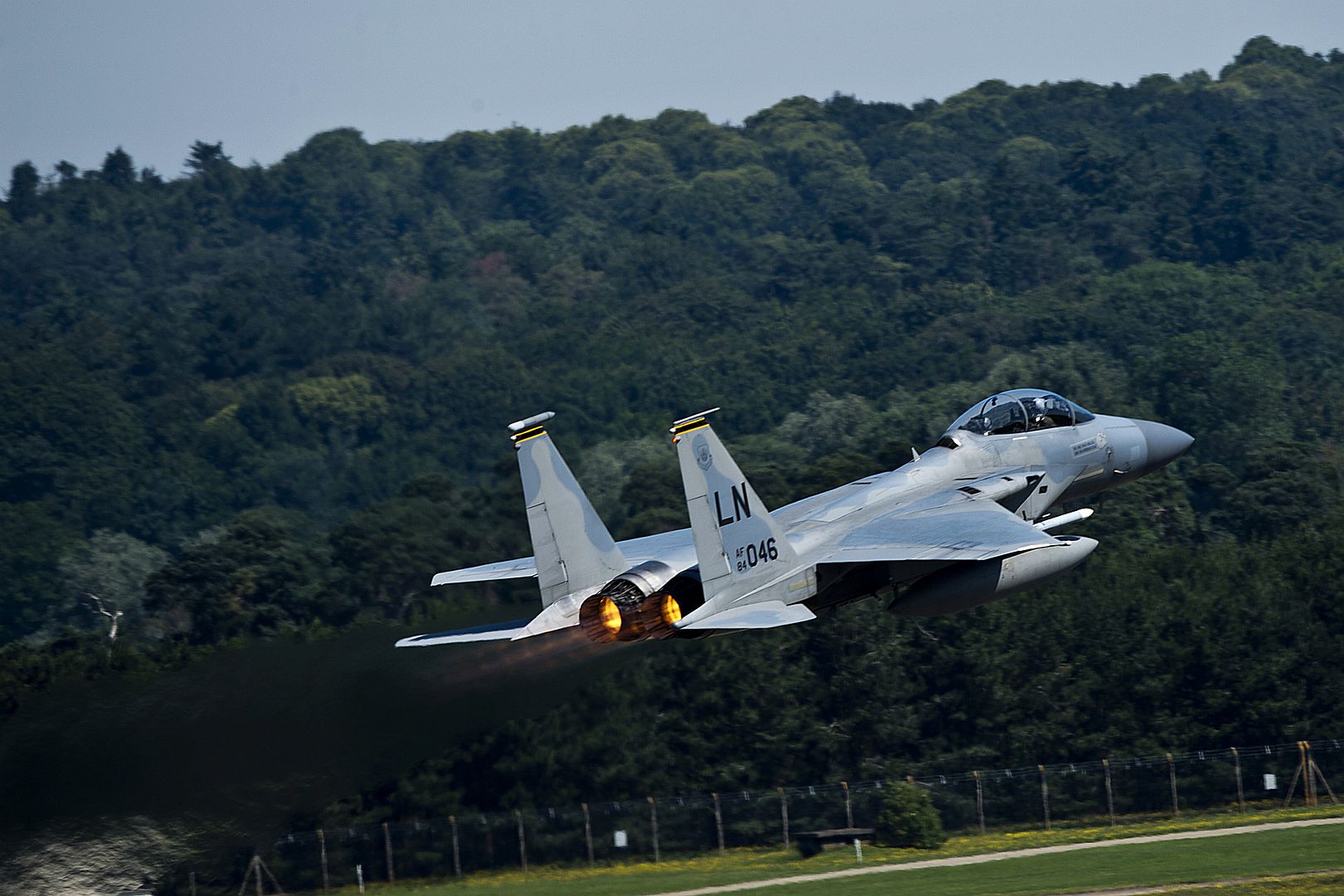
A French Air Force Dassault Rafale taxis past F-15E Strike Eagles from the 492nd and 494th Fighter Squadrons
at Royal Air Force Lakenheath, England, during exercise Point Blank 19-2, June 27, 2019. Training exercises with NATO allies reinforce and enhance deterrence and combined defense capabilities. (U.S. Air Force photo by Master Sgt. Eric Burks)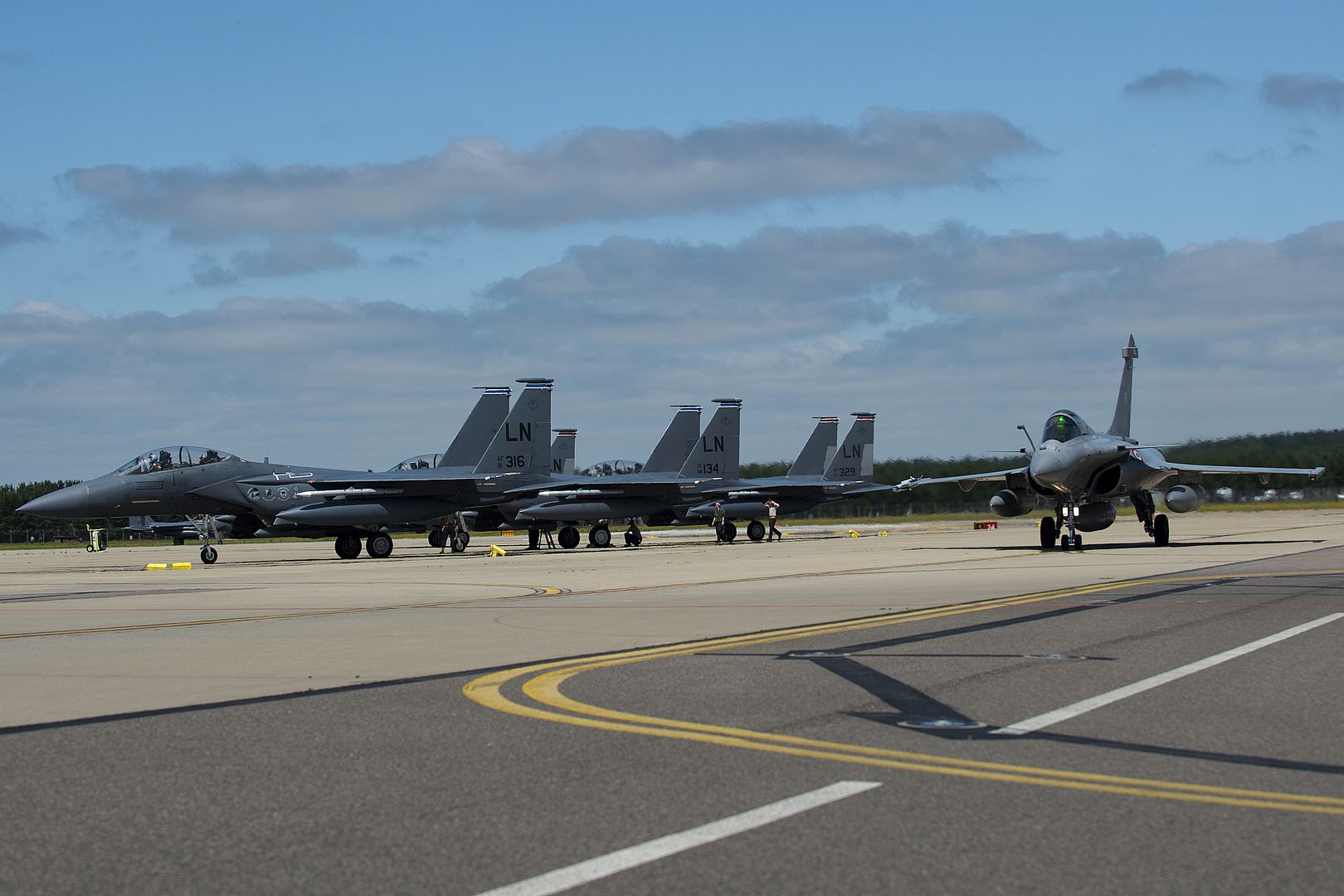
Santiago de Chile - The prototype of the five-bladed H145, which Airbus Helicopters unveiled at Heli-Expo in Atlanta last March, has just arrived in Chile where the aircraft will start a high altitude flight campaign. EASA certification is expected in early 2020, with deliveries following later that year.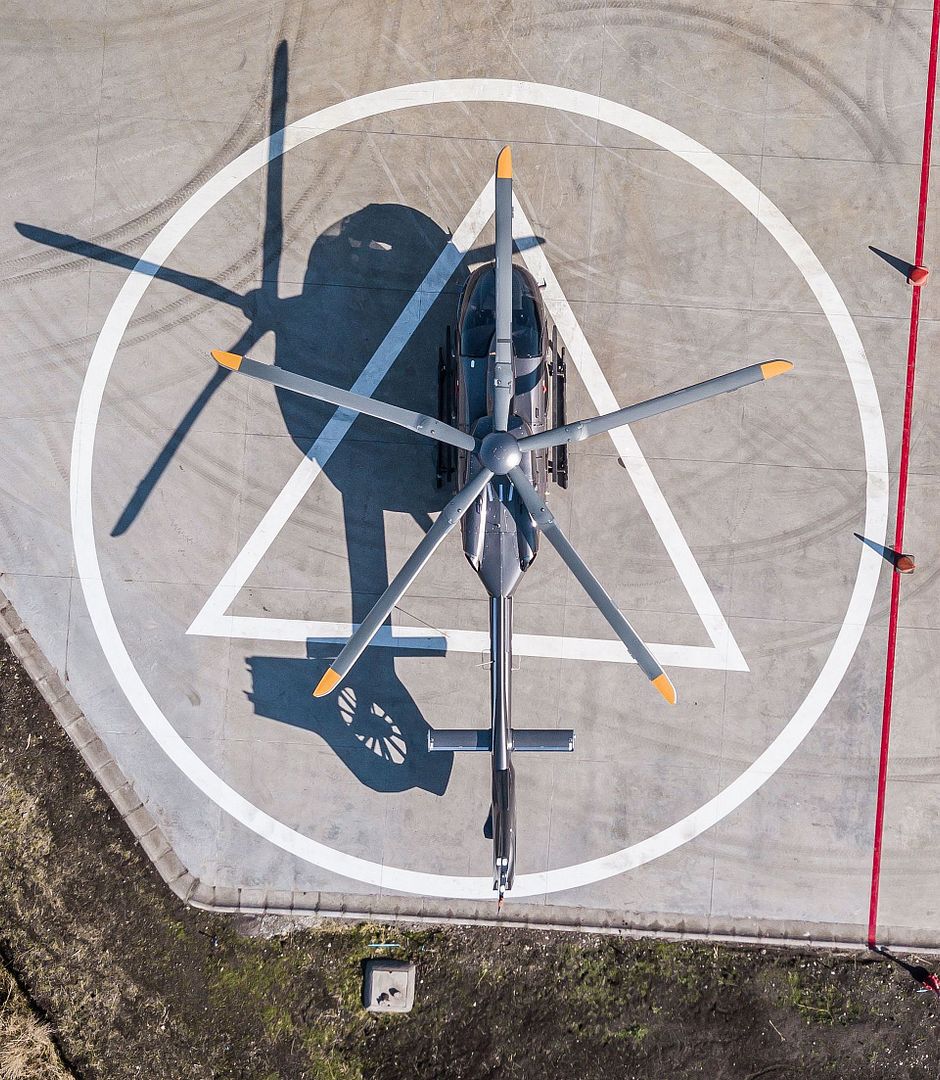
The new H145 is ready to take on the Andes, with altitudes up to 20,000 feet above sea level, after having already performed some altitude tests in the French Pyrenees during the summer of 2018. The objective of this campaign is to expand the flight envelope of the new helicopter and demonstrate its capabilities at high altitudes.
Due to its multi-mission capacity and excellent performance in hot and high conditions, present in many countries in Latin America, the H145 family is one of the region's favourite light twin engine helicopters. The flight campaign will provide some operators with the opportunity to fly the new version and experience first-hand the improvements brought by the new five-bladed rotor ? an increased useful load of 150 kg and new levels of comfort.
The H145?s new five-bladed rotor brings a significant increase in overall performance, with a maximum take-off weight raised to 3,800 kg and a useful load now equivalent to the aircraft?s empty weight. The simplicity of the new bearingless main rotor design will also ease maintenance operations, further improving the benchmark serviceability and reliability of the H145, while improving ride comfort for both passengers and crew. The reduced rotor diameter will allow the H145 to operate in more confined areas.
The new H145 introduces new levels of on-board connectivity to customers and operators through the integration of the wireless Airborne Communication System (wACS), allowing seamless and secure transmission of data generated by the helicopter in real-time, including in-flight.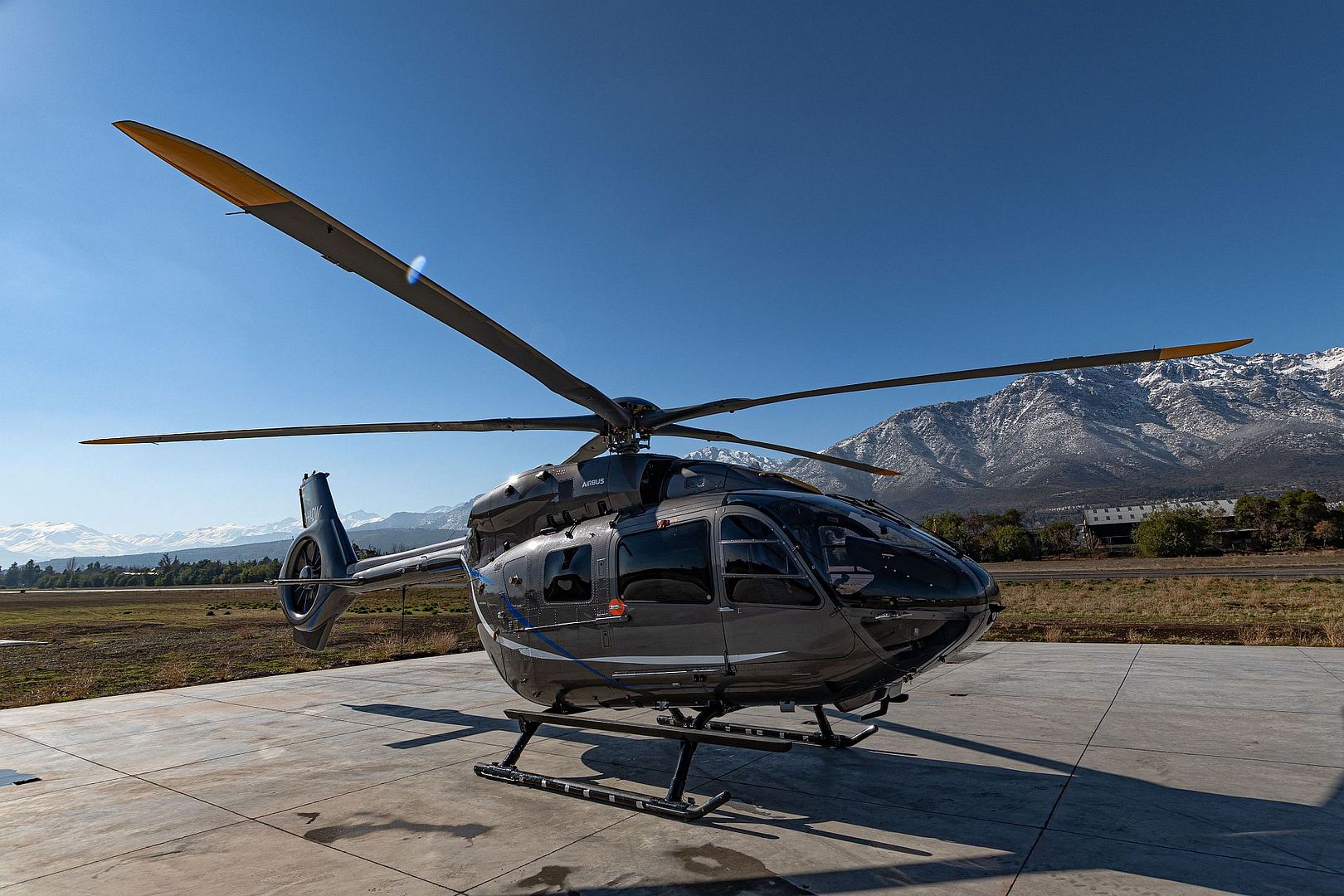
China Southern Airlines has taken delivery of its first of 20 A350-900s, becoming the newest operator of this latest generation and highly efficient twin-engine, long-range wide-body aircraft. The Guangzhou-based carrier operates an Airbus fleet of 335 aircraft, including 282 A320 Family aircraft, 48 A330 Family aircraft and five A380 aircraft (figures at the end of May 2019).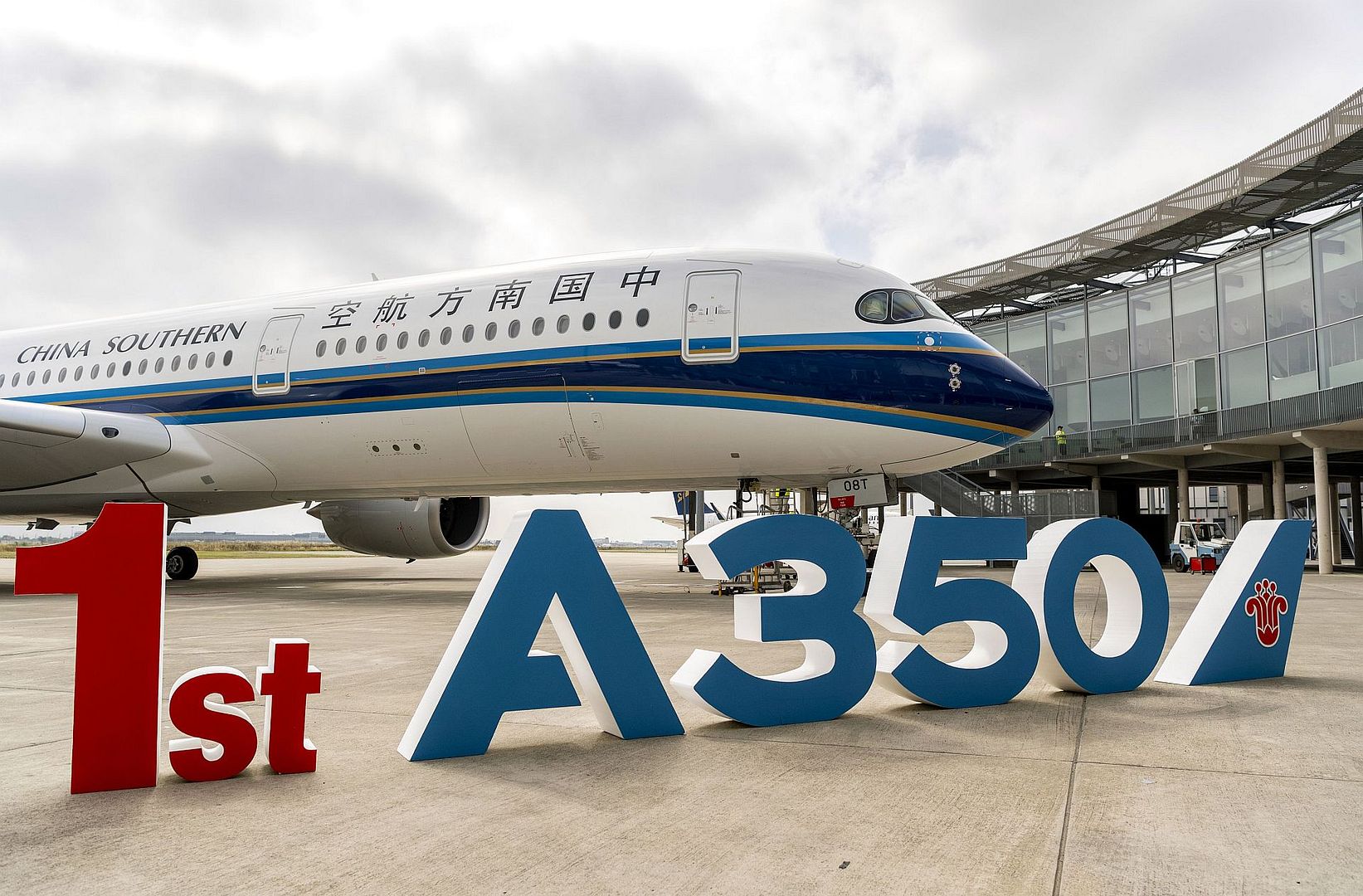
China Southern?s A350-900 aircraft features a modern and comfortable three-class cabin layout of 314 seats: 28 business, 24 premium economy and 262 economy. The airline will initially operate the new aircraft on its domestic routes from Guangzhou to Shanghai and Beijing, followed by flights to international destinations.
Bringing unmatched levels of efficiency and comfort, the A350 XWB Family is particularly well suited to the needs of Asia-Pacific airlines. To date, A350 XWB firm orders from carriers in the region represent over a third of total sales for the type.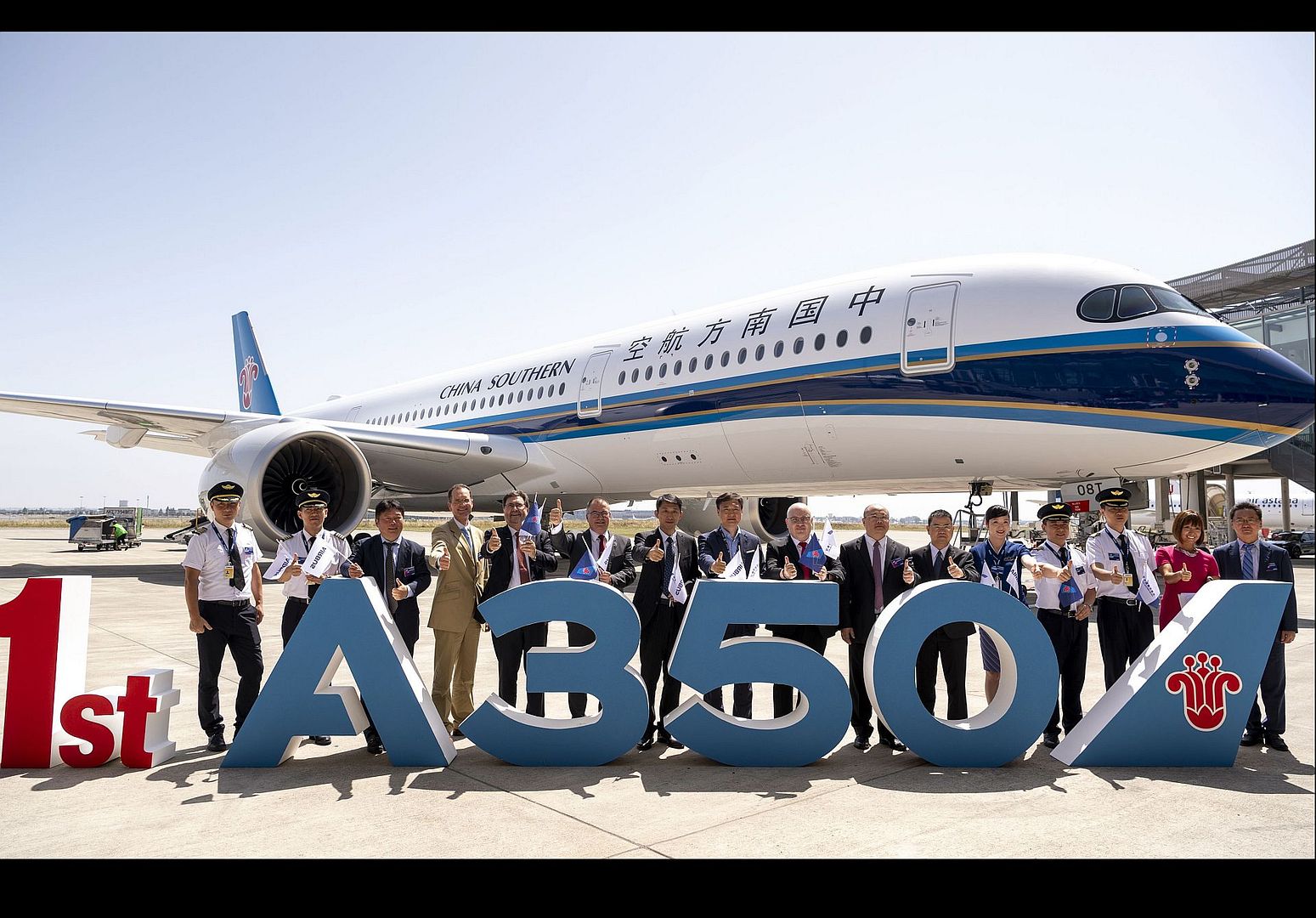
The A350 XWB offers by design unrivalled operational flexibility and efficiency for all market segments up to ultra-long haul (15,000 km). It features the latest aerodynamic design, a carbon fibre fuselage and wings, plus new fuel-efficient Rolls-Royce engines. Together, these latest technologies translate into unrivalled levels of operational efficiency, with a 25% reduction in fuel burn and emissions. The A350 XWB?s Airspace by Airbus cabin is the quietest of any twin-aisle and offers passengers and crews the most modern in-flight products for the most comfortable flying experience.
At the end of May 2019, the A350 XWB Family had received 893 firm orders from 51 customers worldwide, making it one of the most successful wide-body aircraft ever.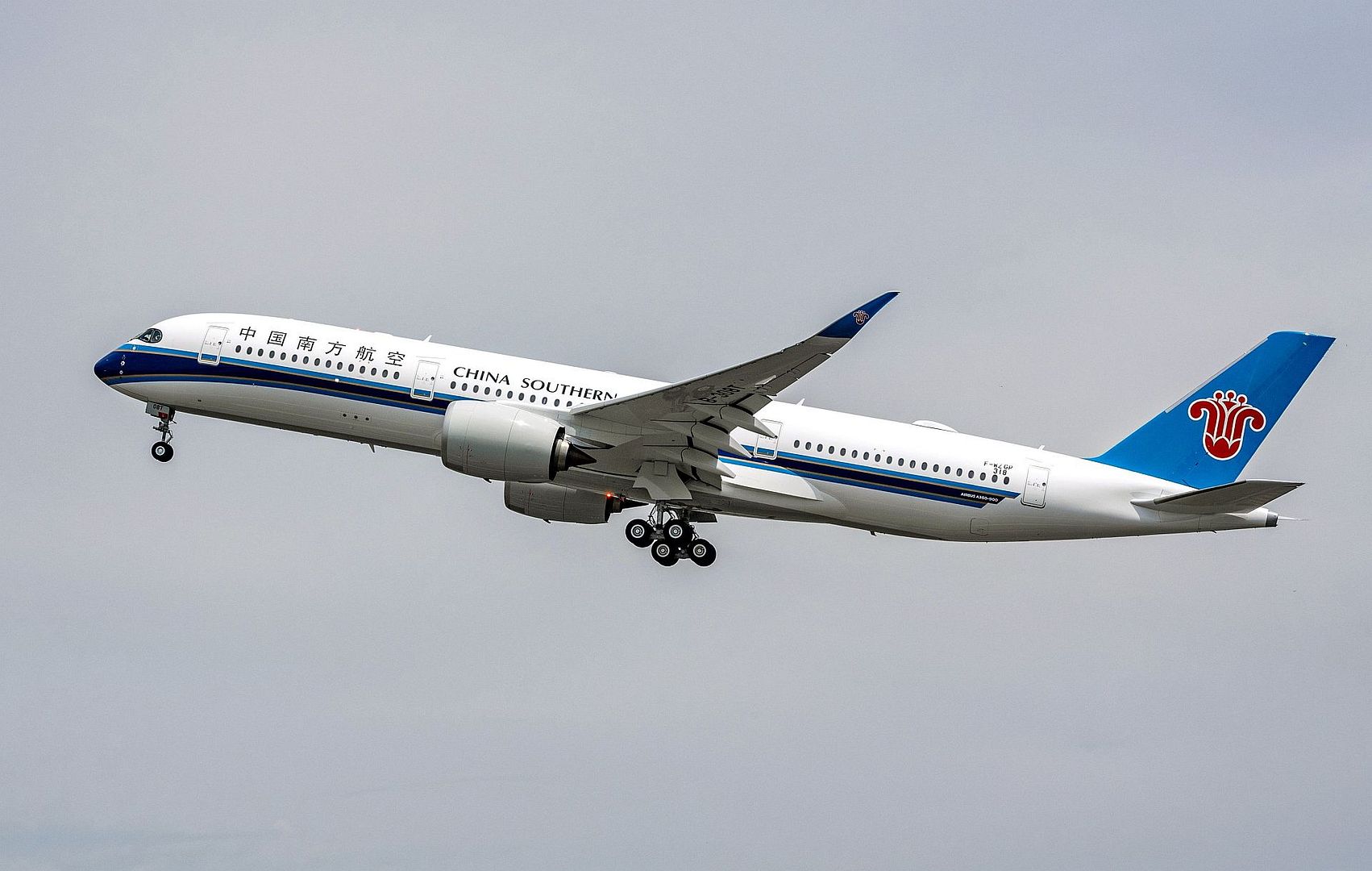
S?o Jos? dos Campos, Brazil, June 28, 2019 ? Embraer announced today the first delivery of its new Praetor 600 super-midsize business jet to an undisclosed European customer. The delivery ceremony was held at the company?s production facility in S?o Jos? dos Campos, Brazil, where the first Praetor 600 rolled off the hybrid assembly line that also produces the Legacy 450 and Legacy 500. Assembly of the Praetor 600 will soon also occur at Embraer?s production facility in Melbourne, Florida, where the company has produced more than 360 Phenom and Legacy aircraft since 2011.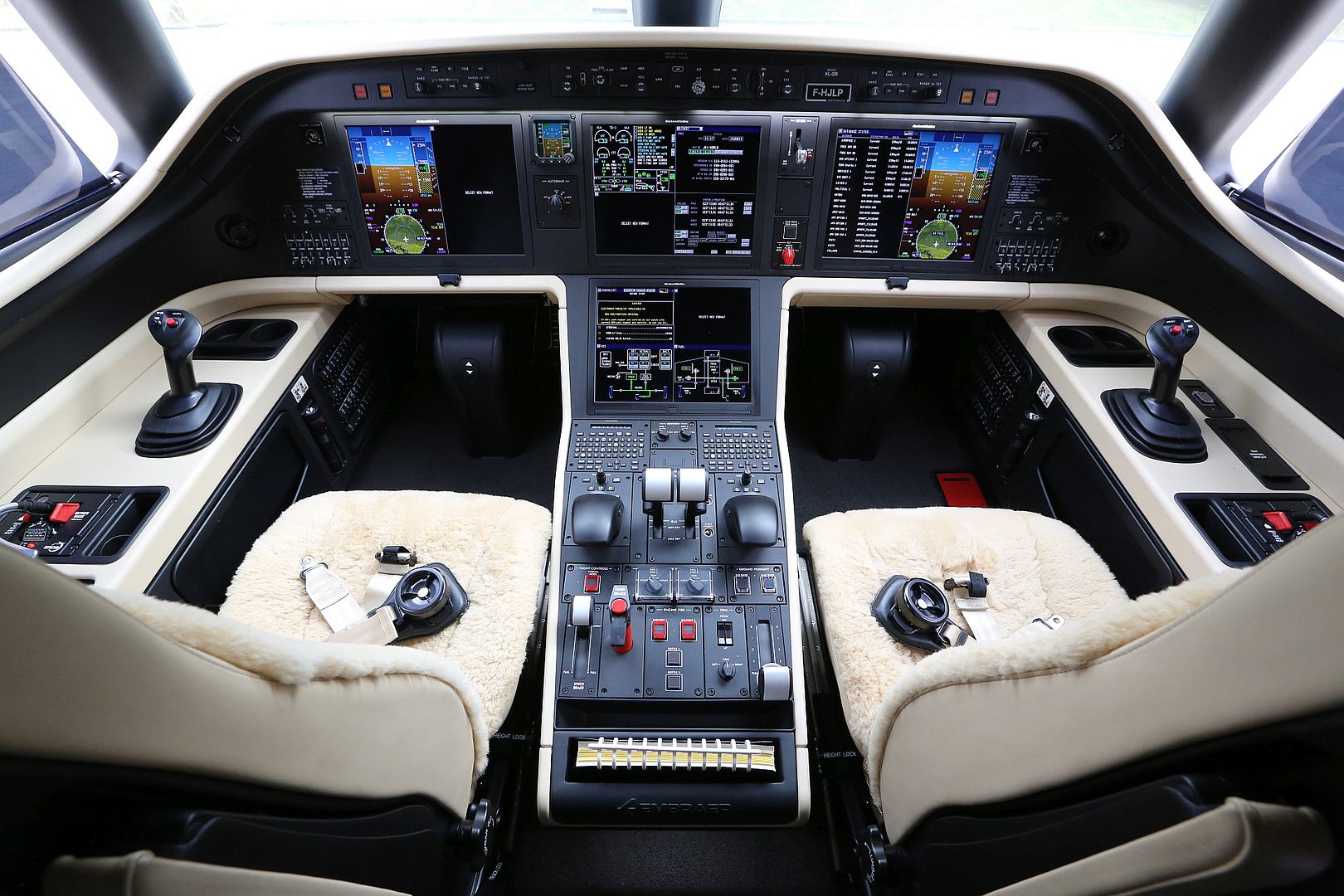
?We are thrilled to deliver the first Praetor 600 and we are confident that our customer will be fascinated with the most disruptive and technologically advanced super-midsize business jet to enter the market,? said Michael Amalfitano, President & CEO, Embraer Executive Jets. ?The Praetor 600 is certain to create a new value experience for our customers and help them outperform in their business and personal endeavors.?
Announced at NBAA-BACE in October 2018, where it also made its debut, the Praetor 600 was certified in April 2019, just six months after its announcement, becoming the only super-midsize business jet to be certified since 2014.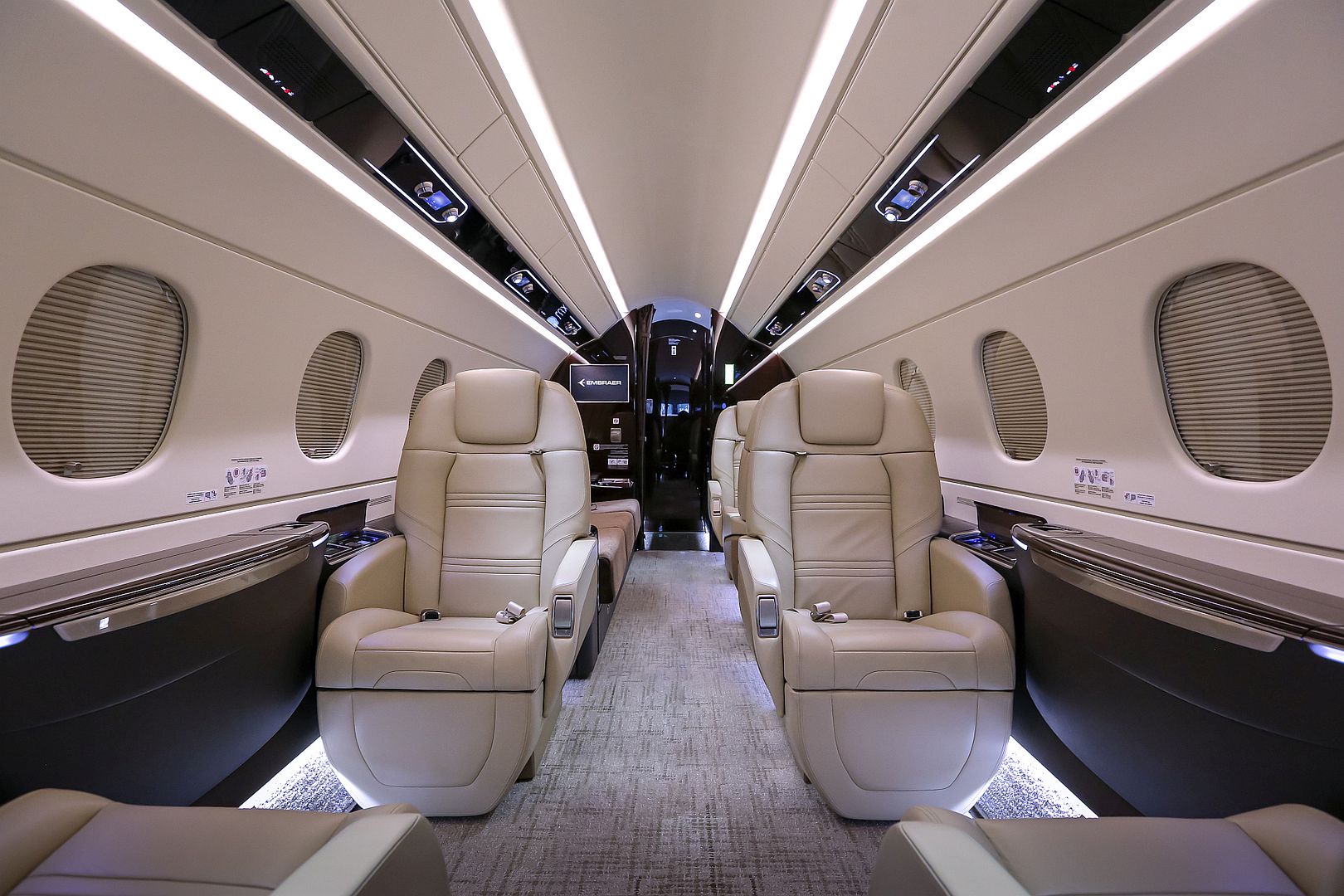
?The Praetor 600 unleashes the full potential of its platform through industry-leading design, engineering and technology that was yet unseen in the medium cabin class,? said Daniel Moczydlower, Executive Vice President, Embraer Engineering and Technology. ?With Embraer?s fourth-generation fly-by-wire technology and more than 25 patented innovations in the interior design and architecture, the Praetor 600 will ensure an industry-exclusive customer experience and raise their expectations of business jets.?
Leading the way, the Praetor 600 is an aircraft of many firsts, including the first super-midsize jet with full fly-by-wire technology, which powers turbulence reduction that not only makes every flight the smoothest but also the most efficient possible.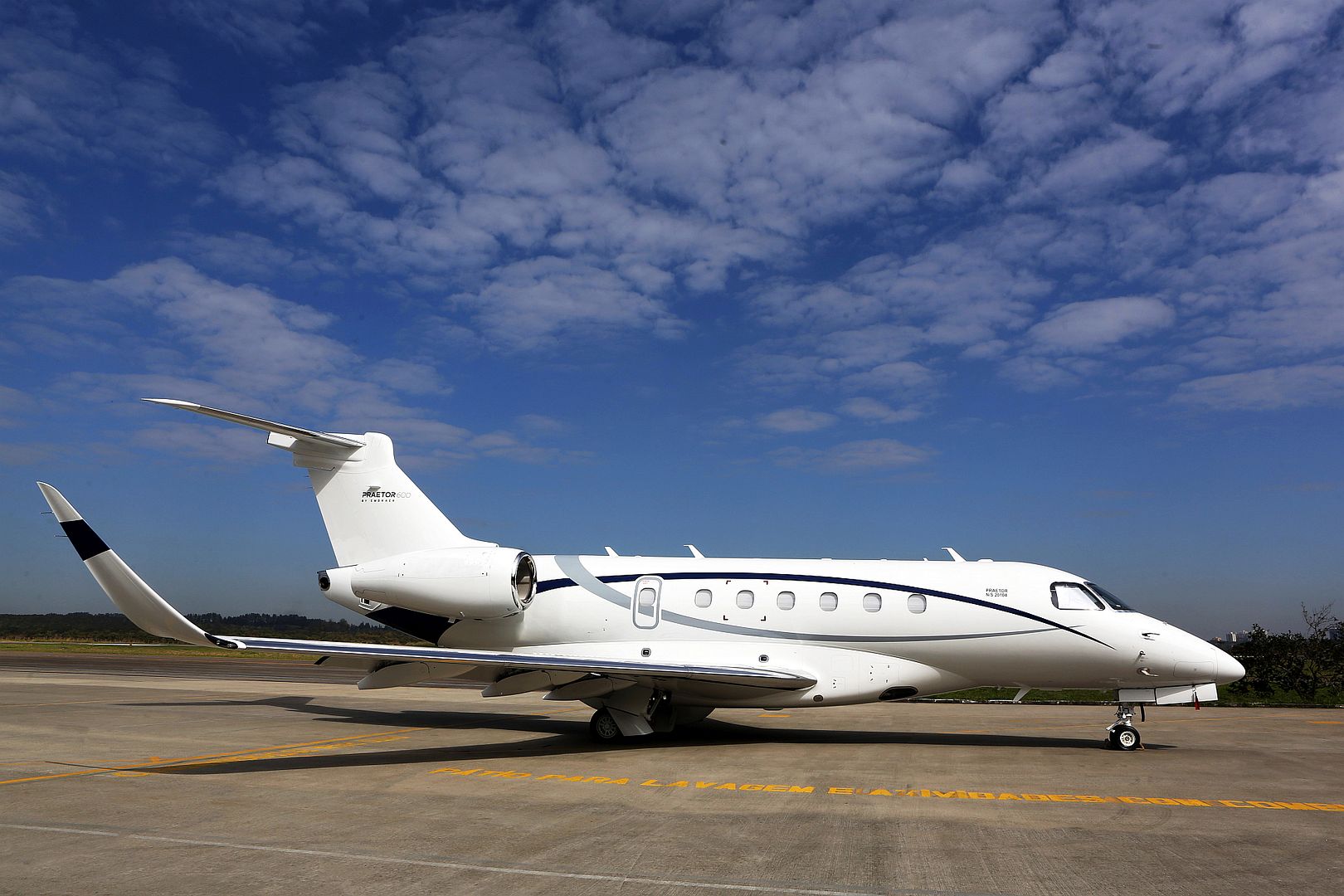
The Praetor 600 is now the farthest-flying super-midsize jet, able to make nonstop flights between Dubai and London, Paris and New York, S?o Paulo and Miami. With four passengers and NBAA IFR Reserves, the Praetor 600 has an intercontinental range of 4,018 nautical miles (7,441 km), with the highest payload capacity in its class, and at Mach 0.80, its range is 3,719 nm (6,887 km).
About the Praetor 600
The Praetor 600 is the most disruptive and technologically advanced aircraft to enter the super-midsize category, delivering the ultimate customer experience with an unparalleled combination of performance, comfort and technology. The Praetor 600 will be the farthest-flying super-midsize business jet, which allows nonstop flights between London and New York. With four passengers and NBAA IFR Reserves, the Praetor 600 will have an intercontinental range of 4,018 nautical miles (7,441 km), with the highest payload capacity in its class, and at Mach 0.80, its range is 3,719 nm (6,887 km).
Being the only super-midsize business jet with full fly-by-wire technology and turbulence reduction, passengers will enjoy the smoothest possible flight in a best-in-class 6-foot-tall flat-floor cabin, complemented by an unmatched 5,800-foot cabin altitude for ultimate passenger comfort. The Embraer DNA Design cabin includes eight fully reclining club seats which may be berthed into four beds for complete rest. The cabin includes a full service galley at the entrance, a rear private lavatory with a vacuum toilet and an in-flight-accessible baggage area. The total baggage space is the largest in the super-midsize category.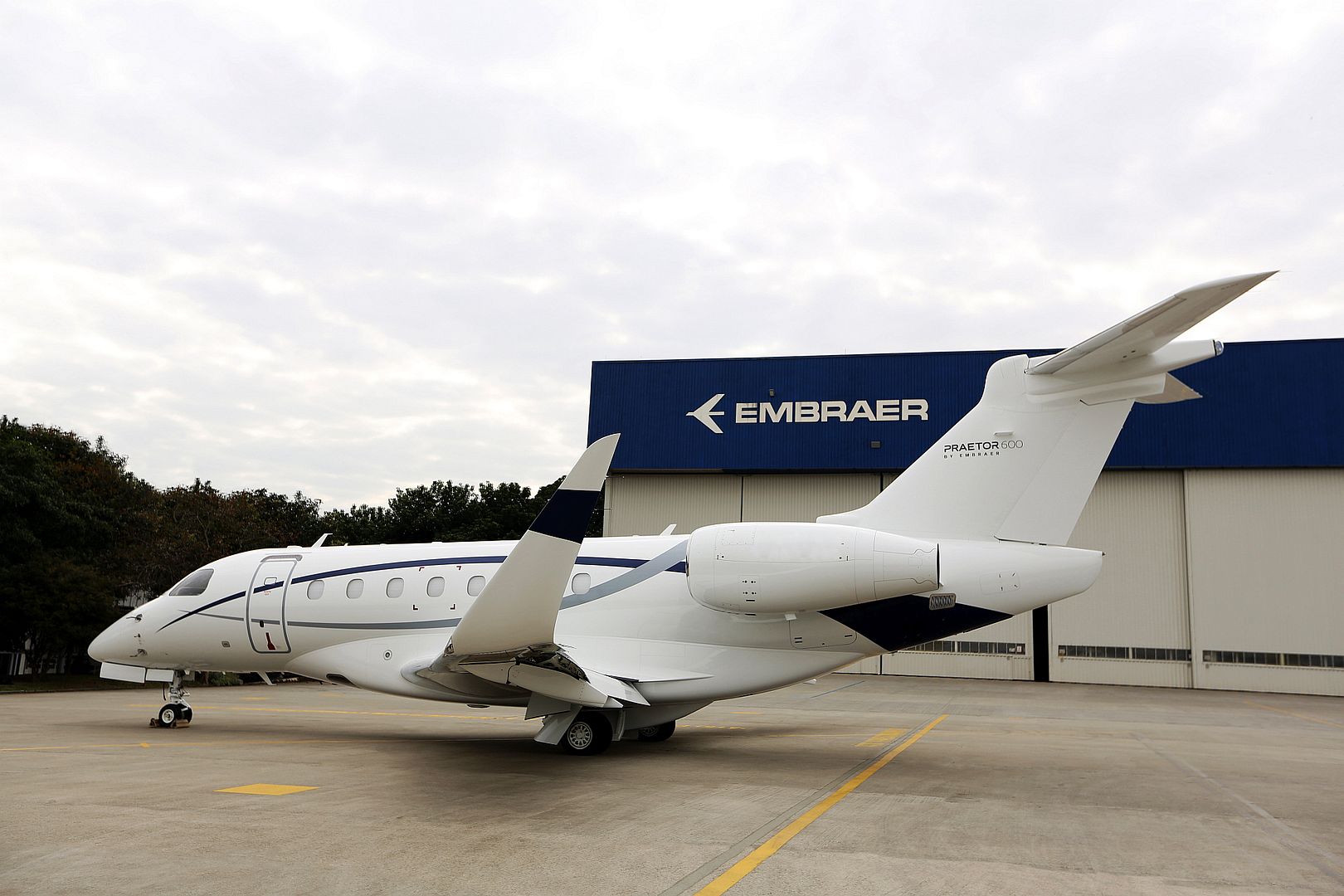
Advanced technology also abounds throughout the cabin beginning with the industry-exclusive Upper Tech Panel that displays flight information and offers cabin management features also available on personal devices through Honeywell Ovation Select. Air to ground Gogo AVANCE L5 connectivity is available for US operators. High-capacity, ultra high-speed connectivity for all aboard is available through Viasat?s Ka-band with speeds of up to 16Mbps and unlimited streaming, another industry-exclusive among midsize business jets. An optional in-flight entertainment system consists of a high-definition video system, surround sound, and multiple audio and video input options.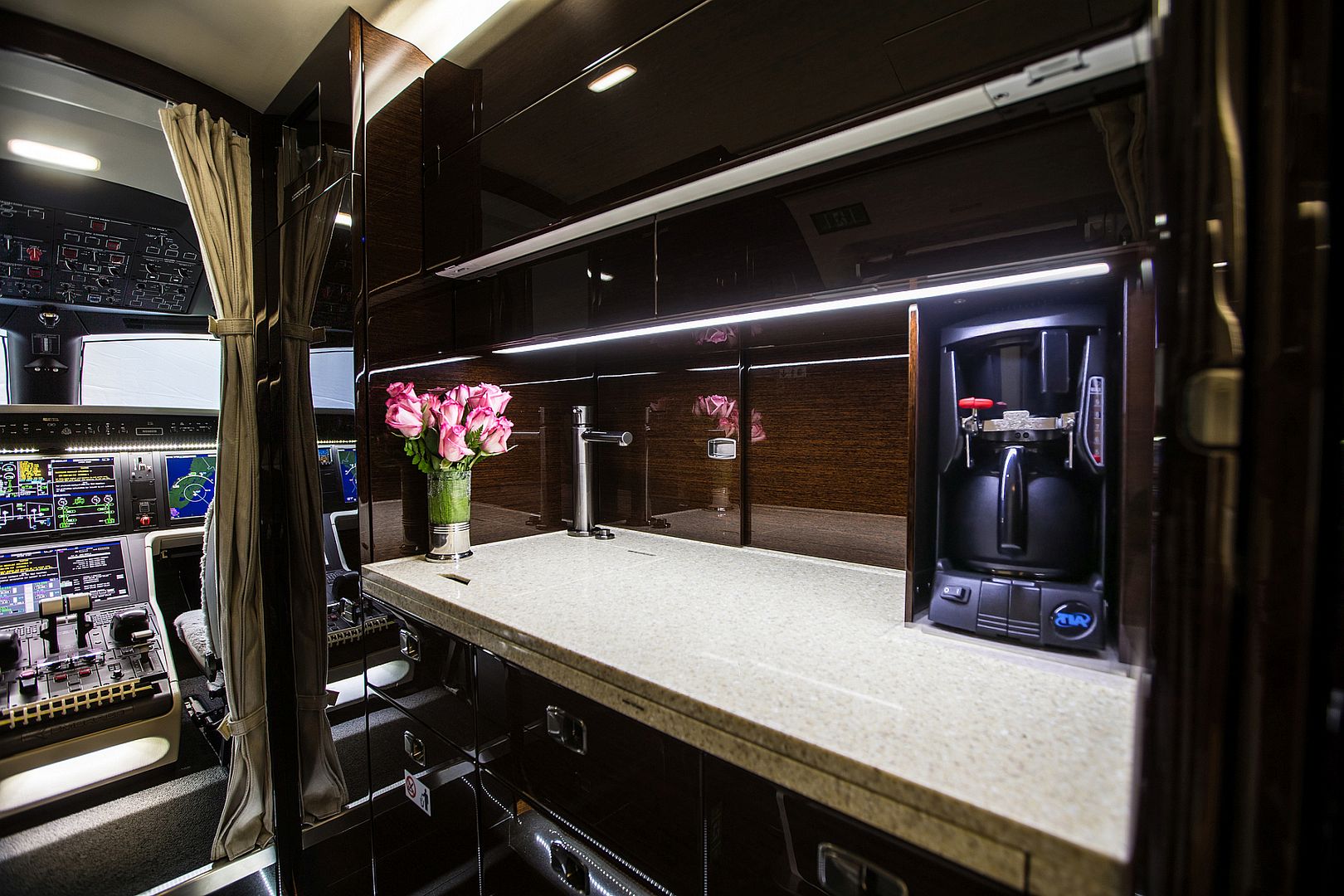
The Praetor 600 features the state-of-the-art Rockwell Collins Pro Line Fusion avionics suite with four 15.1-inch high-resolution LCD displays, and paperless operations capability, with graphical flight planning and industry-first vertical weather display, air-traffic-control-like situational awareness with ADSB-IN, and predictive wind shear radar capability, in addition to Jeppesen charts and maps as well as, an Inertial Reference System (IRS), a Synthetic Vision Guidance System (SVGS), and the Embraer Enhanced Vision System (E2VS) which features a Head-up Display (HUD) and an Enhanced Video System (EVS). The Praetor 600 is powered by two advanced, fuel-efficient Honeywell HTF 7500E turbofan engines, the greenest in their class.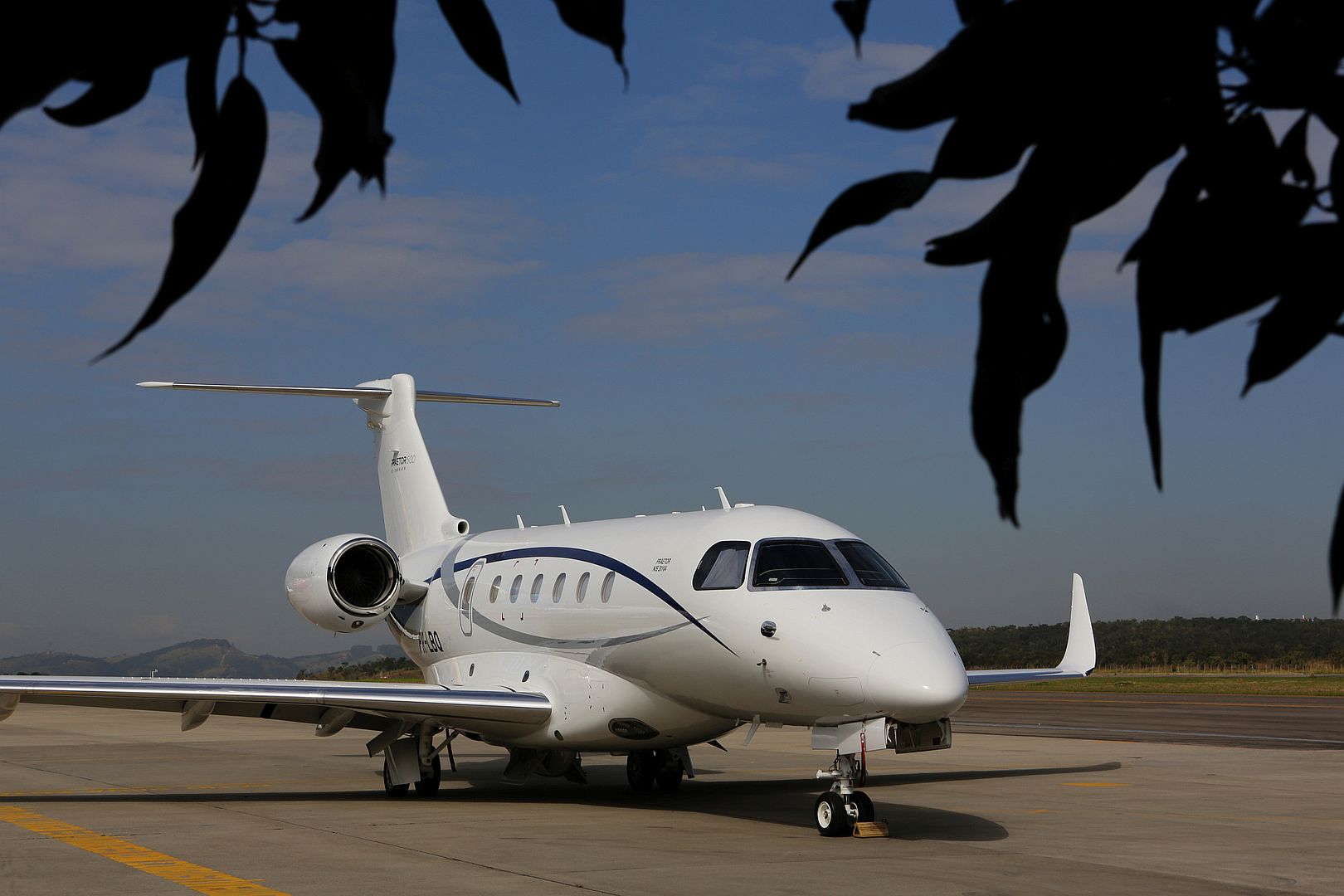
An RAF Typhoon from No. 11 Sqn currently attached to 121 Expeditionary Air Wing at ?mari Air Base in Estonia intercepts a Russian IL-76 military transport aircraft flying close to Estonian airspace earlier this week.
Photo RAF.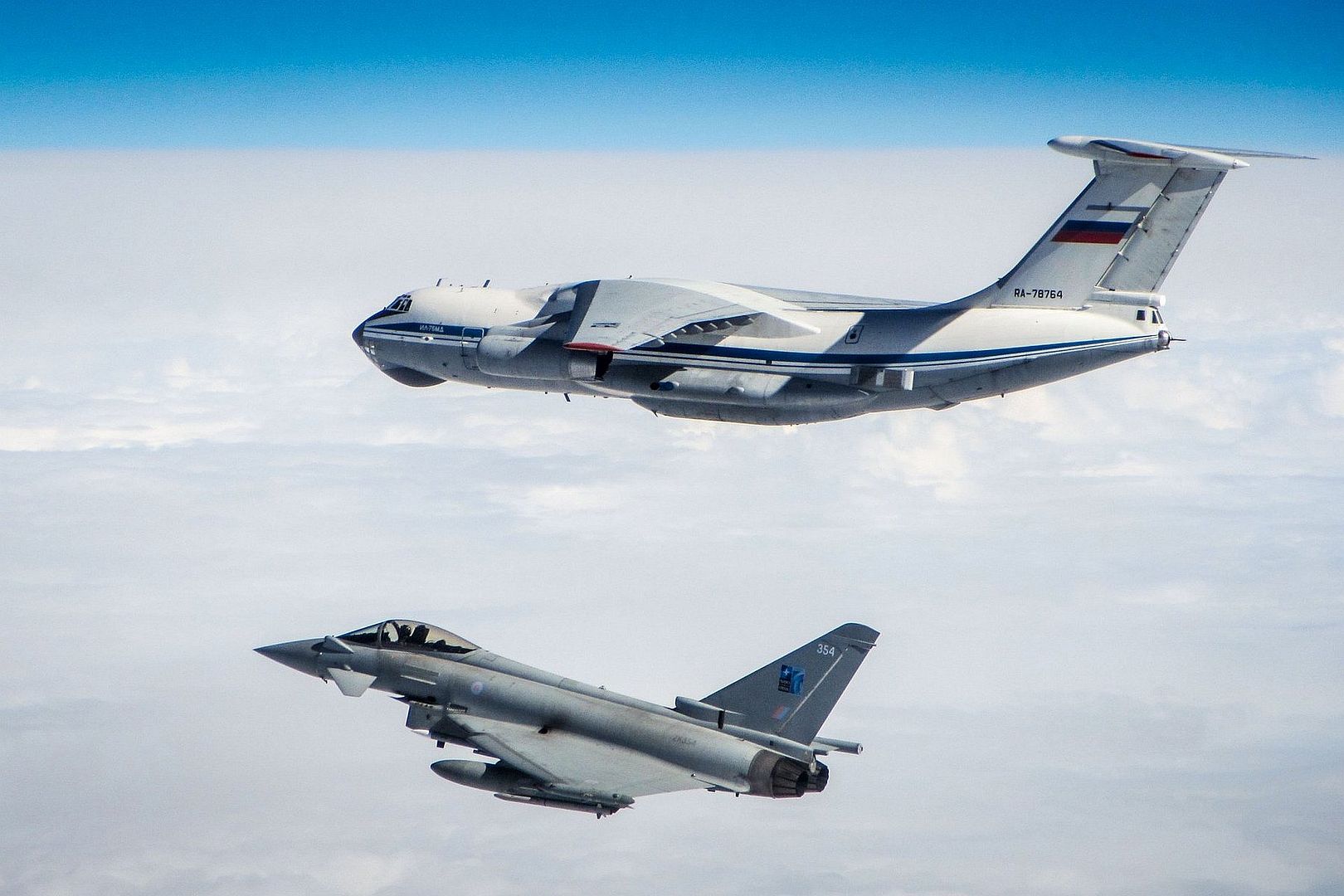
-
A U.S. Air Force F-16 Fighting Falcon assigned to the 510th Fighter Squadron taxis in preparation for takeoff at Aviano Air Base, Italy, July 1, 2019. The 510th FS ?Buzzards? have called Aviano home since July 1, 1994. (U.S. Air Force photo by Staff Sgt. Kelsey Tucker)
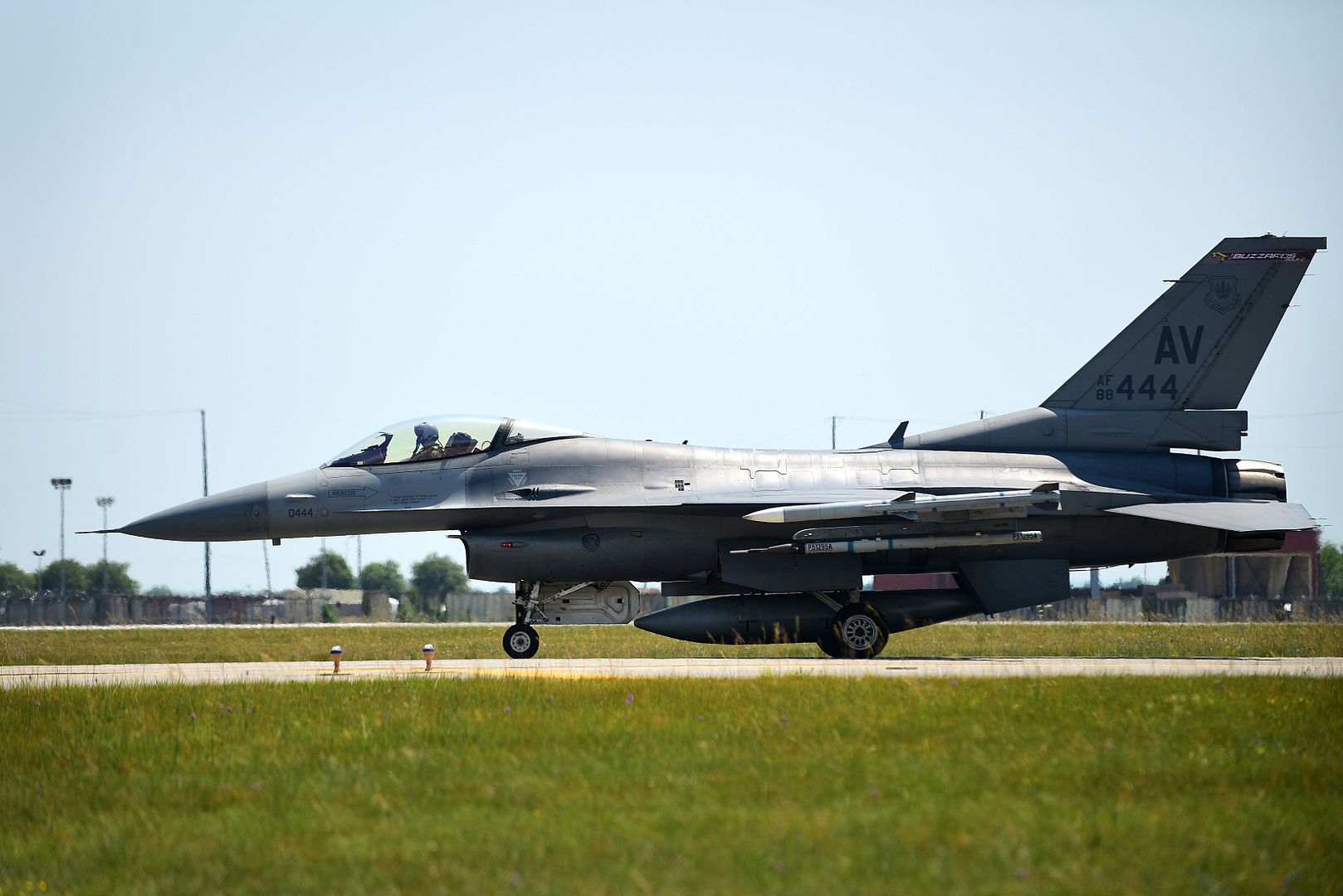
PACIFIC OCEAN (June 30, 2019) An F/A-18F Super Hornet, assigned to the ?Black Knights? of Strike Fighter Squadron (VFA) 154, approaches the flight deck of the aircraft carrier USS Theodore Roosevelt (CVN 71). Theodore Roosevelt is conducting routine operations in the Eastern Pacific 0Ocean. (U.S. Navy photo by Mass Communication Specialist Seaman Olympia O. McCoy)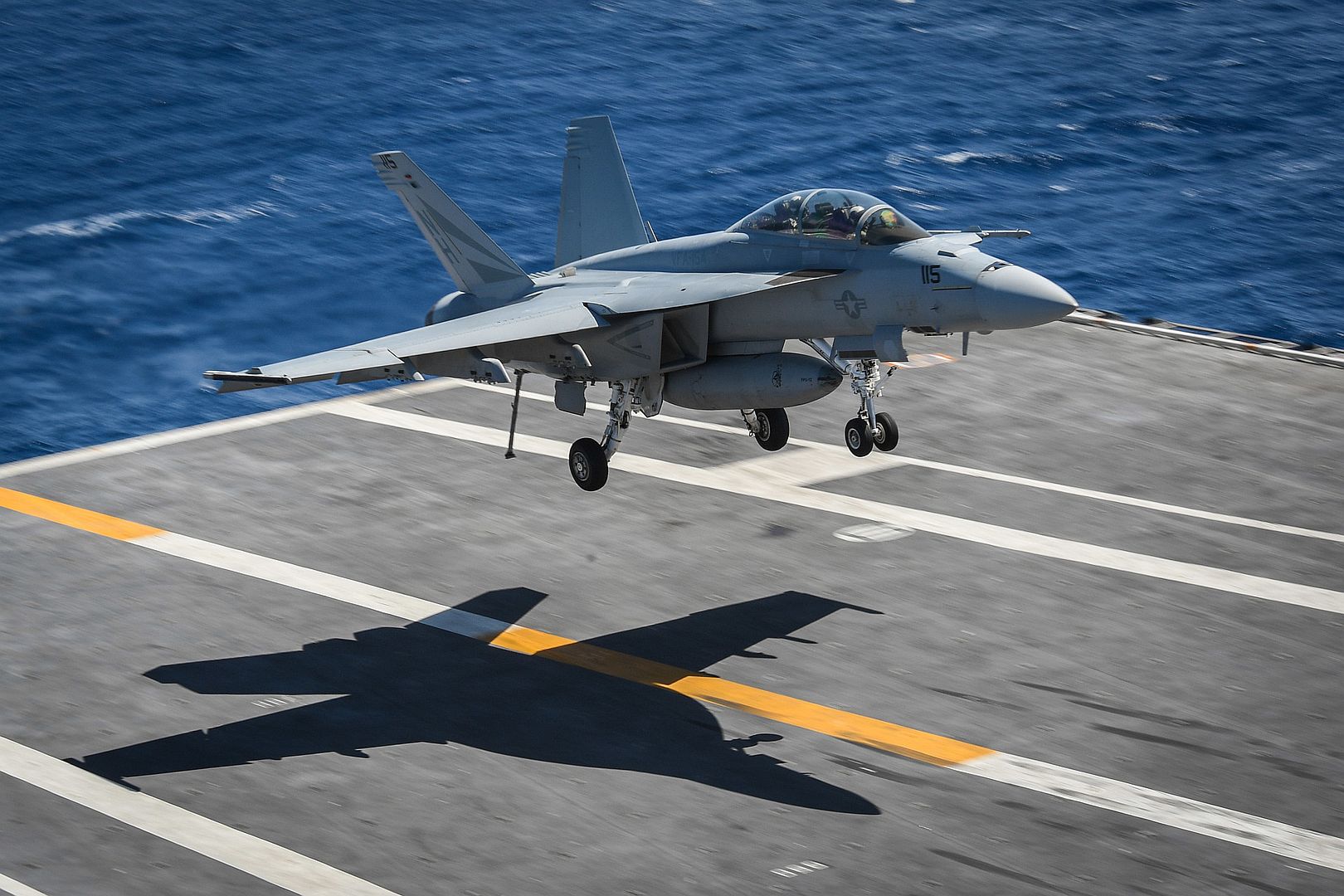
ARABIAN SEA (June 29, 2019) A C-2A Greyhound from the Rawhides of Fleet Logistics Support Squadron (VRC) 40 approaches the Nimitz-class aircraft carrier USS Abraham Lincoln (CVN 72). The Abraham Lincoln Carrier Strike Group is deployed to the U.S. 5th Fleet area of operations in support of naval operations to ensure maritime stability and security in the Central Region, connecting the Mediterranean and the Pacific through the western Indian Ocean and three strategic choke points. With Abraham Lincoln as the flagship, deployed strike group assets include staffs, ships and aircraft of Carrier Strike Group (CSG) 12, Destroyer Squadron (DESRON ) 2, the guided-missile cruiser USS Leyte Gulf (CG 55) and Carrier Air Wing (CVW) 7. (U.S. Navy photo by Mass Communication Specialist Seaman Tristan Kyle Labuguen/Released)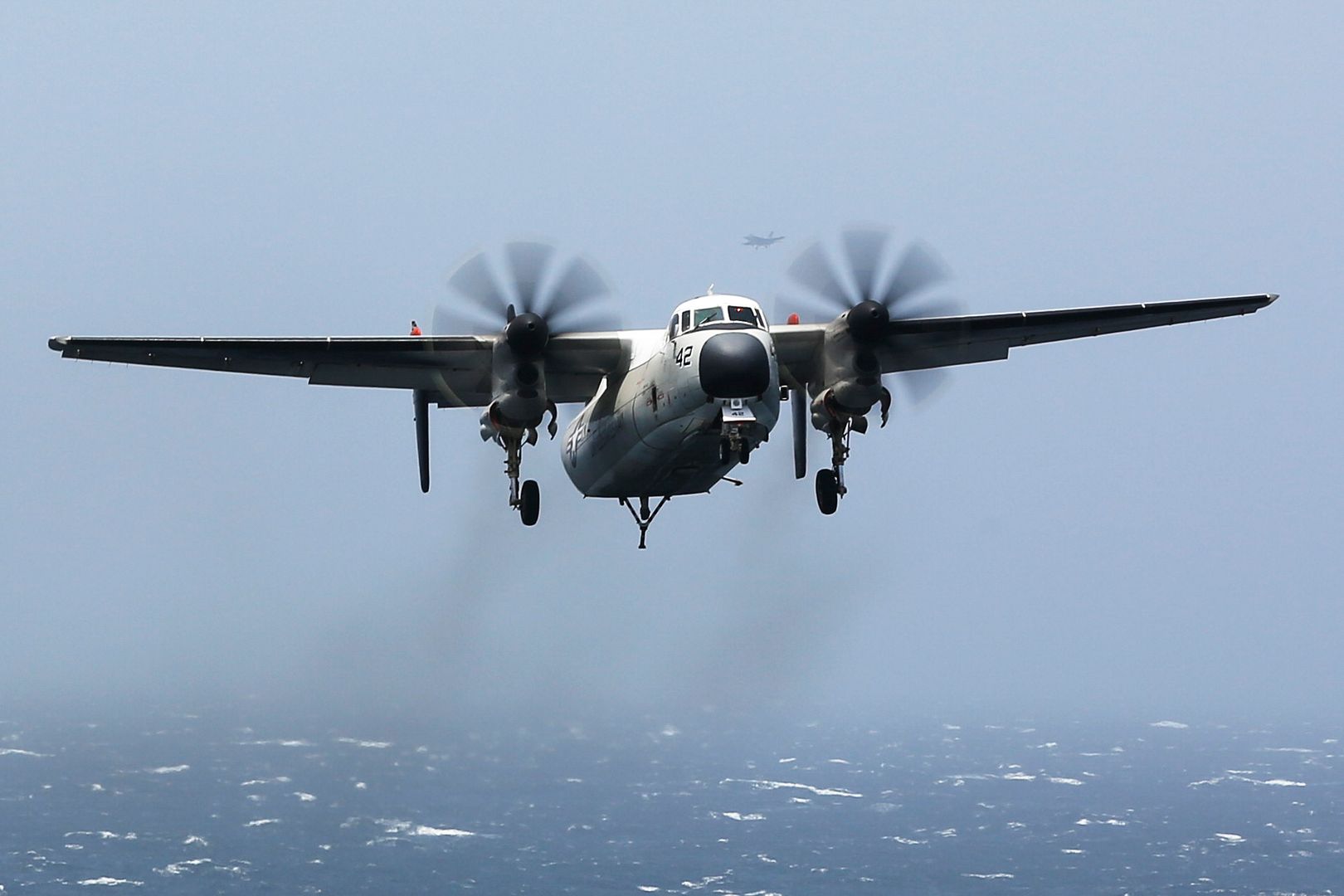
SEATTLE, July 1, 2019 /PRNewswire/ -- Boeing [NYSE:BA] is launching its latest round of flight-testing to assess new technologies that could address real-world challenges for airplane operators and passengers ? from enhancing safety and sustainability to improving the flying experience. The company is debuting a Boeing 777 that will serve as the 2019 flying test bed for 50 projects.
"This is the latest addition to our ecoDemonstrator program, where we look at how crew and passengers can have a better experience and how technologies can make flying safer, more efficient and more enjoyable," said Mike Sinnett, vice president of product strategy and future airplane development at Boeing Commercial Airplanes. "Using the 777 flying test bed lets us learn faster and move forward on improvements much quicker and with greater fidelity in defining their value."
Among the technologies being tested on this year's ecoDemonstrator program are:
Sharing digital information between air traffic control, the flight deck and an airline's operations center to optimize routing efficiency and safety.
An electronic flight bag application that uses next-generation communications to automatically provide rerouting information to pilots when weather conditions warrant.
Connected cabin technologies that make galleys and lavatories smart, and monitor cabin conditions such as temperature and humidity to facilitate automatic adjustments.
Cameras to provide more passengers with a view outside the airplane.
Boeing's ecoDemonstrator program first took to the skies in 2012. Five airplanes ? a 737-800, 787-8 Dreamliner, 757, Embraer E170 and 777 Freighter ? have tested 112 technologies through 2018. More than a third of the technologies have transitioned to implementation at Boeing or by program partners. Nearly half remain in further development while testing on the other projects was discontinued after learnings were accomplished.
Among the technologies now in use are iPad apps that provide real-time information to pilots, enabling them to reduce fuel use and emissions; custom approach path information to reduce community noise; and a camera system on the 777X that will help pilots avoid ground obstacles.
A key part of the ecoDemonstrator program is collaboration with industry partners to jointly test technologies and share learnings that advance aviation. More than a dozen partners are participating in the 2019 program, including an industry consortium developing a connectivity standard for networked cabins of the future known as iCabin.
Flight tests will be conducted this fall. The flights will include a trip to Frankfurt Airport in Germany, where the ecoDemonstrator's technology mission will be presented to government officials, industry representatives and STEM students to help inspire the next generation in aerospace leadership. A majority of the test flights will fly on sustainable aviation fuel to reduce carbon dioxide emissions and demonstrate the fuel's viability.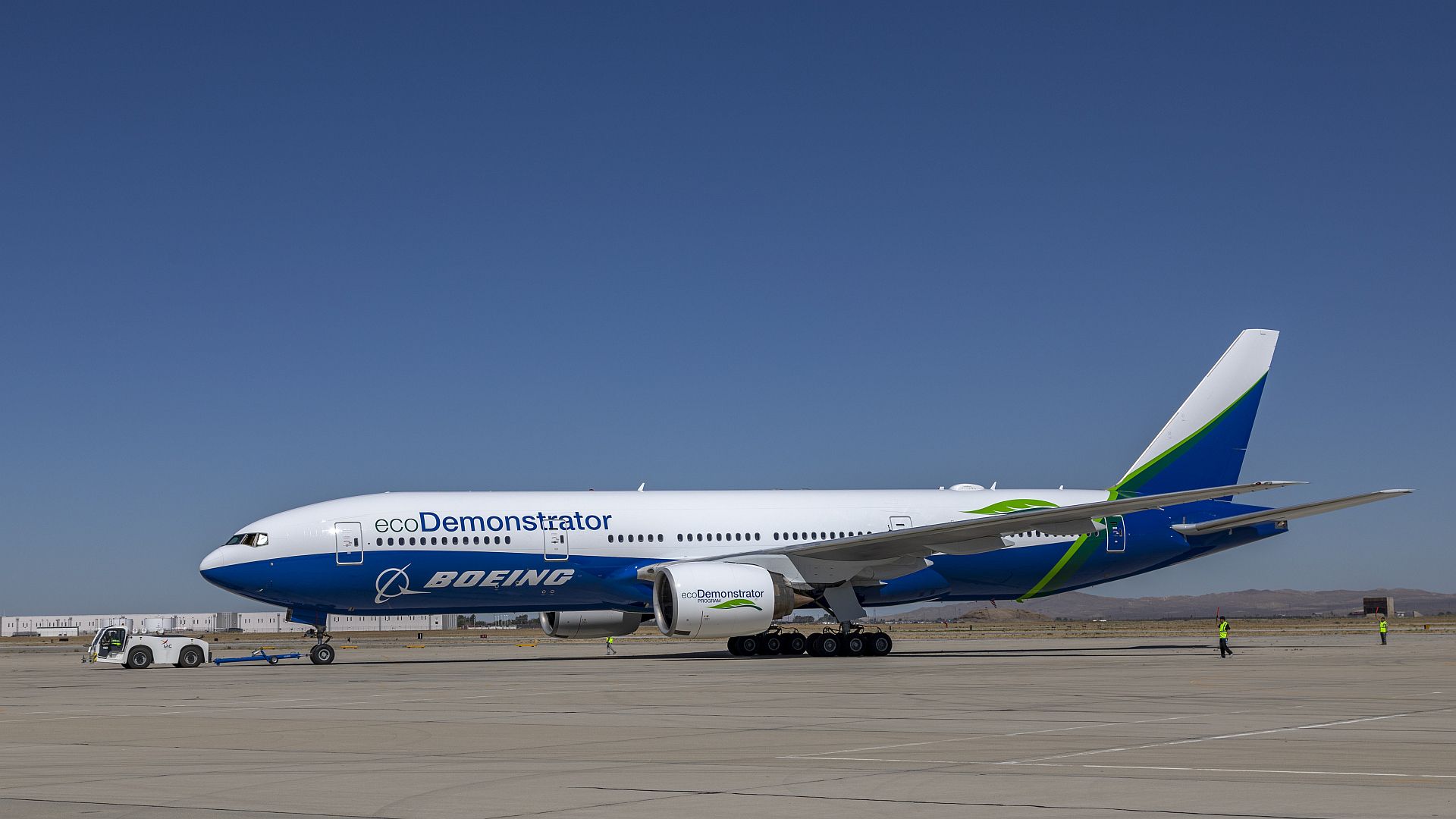
617 Squadron F-35s arrive in Italy - thanks to the Aeronautica Militare and 32 Stormo for allowing another historic first.
617 Squadron will continue to develop the aircraft?s capabilities by operating at range from home and from an allied airbase.
Both the Italian Air Force and the RAF operate the Typhoon and the F-35 and both nations have also previously declared Initial Operational Capability for the F-35.
Photo (MOD)