SPAD S.XIII
-
The SPAD S.XIII is a French biplane fighter aircraft of the First World War, developed by Société Pour L'Aviation et ses Dérivés (SPAD) from the earlier and highly successful SPAD S.VII.
During early 1917, the French designer Louis Béchereau, spurred by the approaching obsolescence of the S.VII, decided to develop two new fighter aircraft, the S.XII and the S.XIII, both using a powerful new geared version of the successful Hispano-Suiza 8A engine. The cannon armament of the S.XII was unpopular, but the S.XIII proved to be one of the most capable fighters of the war, as well as one of the most-produced, with 8,472 built and orders for around 10,000 more cancelled at the Armistice.
By the end of the First World War, the S.XIII had equipped virtually every fighter squadron of the Aéronautique Militaire. In addition, the United States Army Air Service also procured the type in bulk during the conflict, and some replaced or supplemented S.VIIs in the Royal Flying Corps (RFC), pending the arrival of Sopwith Dolphins. It proved popular with its pilots, and numerous aces from various nations flew the S.XIII. Following the Armistice of 11 November 1918, which marked the end of the First World War, surplus S.XIIIs were sold to both civil and military operators throughout the world.
Background
The origins of the SPAD S.XIII lies in the performance of its predecessor, the SPAD S.VII, a single-seat fighter aircraft powered by a 110 kW (150 hp) direct drive Hispano-Suiza 8A water-cooled V-8 engine and armed with a single synchronised Vickers machine gun. The type had good performance for the time, and entered service with the French Aéronautique Militaire during August 1916. By early 1917, however, the S.VII had been surpassed by the latest German fighters such as the Albatros D.III.
More capable German fighters soon resulted in a shift in aerial supremacy towards the Central Powers, which led to calls for better aircraft. French flying ace Georges Guynemer personally lobbied for an improved S.VII, telling the SPAD's designer Louis Béchereau that "The 150 hp SPAD is not a match for the Halberstadt ... More speed is needed." A quick solution to the problem was to increase the compression ratio of the Hispano-Suiza engine, which increased its power to 130 kW (170 hp) to significantly improve performance, allowing the SPAD S.VII to remain competitive for the time being.
Hispano-Suiza were already in the process of developing a more powerful geared version of the 8A engine, and this engine was chosen by Béchereau to power two developed versions of the S.VII. The British Royal Aircraft Factory S.E.5a and Sopwith Dolphin fighters would also be powered by the same engine.
The first of Béchereau's designs to fly with the new, reduction gear HS.8B engine design series was the S.XII in its HS.8BeC (or "HS-38") version, which was armed with an unusual 37 mm (1.457 in) cannon that fired through the propeller shaft. However, this aircraft only saw limited use, having been rapidly followed into production by the more conventionally armed S.XIII, which was deemed to be a preferable configuration by several French pilots and officials. Aviation author C.F. Andrews has claimed that a large portion of the credit for the S.XIII lies with Marc Birkigt, the designer of the engine, who had chosen to introduce various innovative features upon it, such as monobloc aluminium cylinders, which were furnished with screwed-in steel liners, which improved its performance.
The SPAD S.XIII flew for the first time on 4 April 1917.An early distinguishing feature of the S.XIII – as with the SPAD S.XII – was that its similarly geared HS.8Be V8 engine had a left-handed propeller, which rotating in the opposite rotation to the earlier, direct-drive HS.8A-powered S.VII. Early on, similarly to the British Sopwith Dolphin also powered with HS.8B-series geared V8s, problems were encountered with the gearing, however, Béchereau persisted with the engine, which soon became fairly reliable. Production was ramped up almost immediately after the first flight. Within months of its first flight, the S.XIII had not only entered service with the Aéronautique Militaire, but had proven itself to be a successful fighter.
Design
The SPAD S.XIII was a single-engine biplane fighter aircraft. In terms of its construction, it shared a similar configuration and layout to the earlier S.VII,featuring a mainly wooden structure with a fabric covering.It was however generally larger and heavier than its predecessor. Other changes were made to the ailerons, the rounded tips of the tailplanes, the bulkier cowling accommodating the gear-drive Hispano-Suiza 8B engine, and enlarged fin and rudder with a curved trailing edge. The S.XIII was armed with a pair of forward-mounted Vickers machine guns with 400 rounds per gun, which replaced the single gun of the earlier aircraft.
The S.XIII featured relatively conventional construction, that being a wire-braced biplane with a box-shaped fuselage and a nose-mounted engine, except for its interposed wing struts located halfway along the wing span, which gave the fighter the appearance of being a double-bay aircraft instead of a single-bay. This change prevented the landing brace wires from whipping and chafing during flight. Otherwise, it had an orthodox structure, comprising wooden members attached to metal joint fixtures. The fuselage consisted of four square-section longerons, with wooden struts and cross-members while braced with heavy-gauge piano wire. Wire cable was used for the flying and landing wires.
To enable a two-hour endurance, the S.XIII was fitted with several underbelly fuel tanks held within the forward fuselage area which fed into the main service tank in the upper wing center section with an engine-driven pump. Similar pumps were used for supplying pressurised oil and water circulation between the engine's radiator and a header tank was housed within the upper wing. The circular nose radiator incorporated vertical Venetian-style blinds to regulate engine temperatures.
The upper wing was made in one piece, with hollow box-section short spars that connected with linen-wrapped scarf joints, Andrews claims that long runs of spruce were difficult to obtain. Plywood webs and spruce capping strips, internally braced with piano wire, formed the airfoil. The upper wing was fitted with ailerons, actuated by the pilot via a series of tubular pushrods that ran vertical directly beneath the ailerons, with external, 90° bellcranks mounted on top of the lower wings. The lower wing had spruce leading edges and wire-cable trailing edges, while the surfaces were fabric-covered and treated with aircraft dope to produce a scalloped effect.
While the forward Vickers machine guns were standard, they were not always available. As a result of a shortage during the last months of the war, several American S.XIII squadrons replaced Vickers .303 machine guns with the lighter 11.34 kg (25.0 lb) .30/06-calibre Marlin Rockwell M1917 and M1918 aircraft machine guns, saving some 7 kg (15 lb) over the Vickers' 30 kg (66 lb), for the guns alone. By the end of the war, about half of American S.XIIIs had been converted.
The powerplant of the S.XIII was a geared Hispano-Suiza engine, at first a 8Ba providing 150 kW (200 hp), but in later aircraft a high-compression 8Bc or 8Be delivering 160 kW (210 hp) was often used. These improvements produced a notable improvement in flight and combat performance. It was faster than its main contemporaries, the British Sopwith Camel and the German Fokker D.VII, and its higher power-to-weight ratio gave it a good rate of climb. The SPAD was renowned for its speed and strength in a dive, although the maneuverability of the type was relatively poor and the aircraft was difficult to control at low speeds, needing to be landed with power on, unlike contemporary fighters like the Nieuport 27 which could be landed with power off.
The geared engines proved to be unreliable, suffering from vibration and poor lubrication. This severely affected serviceability, with it being claimed in November 1917 that the Spad S.XIII was "incapable of giving dependable service". Even in April 1918, an official report stated that two-thirds of the 150 kW (200 hp) SPADs were out of use at any one time due to engine problems. At least one American observer believed at the time that the French were giving the American SPAD XIII squadrons lower-quality engines from their least favored manufacturers while keeping the best for themselves.The reliability issues were an acceptable price to pay for improved performance, however, improved build quality and changes to the engine improved serviceability.
At the beginning of 1918 the Aviation Militaire issued a requirement for a more powerful fighter, in a C1 (Chasseur single-seat) specification. SPAD responded by fitting the 220 kW (300 hp) Hispano-Suiza 8Fb in the SPAD XIII airframe. The structure was strengthened and improved aerodynamically, retaining the dimensions of the SPAD XIII. Twenty SPAD XVII fighters were built and issued to units with GC 12 (Les Cigones).
Operational history
Deliveries to the Armée de l'Air commenced During May 1917, only one month following the type's first flight. The new aircraft quickly became an important element in the French plans for its fighter force, being expected to replace the SPAD S.VII as well as remaining Nieuport fighters in front line service.
However the slow rate of deliveries disrupted these forecasts and by the end of March 1918, only 764 of the planned 2,230 had been delivered.
Eventually, the S.XIII equipped nearly every French fighter squadron, 74 escadrilles, during the First World War. At the end of the war, plans were underway to replace the S.XIII with several fighter types powered by the 220 kW (300 hp) Hispano-Suiza 8F, such as the Nieuport-Delage NiD 29, the SPAD S.XX and the Sopwith Dolphin II. These plans lapsed following the signing of the Armistice of 11 November 1918, which ended the First World War and the SPAD S.XIII remained in French service as a fighter aircraft until 1923, with Nieuport-Delage NiD 29 deliveries being delayed until 1920.
The S.XIII was flown by numerous famous French fighter pilots such as Rene Fonck (the highest scoring Allied ace, with 75 victories), Georges Guynemer (54 victories), and Charles Nungesser (45 victories), and also by the leading Italian ace Francesco Baracca (34 victories). Aces of the United States Army Air Service who flew the S.XIII include Eddie Rickenbacker (the United States' leading First World War ace with 26 victories) and Frank Luke (18 victories). Andrews attributes the S.XIII's natural stability, which made it a steady gun platform, as the key for its success.
Below SPAD S.XIII-cockpit

Below SPAD XIII aircraft tail number B9914 with a 8Ba providing 150 kW
Below Warrant Officer Adrien Mion, Lieutenant Marcel Duret, and Lieutenant Pierre Pendaries of Escadrille 67 pose together in front of a SPAD XIII aircraft.
Below w Spad XIII is loaded on to a barge, on the river Seine.(Circa 1917)

Below SPAD, XIII (S.12)

Below Spad XIII corporal Pierre Robert hit a wire fence May 22 1918
Below SPAD XIII aircraft, rear and front view

Below SPAD S.XIII-4767
Below SPAD S.XIII C1 at Air Service Production Center No. 2, Romorantin Aerodrome, France, 1918
Below Sergeant Noof French Army Sept 6 1918
Below Captain Xavier de Sévin, of Escadrille No. 26, poses in front of his SPAD XIII aircraft. He would go on to achieve 12 aerial combat victories.
Below Auguste Baux, 9 July 1892 – 17 July 1918, stands next to his SPAD with mates Adjutant flying service in Unit N103-Spa103 Medaille Militaire, Croix de Guerre
Below escadrille de chasse circa 1918
Below SPAD S.XIII-Nov 1920 France
USAAS
Other Allied forces were quick to adopt the new fighter as well and the SPAD XIII equipped 15 of the 16 operational USAAS pursuit squadrons by the Armistice. Prior to the United States entry into the war, American volunteers flying with the Allies had been flying the type. Nearly half of the 893 purchased by the United States were still in service by 1920. In the United States, some S.XIIIs were re-engined with 130 kW (170 hp) Wright-Hispano engines and used to prepare pilots for the new Thomas-Morse MB-3 fighter (which used SPAD-type wings) in 1922. The Wright-Hispano engines were unable to match the performance of the original powerplant.
Below Spad XIII USAAS
Below Spad XIII first air depot Colombey Les Belles France July 26 1918


Below SPAD XIII bears the emblem of the 94th Aero Squadron.
Below SPAD XIII aircraft of the 94th Aero Squadron
Below SPAD XIII aircraft (tail number S16541) of the 22nd Pursuit Squadron, U.S. Army Air Service

Below SPAD XIII aircraft (tail number S15561, fuselage number 30) of the 94th Aero Squadron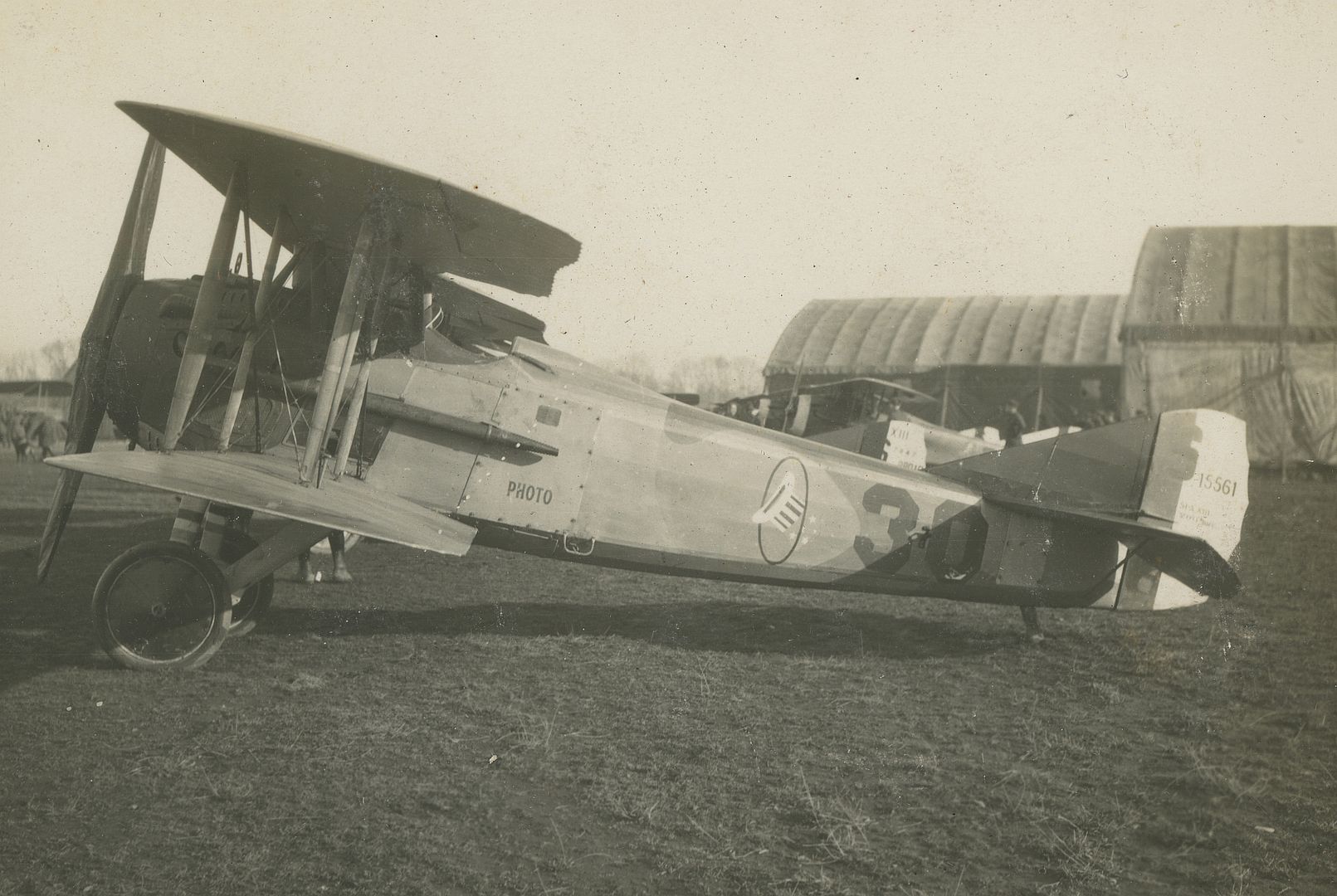
Below SPAD XIII aircraft (fuselage numbers 28, 20, 25) in flight
Below SPAD XIII aircraft (fuselage number 7, tail number S18867)
Below SPAD Spad XIII C.1 of of Capt. Robert Soubiran, 103d Aero Squadron, Serial # S7714.
Below SPAD S.XIII

Below SPAD S XIII of US 22nd Aero Squadron, operational from August 1918. The machines were shipped back to the USA after the war and used as fighter trainers. Seen here in a snow-covered field.
Below Pilots of the 147 th Sq Oct 18 1918
Below Lieutenant Robert Donaldson's Showbird SPAD XIII aircraft, circa 1919. The aircraft is painted in a checkerboard pattern and bears the hat-in-the-ring emblem of the 94th Aero Squadron on its fuselage

Below Eddie Rickenbacker with his SPAD XIII aircraft,Oct 18 1918.
Below Eddie Rickenbacker with his SPAD XIII aircraft, circa 1917-1919


Below Charles W. Drew in the cockpit of a SPAD XIII aircraft (fuselage number 5, designation Betsy), circa 1917-1918.
Below 213th Aero Squadron, pilots and a SPAD XIII, Foucaucourt Aerodrome, France, November 1918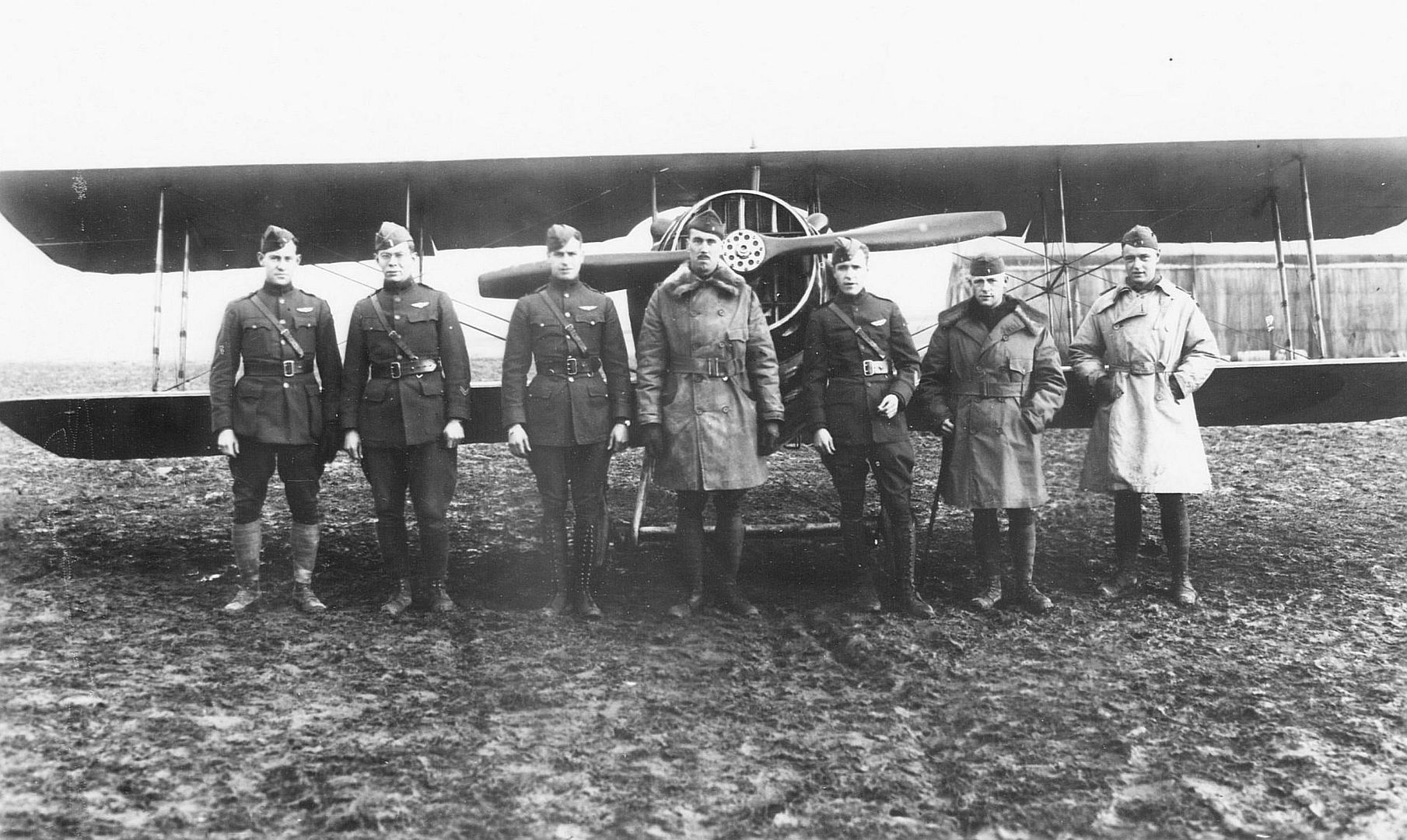
Below 93rd Aero Squadron - SPAD XIII, Foucaucourt Airdrome, France, November 1918
Below 28th Aero Squadron, unit photograph, Foucaucourt Airdrome, France, 18 November 1918
Below 213th Aero Squadron, SPAD XIIIs, Foucaucourt Aerodrome, France, November 1918
RFC
During December 1917, No.23 Squadron Royal Flying Corps (RFC) equipped with the SPAD S.XIII and retaining them until April 1918 when it re-equipped with the Dolphin, while No. 19 Squadron (equipped with the earlier S.VII) also operated at least one S.XIII for a time. The type was used as an interim fighter while awaiting delivery of British-built aircraft.
In his memoir Sagittarius Rising, Cecil Lewis described an aerial competition between himself and a SPAD flown by Guynemer, and Lewis in an SE5, "Their speeds were almost identical, but the high-compression Spad climbed quicker. After the race was over, Guynemeyer and I held a demonstration combat over the aerodrome. Again I was badly worsted. Guynemeyer was all over me. In his hands the Spad was a marvel of flexibility. In the first minute I should have been shot down a dozen times".
Below SPAD 13 aircraft in front of a hangar at Camp Rathbun, one of the Royal Flying Corps' training camps near Deseronto, Ontario.1918
Corpo Aeronautico Militare
The S.XIII was also acquired by Italy for the Corpo Aeronautico Militare.[29] Italian pilots expressed a preference for another French-built fighter, the Hanriot HD.1, which was more maneuverable but less powerful. Belgium also operated the S.XIII and one Belgian ace, Edmond Thieffry, came to prominence while piloting the type.[29] After the end of the war, the S.XIII was also exported, including to Japan, Poland and Czechoslovakia.
Below Spad SXIII Japananese
Below German servicemen with a captured SPAD XIII aircraft, circa 1917-1918.
Specifications (SPAD S.XIII)
General characteristics
Crew: 1
Length: 6.25 m (20 ft 6 in)
Wingspan: 8.25 m (27 ft 1 in) late examples had a span of 8.08 m (26.5 ft)
Height: 2.60 m (8 ft 6 in)
Wing area: 21.11 m2 (227.2 sq ft) late examples had a wing area of 20.2 m2 (217 sq ft)
Empty weight: 601.5 kg (1,326 lb)
Gross weight: 856.5 kg (1,888 lb)
Powerplant: 1 × Hispano-Suiza 8Ba, Bb or Bd Water cooled 8-cylinder vee-type, 150 kW (200 hp)
Propellers: 2-bladed
Performance
Maximum speed: 211 km/h (131 mph, 114 kn) at 1,000 m (3,300 ft)
208.5 km/h (129.6 mph; 112.6 kn) at 2,000 m (6,600 ft)
205.5 km/h (127.7 mph; 111.0 kn) at 3,000 m (9,800 ft)
201 km/h (125 mph; 109 kn) at 4,000 m (13,000 ft)
190 km/h (120 mph; 100 kn) at 5,000 m (16,000 ft)
Endurance: 2 hours
Service ceiling: 6,800 m (22,300 ft)
Time to altitude:
2 minutes 20 seconds to 1,000 m (3,300 ft)
5 minutes 17 seconds to 2,000 m (6,600 ft)
8 minutes 45 seconds to 3,000 m (9,800 ft)
13 minutes 5 seconds to 4,000 m (13,000 ft)
20 minutes 10 seconds to 5,000 m (16,000 ft)
Wing loading: 40 kg/m2 (8.2 lb/sq ft)
Armament
Guns: 2 × .303 in (7.70 mm) Vickers machine guns or on USAS Examples, 2 × Marlin M1917 or M1918 machine guns
Bombs: 4 × 25 lb (11 kg) Cooper bombs
(Text from Wikki)