Photo of the week
-
This midweeks photo.
A nice shot of a Hurricane from No. 85 Fighter Squadron of the Royal Air Force being re-armed.
-
This weekends photo.
Ground crew turn a Messerschmitt Bf.109G-6 fighter on the apron. This aircraft, part of the 5th Group of Fighter Wing JG2 (5./JG2) under the command of Warrant Officer Hünig, was lost in aerial combat on October 20, 1943.
-
This weekends extra.
And some nice air to airs of Consolidated LB-30's in neutrality markings.


-
This midweeks photo.
A N3N-3 is hoisted out of water by crane after a training flight by instructor and aviation cadet.
-
This weekends photo taken December 9th 1941.
An RAF P-51 Mustang Mk I (serial number AG 349) with a P-40 Warhawk, A-20 Bostons and an A-28 Hudson.
-
This weekends extra.
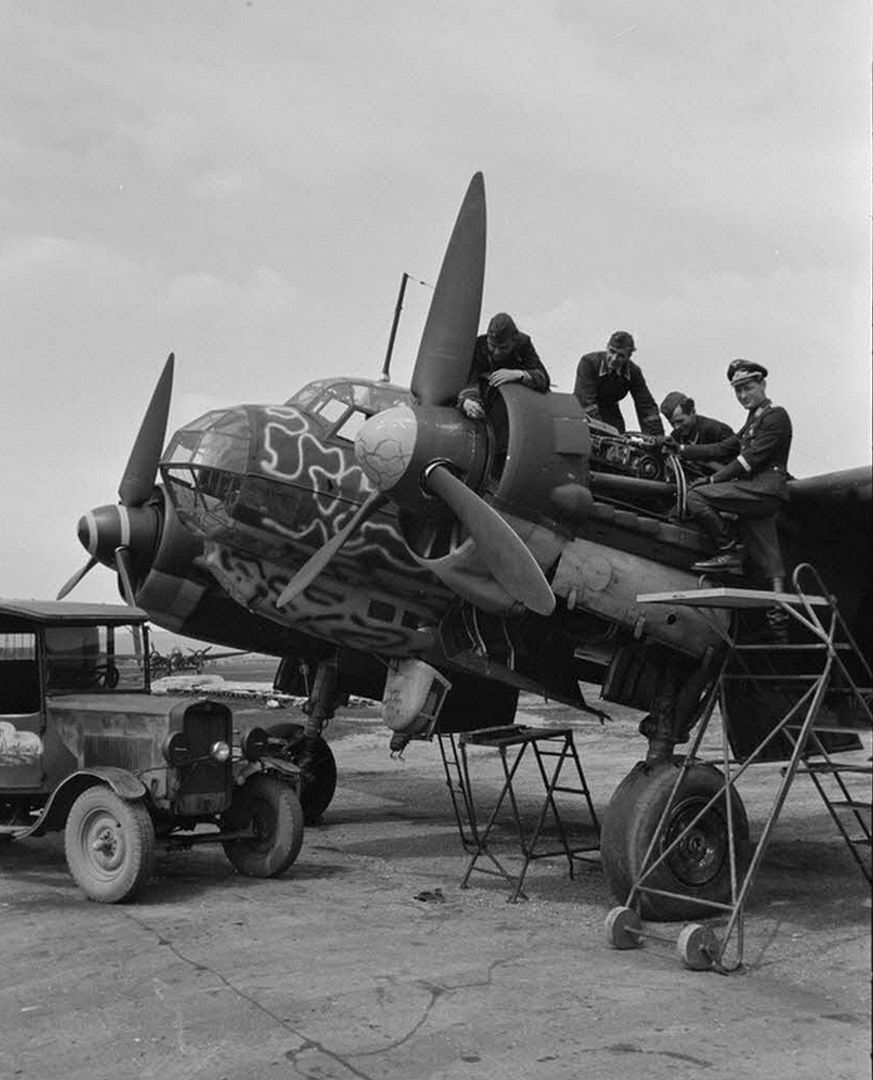
Taken at Heraklion on the island of Crete circa 1942,Major Karl-Heinz Schomann I./LG1 (Lehrgeschwader 1) provides support to mechanics during the maintenance of a Junkers Ju-88 bomber.


-
This midweeks photos.
Neunkirchen,Saarland, Germany, aircraft surrendered by the Germans according to the terms of the Armistice 1918.

-
This weekends photo.
Handley-Page Halifax Mk.I bomber during a test flight. The aircraft was used by Handley-Page as a flying testbed and was based at the factory's Leavesden airfield in Hertfordshire.In this photo, the aircraft is flying over the nearby village of Kings Langley.
-
This weekends extra.
Amand Pinsard was born in Nercillac, Department of Charente, in the cognac country of France. He joined the military in 1906 and fought in Morocco as a cavalryman in 2nd Regiment de Spahis. He was decorated there with the Moroccan Medal. He then transferred to aviation in May 1912, becoming one of the rare professional military men to become a prewar pilot. He trained as a pilot at Chateau Fort on a Borel pusher two seater aircraft, and proved to be a natural.
He was awarded the Médaille militaire for his performance flying a Morane in the French army maneuvers of 1913. He was assigned to MS 23 when World War I broke out.
At the outbreak of war, Pinsard was a sergeant major. In September 1914, he was promoted to adjutant and received his first citation. In October, he participated in a bombing raid that attempted to kill the German Kaiser. He was commissioned in November 1914 because of this bombing raid. It was about this time that he pioneered the use of an aircraft to place an espionage agent behind enemy lines, an act that brought him a second citation.
On 8 February 1915 he fell into German hands and was held prisoner of war when his plane was forced down behind German lines. It took him a month to recover from injuries received in the accident.Thirteen months and several attempts later, Pinsard tunneled under a 12-foot-tall (3.7 m) prison wall to freedom on 26 March 1916. It took him another two weeks to cross the lines into neutral Switzerland and to repatriate himself on 10 April.
His reward for his daring escape was retraining as a fighter pilot and an assignment to France's foremost fighter squadron, Les Cigognes. By July 1916, he was flying a Nieuport with Squadron N26. On 7 August, in a pioneering close air support role, he made no fewer than six firing passes on German troops attempting to counterattack a French unit. Then he and his three wingmen went on to strafe a train loaded with German troops. He was made a Chevalier of the Légion d'honneur for this action.
On 1 November 1916, he opened his victory roll in air combat. After a winter's layoff, he resumed his winning way on 23 January 1917, flying as Commanding Officer of Squadron N78.He became an ace on 6 March, and would continue to fly Nieuports into battle until his 16th victory on 5 June 1917.
Just one week later, Pinsard crashed and suffered serious injuries. He would be confined to hospital for several months. Upon his recovery, he was appointed commanding officer of Squadron Spa23. Pinsard was entrusted with the first Spad VII fighter to see combat, on 23 August 1917. He painted it black and entitled it, Revanche IV ("Revenge IV").
He picked up his victory skein with his 17th triumph on 20 February 1918. With his next win, on 4 May, he began a string that saw him down nine observation balloons in his final decade of wins. Rather remarkably, he had help downing only one of the heavily defended gasbags. His 27th victory came on 22 August 1918. Just eight days later, on 30 August 1918, he was appointed an Officer of the Légion d'honneur. Pinsard ended the war as a much-decorated captain. -
This midweeks photo.
This B-17G was fitted with an experimental chin turret armed with 6 fixed .50 cal. machine guns, designed by Armaments Officer Mike Mazer. The firing of the guns was controlled by the Pilot. Aircraft 42-31435 successfully completed many operational sorties with the new nose gun installation but, while conclusively proving the mechanical practicability of the design, a temporary cessation of head-on attacks by enemy attacks prevented the proof of its effectiveness. The ship crashed returning from a bombing mission on July 6, 1944.