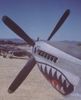
Nakajima Ki-43 Hayabusa
-
The Nakajima Ki-43 Hayabusa (隼, Peregrine falcon), formal Japanese designation Army Type 1 Fighter (一式戦闘機, Ichi-shiki sentōki) is a single-engine land-based tactical fighter designed and produced by the Japanese manufacturer Nakajima Aircraft Company. The Allied reporting name was "Oscar", but it was often called the "Army Zero" by American pilots because it bore a certain resemblance to the Mitsubishi A6M Zero, the Imperial Japanese Navy's counterpart to the Ki-43.It was the Imperial Japanese Army Air Service's (IJAAS) first all-metal enclosed cockpit aircraft with retractable landing gear.
Development began in December 1937, headed by the aeronautical engineer Hideo Itokawa, as a successor to the preceding Nakajima Ki-27 monoplane fighter. Twelve months later, the first prototype was completed, performing its maiden flight in January 1939. While satisfying the performance requirements of the (IJAAS, test pilots expressed dissatisfaction over the limited improvements over the Ki-27. In response, Nakajima enacted a weight reduction programme, slimmed the fuselage, redesigned both the tail unit and canopy, and adopted Fowler flaps (which improved performance during tight turns). In response to these improvements, the company was instructed to proceed with quantity production in November 1939. Beyond the initial production model, designated Ki-43-I, further development of the aircraft proceeded, resulting in the more powerful Ki-43-II (entered service in December 1942) and the Ki-43-III (entered service in summer 1944).
The Ki-43 was first introduced to service by the IJAAS in October 1941, just prior to Japan's entry into World War II. It would serve on every front that the IJAAS engaged in. Akin to the Zero, the radial-engined Ki-43 was light and relatively easy to fly, attributes that helped the aircraft become legendary for its combat performance across East Asia in the early years of the conflict. The Ki-43 could reportedly outmaneuver any opponent, but did not initially have armor or self-sealing fuel tanks, and its armament was relatively poor until its final version, which was produced as late as 1945. Allied pilots often reported that the nimble Ki-43s were difficult targets but burned easily or broke apart with a few hits. Total production amounted to 5,919 aircraft, making it the second-most produced Japanese fighter aircraft during the war after the Mitsubishi A6M Zero.Many of these were used during the last months of the conflict to conduct kamikaze missions against the American fleet.After the conflict, abandoned Ki-43s were used by numerous other services, including the French Air Force and the newly formed Indonesian Air Force.
Design and development
The origins of the Ki-43 can be traced back to December 1937 and the issuing of an instruction by the Imperial Japanese Army (IJA) to the Nakajima Aircraft Company to design a new single-seat fighter to replace the Nakajima Ki-27 'Nate' monoplane fighter.While the Ki-27 had been a major step forwards over its regional rivals, it was hoped that the development of a more advanced fighter could surpass even Western fighter aircraft of the era. Accordingly, the specification was atypically stringent, calling for a maximum speed of 500 km/h (310 mph), a climb rate of 5,000 m (16,000 ft) in five minutes and a range of 800 km (500 mi). Manoeuvrability was to be at least as equal to that of the preceding Ki-27, which was a fairly agile aircraft for the era. Political factors favoured Nakajima for the contract, partially due to the company's track record with the Ki-27. In response, Nakajima assembled a design team headed by the aeronautical engineer Hideo Itokawa, who would subsequently distinguish himself as a pioneer of Japanese rocketry. Within twelve months, an initial prototype of the new design had been completed.
Rolled out in secret and first flown in early January 1939, the first Ki-43 prototype was promptly joined by two additional prototypes over the following two months.Initial manufacturer's trials proceeded with only minor problems identified prior to the prototypes being delivered to the Imperial Japanese Army Air Service (IJAAS) to conduct service trials. Although this round of testing proved that the Ki-43 fulfilled the specified performance requirements, the test pilots criticised the retractable landing gear as an unnecessary luxury as well as that the aircraft was less manoeuvrable than the Ki-27 while not being much faster. Amid these expressions of dissatisfaction, there was genuine doubts over the future of the Ki-43, to the extent that Nakajima exacted work on a refined version of the Ki-27, referred to as the Ki-27 KAI, as a potential fall-back option. While two prototypes were built and demonstrated a reduced wing loading along with a higher top speed, this work was discontinued as the Ki-43 programme proceeded.
To address the raised concerns over the Ki-43, Nakajima produced a series of progressively modified prototypes through 1939 and 1940.The aircraft was subject to a major weight saving program, adopted a slimmer fuselage, a new canopy was fitted, and the tail surfaces were repositioned further aft. Perhaps most significantly, the 11th prototype was outfitted with the unique differential "butterfly" maneuvering Fowler flaps, which dramatically improved performance in tight turns and thus was received positively by test pilots. The 13th prototype combined all these changes and tests of this aircraft was met with an instruction for Nakajima to place the Ki-43 into production while the Ki-27 jigs were transferred to the Mansyu factory at Harbin in Japanese occupied Manchukuo.
Initial production of the Ki-43 was enacted in November 1939, early-built examples were given the designation Ki-43-I. Deliveries from Nakajima's Ota factory commenced in February 1941. In addition to outstanding maneuverability, the Ki-43-I had an impressive rate of climb due to its light weight. Power was provided by the Nakajima Ha-25 engine turning a two-bladed, two-position variable-pitch metal propeller. Top speed was 495 km/h (308 mph) at 4,000 m (13,000 ft).The Ki-43 was equipped with two synchronized cowling machine guns in various configurations, with either two 7.7 mm (0.303 in) Type 89 machine guns, one 12.7 mm (0.50 in) Ho-103 machine gun and one 7.7 mm (0.303 in) gun, or two 12.7 mm (0.50 in) Ho-103 guns; the aircraft was given various sub-designations to reflect these differences. The configuration that appears to have been most prevalent at the outset of the war was the first configuration with two 7.7 mm (0.303 in) Type 89 machine guns, while as the conflict progressed the heavier combinations gained popularity and the version with the heaviest armament was sometimes given the designation Ki-43-Ic. The Ho-103 was often loaded with explosive ammunition to increase target effect; its penetrative effect against later Allied aircraft armor appears to have been marginal.
Prototypes for the Ki-43-II flew in February 1942. The Ha-25 engine was upgraded with the two-stage supercharger, thus becoming the more powerful Nakajima Ha-115 engine, which was installed in a longer-chord cowling. The new engine turned a three-bladed propeller. The wing structure, which had suffered failures in the Ki-43-I, was strengthened and equipped with racks for drop tanks or bombs. The Ki-43-II was also fitted with a 13 mm (0.51 in) armor plate for the pilot's head and back, and the aircraft's fuel tanks were coated in rubber to form a crude self-sealing tank. This was later replaced by a three-layer rubber bladder, 8 mm core construction; with 2 mm oil-proof lamination. This bladder proved to be highly resistant against 7.7 mm (0.303 in) bullets, but was not as effective against larger calibers. The pilot also enjoyed a slightly taller canopy and a reflector gunsight in place of the earlier telescopic gunsight. Nakajima commenced production of the Ki-43-II at its Ota factory in November 1942. Production was also started at the Tachikawa Aircraft Company Ltd (Tachikawa Hikoki KK) and the 1st Army Air Arsenal (Tachikawa Dai-Ichi Rikugun Kokusho), also at Tachikawa. Although Tachikawa Hikoki managed to begin mass production of the Ki-43, the 1st Army Air Arsenal was less successful – hampered by a shortage of skilled workers, it was ordered to stop production after 49 Ki-43s were built. Nakajima eventually ceased production in mid-1944 in favor of the Ki-84 Hayate, but the Tachikawa Hikoki continued to produce the Ki-43.
Tachikawa also produced the Ki-43-III, which used the more powerful Nakajima Army Type 1 Ha-115-II engine and increased its maximum speed to 576 km/h (358 mph). Tachikawa produced 2,124 Ki-43-II and -III aircraft between April 1944 and the end of the conflict.[31] Total production of all versions amounted to 5,919 aircraft.
Operational history
The Ki-43 was the most widely used Army fighter, and equipped 30 sentai FR (flight regiment) and 12 Dokuritsu Dai Shijugo Chutai ("Direct command fighter squadron" - independent squadrons not incorporated into sentais)The first unit equipped with the Ki 43-I was the 59th FR at Hankow Airfield, during June–August 1941 and began operational sorties over Hengyang on 29 October 1941.The second unit to re-equip with the new Aircraft was the 64th FR, from August to November 1941.
The first version, Ki-43-I, entered service in 1941, the Ki-43-II in December 1942, the Ki-43-II-Kai in June 1943, and the Ki-43-IIIa in summer 1944. The aircraft fought in China, Burma, the Malay Peninsula, New Guinea, the Philippines, South Pacific islands and the Japanese home islands.As such, the Ki-43 would see action on every front that the IJAAS would be active on during the conflict.
Like the Zero, the Ki-43 initially enjoyed air superiority in the skies of Malaya, Dutch East Indies, Burma and New Guinea. This was partly due to the better performance of the Oscar,and partly due to the relatively small numbers of combat-ready Allied fighters, mostly the Curtiss P-36 Hawk, Curtiss P-40, Brewster Buffalo, Hawker Hurricane and Curtiss-Wright CW-21 in Asia and the Pacific during the first months of the war. As the war progressed, however, the fighter suffered from the same weaknesses as the slower, fixed-gear Ki-27 "Nate" predecessor to the Oscar, and the more advanced naval A6M Zero: light armor and less-than-effective self-sealing fuel tanks, which caused high casualties in combat. Its armament of two machine guns also proved inadequate against the more heavily armored Allied aircraft. As newer Allied aircraft were introduced, such as the Republic P-47 Thunderbolt, Lockheed P-38 Lightning, North American P-51 Mustang, Vought F4U Corsair, Grumman F6F Hellcat, Yakovlev Yak-9, Yakovlev Yak-3U and late-model Supermarine Spitfire/Seafire, the Japanese were forced into a defensive war and most aircraft were flown by inexperienced pilots. However, even near the end, the Oscar's excellent maneuverability could still gain advantage over rash Allied pilots.
Between October and December 1944, 17 Ki-43s were shot down in air combat; their pilots claimed seven C-47s, five Consolidated B-24 Liberators, two Spitfires, two Bristol Beaufighters, two de Havilland Mosquitoes, two F4U Corsairs, two Boeing B-29 Superfortresses, one F6F Hellcat, one P-38, and one North American B-25 Mitchell. Akin to most Japanese combat aircraft, hundreds of Ki-43s were expended in kamikaze missions against the advancing Allied forces in the final months of the conflict; the type was considered to be particularly effective in this capacity.
The Ki-43 also served in an air defense role over Formosa, Okinawa and the Japanese home islands. Some examples were supplied to the pro-Japanese regimes of Thailand, Manchukuo and Wang Jingwei Government as well. The Thai units sometimes fought against the United States Army Air Force (USAAF) in southern China.It was in this context that one Ki-43 became the last aircraft to be downed during WW2.
The type was typically well liked in the IJAAS because of its pleasant flight characteristics and excellent maneuverability, and almost all of the service's fighter aces claimed victories with Hayabusas in some part of their career. At the end of the war, most Hi-43 units received the newer Nakajima Ki-84 Hayate "Frank" and Kawasaki Ki-100 fighters, but some units continued to fly the Hayabusa to the end of the conflict. The top-scoring Hayabusa pilot was Sergeant Satoshi Anabuki with thirty-nine confirmed victories, almost all scored with the Ki-43.
After the war, some captured examples served in limited numbers in the French Air Force in Indochina against Viet Minh rebels.
Several Ki-43s that had been abandoned by the Japanese in the Dutch East Indies were promptly taken over by the newly declared Indonesian government and put into service during the fight against Dutch forces.
Below Nakajima Ki-43 Hayabusa-Akeno flight school
Below Nakajima Ki-43 Hayabusa with drop tanks.
Below Nakajima Ki-43 Hayabusa in flight.


Below Nakajima Ki-43 Hayabusa unknown

Below
Below Oscar Crashed On An Airstrip In The Korako Area Three Miles South Of Aitape New Guinea. 22 April 1944
Below Nakajima Ki-43 Hayabusa (Oscar) fighter aircraft at the Tachikawa plant in Japan, circa 1943
Below Ki-43-II Ko Hayabusa Oscar of the 25 Sentai China 1943
Below Ki-43-II Ko 71 of the 2 Chutai, 25 Sentai Nankin 1943. Pilot Cpt Nakakazu Ozaki.
Below Ki-43-II Ko 15 of the 2 Chutai, 25 Sentai China 1943. Pilot Sgt Kyushiro Otake.
Below Ki-43 on Okinawa, being inspected by U.S. troops.
Below Ki-43 II
Below KI-43 derelict
Below an abandoned Nakajima Ki-43 Oscar pictured at an unidentified airfield
Below 33rd Sentai Ki-43 at Cyclops airstrip
Below 77th Sentai Ki-43 at Cyclops airstrip
Below Schoolgirls wave goodbye to a Ki-43 IIIa, loaded with a 250 kg (550 lb) bomb, on a kamikaze mission, 12 April 1945.
Below Nakajima Ki-43 Hayabusa-captured Chinese Nationalist forces


Below Nakajima Ki43 II, P-5017 Chinese

Below Nakajima Ki-43-II Ko Hayabusa (MSN 5388) Assigned to the 59th Sentai. Painted with green upper surfaces. The tail had the motif of the 59th Sentai, a diagonal line in Chutai color. After the fall of Hollandia, New Guinea the aircraft was abandoned in the trees near the Cyclops runway there. The 8th Fighter Squadron, 49th Fighter Group was stationed in Hollandia between May 3 and June 22, 1944. It chose to restore the aircraft in their spare time.Fortunately for the group there was a veritable Japanese spare parts store in the form of other wrecks that were strewn throughout the field and surrounding jungle. During the rebuilding the aircraft received new control surfaces, a rebuilt engine and had its landing gear completely reconstructed. Even the set of 12.7 mm guns was rebuilt and put into the Oscar before its reconstruction was complete. The 8th FS also had help from Air Technical Intelligence on their build when on June 10th a group from the Air Technical Intelligence Center in Brisbane arrived to complete the aircraft after already having given the aircraft its XJ004 code on first inspection late April. The aircraft was stripped to bare metal and the tail code XJ004 was painted in black on both sides of the tail. Later, this code was over painted with pre-war red, white and blue markings. Oversized stars and bars were painted on the fuselage and wings.
The finishing touch was the name "Raccoon Special!"; "Raccoon Special" was the call sign of the 8th Fighter Squadron, the Blacksheep. The aircraft was not yet ready when the 8th FS was given orders to move forward to the Philippines and leave their Oscar behind. The squadron was disappointed by this development and appealed to Brigadier General Donald Hutchinson, who was so moved by the group's presentation that he ordered that 8th FS would finish the build. When the unit left Hollandia, the aircraft was left behind with its crew chief. On June 21, 1944 after successful preflight tests the Oscar once again took flight. The flight was joined by a silver P-40 piloted by the Group Operations Officer. The pilots put on a mock combat to put the Oscar through its paces. The unit found that the Oscar rolled,turned sharply, and split esses to get on the P-40's tail repeatedly. The aircraft was flown on at least one more occasion by a pilot of the 7th Squadron and also flew a second mock combat against a group P-40 with the same result. The aircraft was transferred to Eagle Field, near Brisbane, QLD, Australia for further testing. Shipped to the USA. NAS Alameda, California. The ultimate fate of this airframe is unknown.


Below Nakajima Ki-43-II Ko Hayabusa Assigned to an unknown Sentai (perhaps the 77th), operating from one of the Hollandia airfields in New Guinea.During late April 1944, this Ki-43-II 'Oscar' was captured by the US Army in the Hollandia area at one of the
four dromes. Afterwards, having been inspected by the Air Technical Intelligence Unit (TAIU-SWPA), it was assigned the tail code XJ005. Between June and September 1944 the aircraft was repaired by American personnel from the 41st Troop Carrier Squadron, 317th Troop Carrier Group, 5th Air Force during their free time.During the restoration the aircraft was paint-stripped to a bare aluminum finish. On the fuselage and wings the US star-and-bar markings were applied. On both sides of the nose, below the cockpit and running to the engine cowl, was a lightning-like stripe with "Rebuilt by the 41st Troop Carrier Sq." written in cursive,with the squadron's motif of Felix the Cat carrying a kitten. The tail code XJ005 was painted in black on both sides of the tail. The tail rudder was painted with pre-war-like red and white stripes. Both main wheel hubs of the landing gear had the 5th Air Force emblem. On the 16th of November 1944, when the 41st Troop Carrier Squadron moved northwards, this Oscar was left behind at Hollandia Airfield. Sometime after the departure of the 41st Troop Carrier Squadron, XJ005 suffered a landing gear collapse damaging the aircraft.Afterwards, it was towed to an aircraft scrap yard area and abandoned there.

Below Nakajima Ki-43-II-Otsu Hayabusa (MSN 6430) Built by Nakajima Hikoki K.K. Jan44. No known markings or tail code. Operated from Hollandia, New Guinea.During late Apr44, this Ki-43 was captured by the US Army in the Hollandia. Afterwards, inspected by the Allied
Technical Air Intelligence Unit TAIU-SWPA. During the middle of 1944, this Ki-43 (also known as Hollandia Oscar #2) and Ki-43-II Oscar MSN 5894 were repaired at Cyclops airfield by American personnel from the US Army Air
Force 84th Airdrome Squadron. Both Oscars were repaired using spare parts found in the area and parts from other Oscars.This Oscar was stripped to bare aluminum finish and painted with US star-and-bar markings and a red and white tail rudder. The cowl had a circular motif with "84" for the 84th Airdrome Squadron painted on both sides.This Oscar received a modified flat sided movable canopy similar to that fitted to the Ki-43-I. Presumably the canopy was obtained from a model 1 and modified to fit the front fixed section of the Ki-43-II canopy.
By Sep44, this Oscar was test flown in the Hollandia area. Later, this Oscar was loaded aboard the escort carrier USS Attu and transported to the United States for technical evaluation. Received by TAIC, it was designated "10" stenciled on the tail with "Technical Air Intelligence Center" on the right side of the cockpit and "Oscar 2" on the right side of the nose cowling. The plane was identified by the Wright Field technical intelligence unit as FE-6430 (later T2-6430), but they thought the number not to be the original Japanese manufacture number as they were confused about the various parts with different manufacture numbers.The pilot seat of MSN 6430 appeared to be that of MSN 5894, the 'other' Oscar (Hollandia Oscar #1), that had suffered landing gear problems upon landing after its maiden test flight. Foreign Equipment Branch,Technical Data Laboratory, Air Technical Service Command, Wright Field, Dayton, Ohio. T-2 Office of Air Force Intelligence, Technical Data Laboratory, Air Materiel Command, Wright Field, Dayton, Ohio. Renumbered as T2-6430.


Below Nakajima Ki-43-I Ko Hien.Assigned to the 11th Sentai. During 1943, the aircraft operated from Lae Airfield, New Guinea. It was abandoned largely intact, but with the tail rudder and fabric surfaces damaged and the cockpit canopy glass missing.
In Japanese service painted with green upper surfaces with the fuselage Hinomaru outlined in white. The rear had a white vertical stripe rear aft of the Hinomaru. The leading edge of the wing had a yellow recognition stripe. The tail had the lightning bolt motif of the 11th Sentai. During September 1943 Lae was captured by the Australian Army and the area was occupied by the Allies whereupon the aircraft was found.Afterwards, it aircraft was disassembled and shipped to Brisbane and transported to Hangar 7 at Eagle Farm Airfield, arriving November 4, 1943 where the aircraft was reassembled and restored to flying condition by the then Air Technical Intelligence Unit (ATIU), using parts of various airframes [Ki-43 MSN 400, Ki-43 MSN 426,Ki-43 MSN 622, Ki-43 MSN 779 and Ki-43 MSN 805]. When ready, it was flown and tested as XJ002 at Eagle Farm Airbase, Brisbane, Queensland, Australia. After restoration, the aircraft was painted green with US markings and tail code XJ002 in black on both sides of the tail. Later the aircraft was repainted in Japanese markings for recognition manual purposes. On March 17, 1944 this aircraft was test flown by a USAAF test pilot for 25 minutes. On March 18, 1944 it was test flown for 55 minutes; afterwards, the fate of this Oscar is unknown.
Below Nakajima Ki-43-II-Otsu Hayabusa(MSN 5894) Operated from Hollandia, New Guinea. During late Apr44, this Ki-43 was captured by the US Army in the Hollandia. Afterwards, inspected by the Allied Technical Air Intelligence Unit TAIU-SWPA. During the middle of 1944,
this Ki-43 was repaired at Cyclops airfield by American personnel from the US Army Air Force 84th Airdrome Squadron.Repaired using spare parts found in the area and parts from other Oscars. Suffered landing gear problems upon landing after its maiden test flight. Believed to have been mounted on a pole at the entrance to Clark Field, Manilafor several years.

Below taken1948
Specifications (Ki-43-IIb)
General characteristics
Crew: One
Length: 8.92 m (29 ft 3 in)
Wingspan: 10.84 m (35 ft 7 in)
Height: 3.27 m (10 ft 9 in)
Wing area: 21.4 m2 (230 sq ft)
Airfoil: root: NN-12 mod. (18%); tip: NN-12 mod. (8%)
Empty weight: 1,910 kg (4,211 lb)
Gross weight: 2,590 kg (5,710 lb)
Max takeoff weight: 2,925 kg (6,449 lb)
Fuel capacity: 550 L (120 imp gal) plus 2 × 200 L (53 US gal; 44 imp gal) drop tanks
Powerplant: 1 × Nakajima Ha-115 14-cylinder air-cooled radial piston engine, 970 kW (1,300 hp) for take-off
890 kW (1,200 hp) at 3,000 m (9,800 ft)
820 kW (1,100 hp) at 6,200 m (20,300 ft)
Propellers: 3-bladed metal constant-speed propeller, 2.79 m (9 ft 2 in) diameter
Performance
Maximum speed: 530 km/h (330 mph, 290 kn) at 4,000 m (13,000 ft)
Cruise speed: 440 km/h (270 mph, 240 kn)
Range: 1,760 km (1,090 mi, 950 nmi)
Ferry range: 3,200 km (2,000 mi, 1,700 nmi)
Service ceiling: 11,200 m (36,700 ft)
Time to altitude: 5,000 m (16,000 ft) in five minutes and 49 seconds
Wing loading: 121 kg/m2 (25 lb/sq ft)
Power/mass: 0.33 kW/kg (0.20 hp/lb)
Armament
Guns: 2 × 12.7 mm (0.500 in) Ho-103's in the forward fuselage with 270 rpg
Bombs: 2 × 30 kg (66 lb) bombs or 2 × 250 kg (550 lb) bombs
(Text from Wikki)